
Neena Lokare
Assistant Professor,
Fashion Design,
NIFT Mumbai (Ministry of Textiles, Govt. of India)
THIS STUDY BEGINS with a question that may appear at odds with decades of established practice: has Paithani genuinely continued to evolve, or has material innovation quietly stalled?
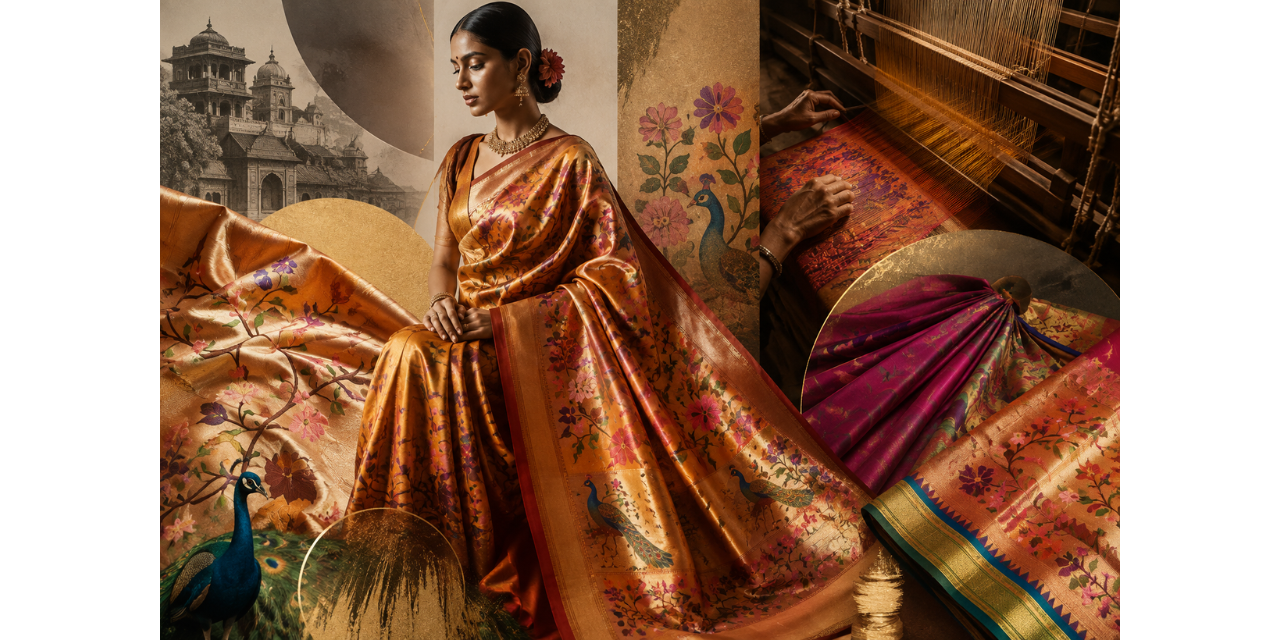
The premise is not that Paithani requires correction. Its palette, its coconut-shaped narali borders, the dancing peacocks set inside bangle-shaped bangadi mor (बांगडी मोर) medallions, and the flowering vines of the asavali (आसावली) that wind across every pallu remain central to Maharashtra’s textile identity.
Historically, however, the craft has undergone material transition before. Paithani originated as a pure-silk weave reserved for royal households; the later introduction of cotton into the warp extended its reach to a wider base of wearers without altering the technique that defines it. This was not a dilution of the craft but an adaptation within it.
The present inquiry examines why such adaptation appears to have ceased.
Market Confusion as the Primary Constraint
Available evidence suggests that Paithani’s central challenge is not declining demand but market conflation. Powerloom reproductions are routinely sold under the Paithani name, and buyers frequently lack the means to distinguish handwoven pieces from mechanised imitations.
A purchaser spending fifty thousand rupees on what is believed to be a handwoven saree may, in practice, acquire a different product entirely.
The implications extend to both consumer trust and artisan livelihood, as genuine weavers’ output is displaced by imitation within the same price bracket.
A parallel shift is observed among younger consumers, who increasingly weigh provenance, material composition, and narrative value alongside visual appeal, rather than visual appeal in isolation.
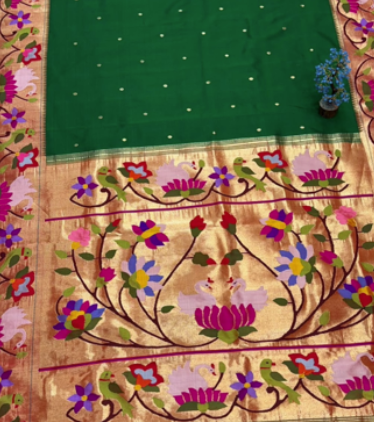
A woven silk Paithani from Yeola, with bangadi mor and asavali motifs
Methodology
To examine whether material innovation could be introduced without disrupting traditional technique, a practice-led collaboration was undertaken with master weaver Sagar Kherud in Yeola, Nashik. The central question was whether hemp — a fibre with a substantially smaller environmental footprint than silk or cotton, and with a long but underexplored presence in Indian textile tradition — could be integrated into Paithani construction without compromising its handloom identity. (For readers unfamiliar with the process: the warp comprises the lengthwise threads held under tension on the loom, while the weft is passed across them, row by row, to construct the cloth and its motifs.)
“Innovation need not replace tradition. It can instead create room for tradition to evolve.”
Glossary of Terms
- Bangadi mor — a peacock set inside a bangle-shaped medallion, one of Paithani’s oldest and most prized pallu motifs.
- Asavali — the flowering-vine pattern that became a signature of the Peshwa era, still woven across the pallu and body today.
- Narali border — the coconut-shaped edge, among the most traditional of Paithani’s border designs.
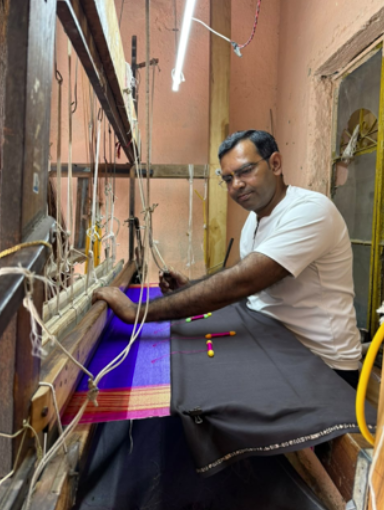
Master weaver Sagar Kherud at his loom in Yeola, Nashik
Findings
An initial trial employed hundred-percent hemp as weft against a silk warp. The resulting fabric exhibited excessive stiffness, compromising drape, and did not accept dye under standard processing conditions. While hemp presented favourable properties on paper, its performance at the loom diverged substantially from expectation.
The subsequent adjustment in approach was informed not by laboratory data but by empirical assessment at the loom. It was determined that raw hemp was unsuited to a warp role: the constant tension and abrasion characteristic of warp threads exceeded what untreated hemp could withstand, a limitation silk and cotton do not present. This single observation, derived from tactile assessment rather than instrumentation, redirected the trajectory of the research.
A second trial employed a hemp-cotton blended yarn as weft against a conventional warp. This iteration produced a fabric that accepted dye, exhibited appropriate drape, and preserved the traditional weft-interlock technique responsible for Paithani’s characteristic motifs, without requiring modification to established practice.
“The weaver revised the direction of the experiment twice before it produced a usable fabric. That iterative correction is, arguably, the more significant finding.”
Two parallel constructions are currently in production — one with a cotton warp and one with a silk warp, both employing a hemp weft — while yarn testing for count, tensile strength, and twist is conducted in parallel with BOHECO, so that resulting claims are grounded in measurable data rather than observational impression.
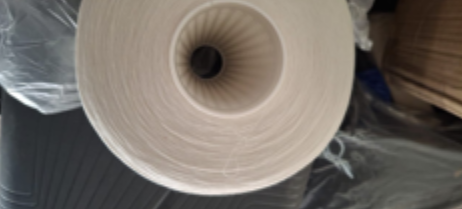
Hemp yarn undergoing count and strength testing with BOHECO
Discussion
It should be noted that this research remains in progress. The sarees under construction have not yet been completed, yarn-performance data has not been finalised, and pricing has not been determined. The findings presented here constitute a documented, ongoing inquiry rather than a concluded outcome.
The methodological implication may be of greater significance than the material one: innovation in handloom craft appears difficult to specify in advance and hand off for execution. It is, instead, discovered iteratively at the loom, with the weaver positioned as a research collaborator rather than an executor of external instruction.
The two hemp-Paithani trials on the loom — cotton warp with hemp weft, and silk warp with hemp weft.
Conclusion
This research does not propose that silk or cotton Paithani be superseded; both are expected to remain central to the tradition. Hemp is instead positioned as an additional material option — relevant to consumers seeking lighter-weight garments suited to humid climates, and to weavers seeking to diversify offerings within a changing market.
Coinciding with National Handloom Day, this research underscores a broader proposition: traditions persist not through preservation alone but through carefully weaver-directed adaptation. Whether hemp becomes an established component of Paithani production remains undetermined; the process by which that determination is being made, however, may itself constitute the more transferable finding.
References
- Sahapedia. “Paithani Saree: Woven Histories of Maharashtra.” sahapedia.org.
- Grokipedia. “Paithani.” grokipedia.com/page/Paithani.
- Monamaar. “The History and Significance of Paithani Silk Sarees.” monamaar.com.
- Cherrett, N., Barrett, J., Clemett, A., Chadwick, M. and Chadwick, M.J. Comparative study of water requirements and water footprints of fibre crops hemp (Cannabis sativa) and cotton (Gossypium hirsutum L.). Journal of Agrometeorology.
- Bombay Hemp Company (BOHECO). “Lab.” boheco.com/pages/lab.
- Press Information Bureau, Government of India, Ministry of Textiles. “11th National Handloom Day to be celebrated on 7th August 2025.” pib.gov.in.