QD-OLED Display Market Poised for Strong Growth Through 2034
The global Quantum-Dot OLED (QD-OLED) display market is entering a significant growth phase as consumers increasingly seek richer colours, deeper contrast, faster response times, higher refresh rates and more immersive viewing experiences.
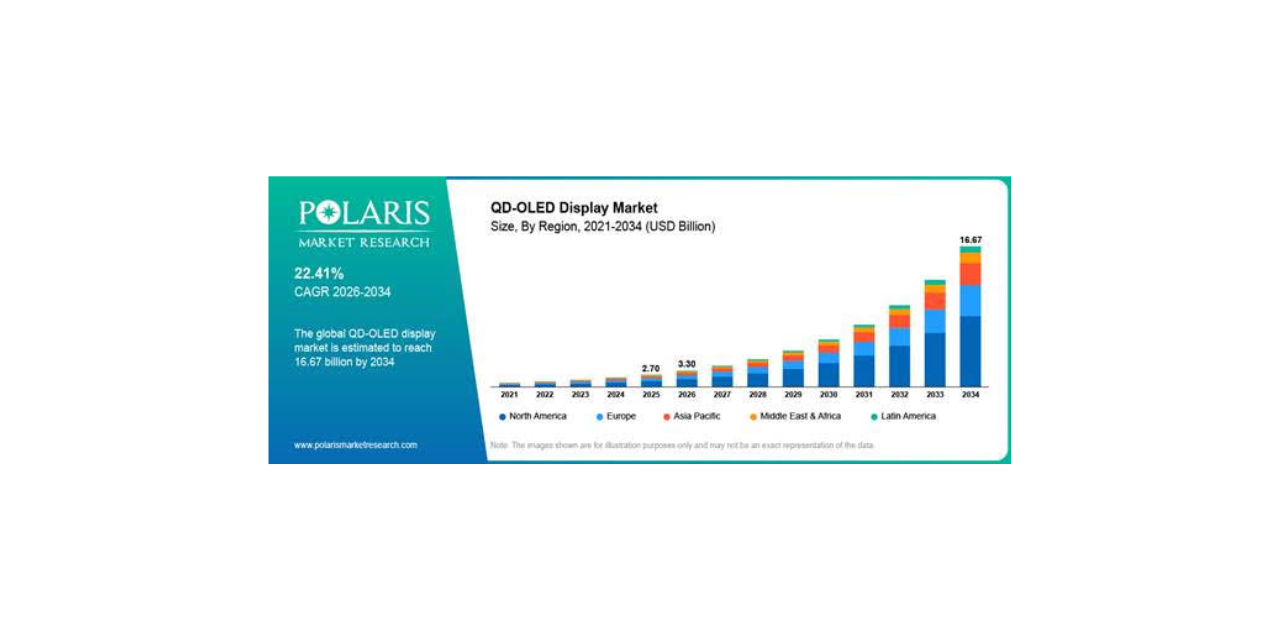
According to Polaris Market Research, the global QD-OLED Display Market was valued at USD 2.70 billion in 2025 and is estimated to reach USD 3.30 billion in 2026. The market is projected to reach USD 16.67 billion by 2034, expanding at a CAGR of 22.41% from 2026 to 2034.
QD-OLED combines OLED’s self-emissive technology with quantum-dot materials, enabling deep blacks, high contrast, vibrant colours and fast response performance. These capabilities are positioning the technology as an increasingly important differentiator for premium televisions, gaming monitors, professional displays and enthusiast computing.
QD-OLED Strengthens Premium Display Positioning
As 4K resolution, HDR, high refresh rates and smart-TV capabilities become increasingly widespread, display manufacturers are looking for new ways to differentiate premium products.
QD-OLED provides an opportunity to deliver a visibly enhanced viewing experience through pixel-level control and quantum-dot technology. The combination supports vivid imagery, strong contrast and detailed visuals, giving manufacturers another avenue for premium product positioning.
Gaming Emerges as a Key Growth Opportunity
Gaming is expected to play an important role in QD-OLED adoption as players increasingly demand high refresh rates, rapid response times, HDR performance, accurate colours and strong contrast.
According to Polaris Market Research, the monitor segment is projected to grow at an 11.60% CAGR during the forecast period. Gaming monitors could therefore become an important growth avenue as enthusiasts show greater willingness to invest in performance-oriented display hardware.
The technology also presents opportunities across content creation and professional visualisation, allowing manufacturers to diversify beyond traditional television applications.
Panel Sizes Reveal Diverse Market Opportunities
The below-32-inch panel segment accounted for 56.70% of the QD-OLED market in 2025, reflecting demand for smaller premium displays, particularly gaming and professional monitors.
Meanwhile, the 32-to-55-inch panel-size segment is expected to register the fastest growth during the forecast period as QD-OLED expands across televisions and other display applications.
This creates opportunities across different product categories. Televisions can support market volume and mainstream visibility, while gaming and professional monitors can provide opportunities for premium pricing and technology-focused adoption.
Consumer Electronics Remains the Leading End-User Segment
Consumer electronics accounted for 63.40% of the global QD-OLED market in 2025, making it the largest end-user segment.
Televisions remain a major demand centre as consumers seek increasingly advanced viewing experiences. At the same time, gaming is expected to be the fastest-growing end-user segment, strengthening the role of monitors and performance-oriented displays.
This combination could allow QD-OLED to achieve scale through consumer electronics while building differentiation through high-performance applications.
Asia Pacific Leads the Market
Asia Pacific accounted for 48.30% of the QD-OLED Display Market in 2025, making it the largest regional market. Its position is supported by extensive electronics manufacturing infrastructure and the presence of major display and consumer electronics companies.
South Korea remains important to advanced OLED development, while China and Japan contribute significant manufacturing, component and electronics capabilities.
North America is expected to be the fastest-growing regional market, supported by demand for premium televisions, gaming monitors, professional displays and advanced consumer electronics.
Competitive Landscape Expands Beyond Panel Technology
The QD-OLED market includes major companies such as Samsung Display, Sony, LG Electronics, Dell Technologies, ASUS, Acer, HP, Lenovo, MSI, Philips, Gigabyte Technology and TCL Technology.
Competition is increasingly focused on product innovation, manufacturing capabilities, display integration and brand positioning. Production costs and manufacturing capacity remain important considerations as companies look to expand QD-OLED beyond premium products.
Manufacturers capable of improving production efficiency and availability could gain an advantage, while premium brands can use QD-OLED technology to strengthen flagship product lines.
QD-OLED Outlook
With the market projected to expand at a 22.41% CAGR through 2034, QD-OLED has significant potential to move beyond its current premium positioning.
Future opportunities could extend into professional visualisation, content creation, automotive displays and other specialised applications where advanced display performance is increasingly important.
The central challenge will be scaling QD-OLED technology economically enough to reach a broader customer base. If manufacturers can address production costs and expand availability, QD-OLED could evolve from a premium display differentiator into a wider display technology platform.