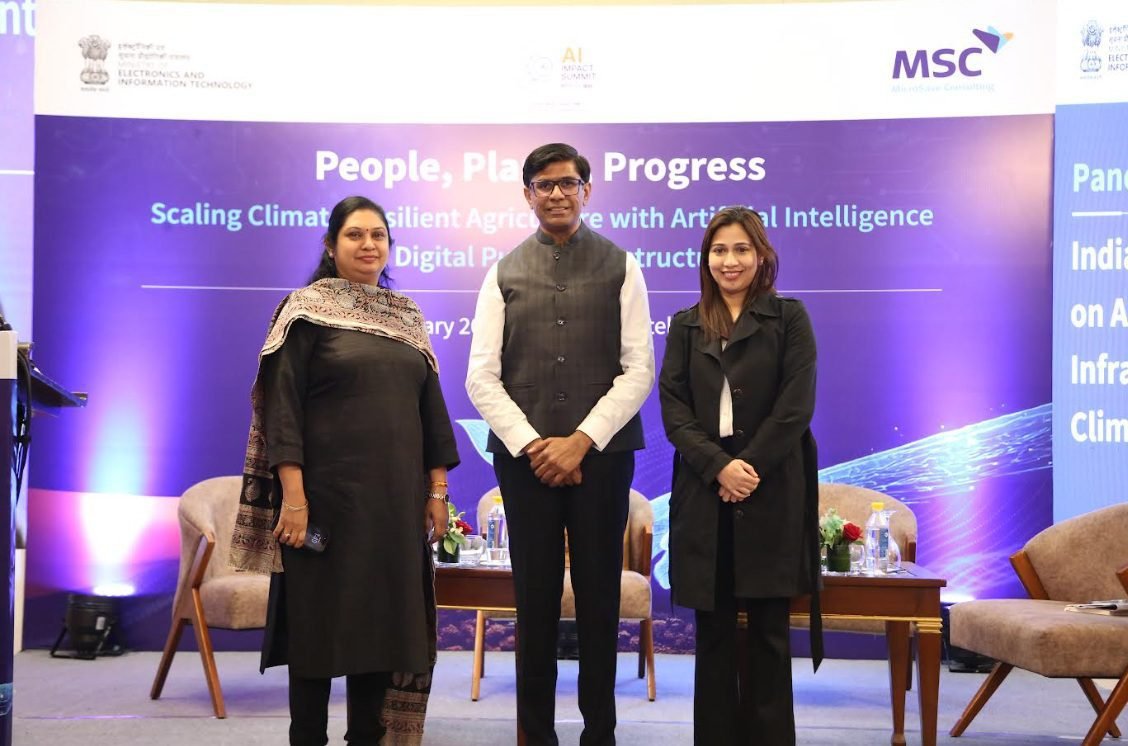
MicroSave Consulting (MSC) convened a high-level pre-summit event in New Delhi. The event focused on using artificial intelligence (AI) and Digital Public Infrastructure (DPI) to scale climate-resilient agriculture.
Policymakers, development partners, technology leaders and practitioners took part in the discussion. They explored ways to move beyond small pilot projects and deliver solutions through public systems at scale.
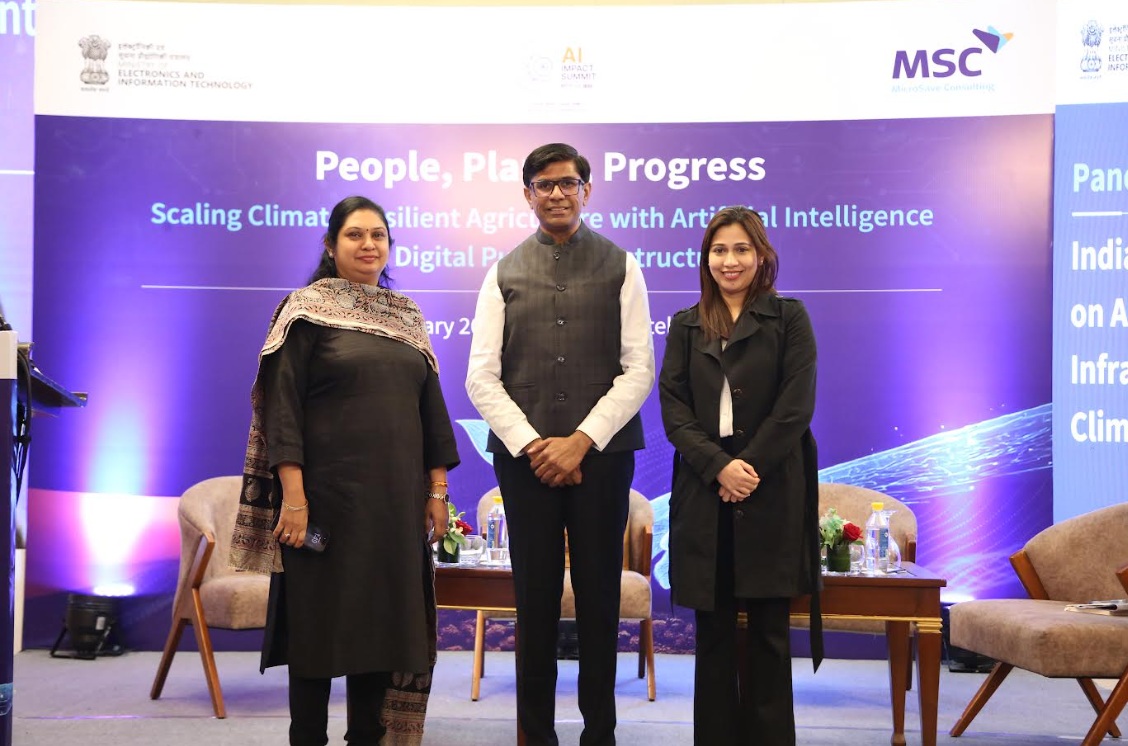 |
Srivalli Krishnan, Deputy Director, Agricultural Development, Gates Foundation; Kunjbihari Daga, Partner, Centre for Responsible Technologies, MSC and Gauri Bandekar, Advisor, Royal Norwegian Embassy
Climate Change and the Role of AI in Agriculture
Mitul Thapliyal, Managing Partner, MicroSave Consulting, highlighted the impact of climate change on farmers. He noted that farmers often recognise changing seasonal conditions. However, they may not use the term climate change. This gap in communication can affect the adoption of climate-focused solutions.
Hemendra Mathur, Venture Partner, Bharat Innovation Fund and Co-founder, ThinkAg, said Indian agriculture has large amounts of data and complex systems. He stressed that AI can achieve scale only when systems connect across registries. Such connections also need compliant data sharing and privacy safeguards.
C. V. Madhukar, Chief Executive Officer, Co-Develop, cautioned that not every pilot project should be expanded. He called for clear criteria to assess which solutions are suitable for wider use.
He also highlighted the need for federated-first data governance. This approach can help avoid isolated data systems and risky centralisation. Trust safeguards are also important across technology and institutions.
Building AI Services Around Farmers
The discussion on private-sector innovation focused on farmers’ needs. Speakers said AI services must reflect real farming conditions to gain acceptance and remain useful.
Neeraj Huddar, Product Manager and GTM Lead, Digital Public Infrastructure, Google India, discussed the digital systems needed to support AI at scale.
He highlighted shared digital infrastructure, clear protocols and secure access. He also stressed the importance of verifiable credentials, audit logs, feedback channels and grievance systems. Data quality and its source were among the key requirements.
Nidhi Bhasin, Chief Executive Officer, Digital Green Trust, shared lessons from scaling voice-based farmer advisory services. She said trust, local language support and regular feedback are important for wider adoption.
She also highlighted the experience of women farmers. Many face barriers to accessing services. However, they show strong engagement once they join through trusted channels.
Preparing States for AI-Based Agriculture Services
Speakers also discussed how states can move from basic digitisation to AI readiness.
Kirti Pandey, Country Engagement Partner, Centre for Open Societal Systems (COSS), said advisory and market information must be available in consistent, machine-readable formats. These formats should follow shared protocols. This would allow states to connect services through common digital systems instead of building separate platforms.
Jagadish Babu, Chief Operating Officer, EkStep Foundation, highlighted the role of institutions in building trust in public systems. He noted that APIs are institutional commitments. Therefore, AI systems must fit government processes and accountability structures.
Lessons from Bihar Krishi
Navin Bhushan, Partner, MicroSave Consulting, shared implementation lessons from Bihar Krishi.
He highlighted the need to bring farmer-facing services together. He also discussed the importance of reliable systems as government schemes change.
In addition, he stressed institutional ownership and regular review mechanisms. These measures can help sustain service delivery beyond a single pilot project.
AI Opportunities for India and the Global South
The closing session focused on opportunities for India and the Global South.
Srivalli Krishnan, Deputy Director, Agricultural Development (Asia), the Gates Foundation, discussed how AI can reduce information gaps for small and marginal farmers.
She highlighted voice-based access, timely agricultural advice and lower-cost service delivery as key opportunities. She also said that other states and institutions are more likely to adopt successful solutions when they see clear value.
Breaking data silos across departments is another important step. It can help public systems provide more connected services.
Other Participants
Other participants included:
- Siddharth Chaturvedi, Senior Program Officer, Agricultural Development (Asia), the Gates Foundation
- Jatin Singh, Founder and Managing Director, Skymet Weather Services Pvt. Ltd.
- Poorna Pushkala Chandrasekaran, Chief Executive Officer, Samunnati Foundation
- Gauri Bandekar, Advisor, Royal Norwegian Embassy, New Delhi
- Vikash Kumar Sinha, Associate Partner, Climate Change and Sustainability, MicroSave Consulting
- Kunjbihari Daga, Partner, Centre for Responsible Technologies, MicroSave Consulting
- Rahul Agrawal, Partner, Agriculture and Food Systems, MicroSave Consulting