
Dhara Padia
Faculty In-charge,
Dr BNCDC (Nanavati College)
Abstract
India’s handloom sector is an integral part of the country’s cultural heritage and rural economy, supporting millions of artisans while preserving centuries-old weaving traditions. However, the sector faces significant challenges, including counterfeit products, inadequate product traceability, limited consumer awareness, and fragmented supply chains. Emerging digital technologies such as Quick Response (QR) codes and blockchain offer transformative solutions by enabling product authentication, supply chain transparency, and enhanced consumer trust. This paper explores how digital traceability can strengthen the Indian handloom ecosystem, improve market competitiveness, protect Geographical Indication (GI) products, and contribute to sustainable development. It also discusses implementation challenges and provides recommendations for adopting these technologies across the handloom value chain.
Keywords: Indian Handlooms, Digital Traceability, QR Code, Blockchain, Sustainability, GI Tags, Supply Chain, Smart Textiles
Introduction
The Indian handloom sector is one of the oldest living textile traditions in the world, employing more than three million weavers and allied workers. Every region of India possesses unique weaving techniques that reflect its cultural identity and craftsmanship. Despite its heritage value, the sector faces increasing competition from machine-made imitations, counterfeit products, and lack of transparency in supply chains.
Consumers, particularly in international markets, increasingly demand authentic, ethically produced, and traceable products. Digital traceability through QR codes and blockchain technology offers an opportunity to address these concerns while enhancing the value of Indian handloom products.
Objectives of the Study
- To understand the concept of digital traceability in handlooms.
- To examine the role of QR codes in product authentication.
- To study blockchain technology in supply chain management.
- To analyse the benefits of digital traceability for artisans, consumers, and exporters.
- To recommend strategies for implementing digital traceability in the Indian handloom sector.
What is Digital Traceability?
Digital traceability is the ability to track a product throughout its lifecycle—from sourcing raw materials to production, distribution, and final sale.
In the handloom sector, digital traceability ensures transparency by documenting every stage of the weaving process.
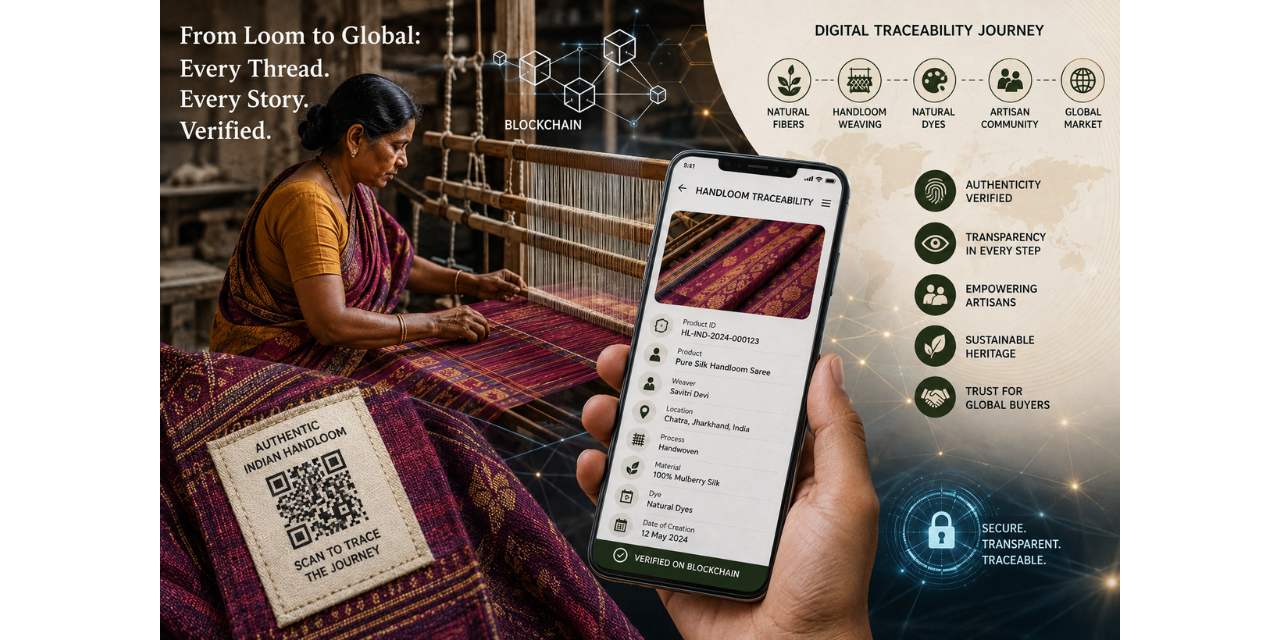
Digital traceability of handloom products uses modern tools like QR codes, blockchain, and NFC chips to track a garment’s journey from the weaver’s loom to the buyer. This technology proves authenticity, stops counterfeits, and shares the artisan’s story. The system allows consumers to verify the authenticity of a product and understand its origin.
QR Code Technology in Handlooms
A QR code is a machine-readable code that stores digital information about a product.
When scanned using a smartphone, it can provide:
- Name of the artisan
- Weaving cluster
- Fibre composition
- Dyeing method
- GI certification
- Production date
- Care instructions
- Product story
The key benefits include easy product authentication, enabling customers to quickly verify the authenticity of products and reducing the risk of counterfeit goods. It also enhances customer engagement by providing interactive and personalised experiences, while digital storytelling allows brands to share detailed product information, origin, and sustainability efforts. These features help build greater transparency, ultimately increasing consumer confidence and strengthening trust in the brand.
Example: A Banarasi silk saree carrying a QR code can provide details about the weaving cooperative, artisan, GI registration, weaving duration, and maintenance instructions, assuring customers that they are purchasing an authentic handloom product.
Blockchain Technology in Handlooms
Blockchain is a decentralised digital ledger that securely records every transaction within a supply chain. Once information is entered, it cannot be altered without consensus, making the system highly secure and transparent.
In handlooms, blockchain can record:
- Cotton or silk sourcing
- Yarn preparation
- Dyeing process
- Weaving details
- Quality inspection
- Packaging
- Distribution
- Retail sale
Each stage becomes permanently recorded and accessible to authorised stakeholders.
The system ensures product authenticity by enabling consumers to verify genuine handloom products with confidence. It also promotes supply chain transparency by allowing every stakeholder to access verified production records, improving traceability and accountability throughout the production process. Additionally, it helps protect Geographical Indication (GI) products by safeguarding their identity, preserving their uniqueness, and preventing misuse or counterfeiting.
Blockchain helps prevent misuse of GI-tagged textiles such as:
- Banarasi Brocades
- Kanchipuram Silk
- Pochampally Ikat
- Chanderi Fabric
- Muga Silk
Blockchain enhances export competitiveness by providing the transparency that international buyers increasingly expect regarding ethical sourcing, authenticity, and sustainability. It also ensures fair recognition for artisans by creating permanent digital records of their contributions, preserving their craftsmanship, improving traceability, and helping them receive greater visibility and credibility in global markets.
Case Studies
Case Study 1: India Handloom Brand
The India Handloom Brand promotes authentic handloom products meeting specified quality standards. QR-code-based identification can strengthen consumer confidence by providing verified product information.
Case Study 2: Banarasi Silk
Banarasi silk products are often imitated by powerloom fabrics. QR-code authentication and blockchain-based traceability can help distinguish genuine handwoven products from counterfeit versions, protecting both artisans and consumers.
Case Study 3: Pochampally Ikat
Pochampally Ikat, a GI-tagged textile from Telangana, can benefit from blockchain records documenting every stage of production, thereby increasing export credibility and preserving its unique heritage.
Sustainability and Digital Traceability
Digital traceability contributes to sustainability by:
- promoting ethical sourcing,
- encouraging responsible production,
- reducing counterfeit goods,
- supporting fair trade,
- improving resource management,
- strengthening consumer awareness.
Consumers become informed participants in sustainable fashion by understanding the journey of each product.
Challenges
Several barriers hinder large-scale implementation:
- Limited digital literacy among artisans.
- Initial implementation costs.
- Internet connectivity in rural weaving clusters.
- Lack of standardised digital infrastructure.
- Data privacy and cybersecurity concerns.
- Need for technical training.
Recommendations
- Introduce QR-code-based product identification for all certified handloom products.
- Pilot blockchain traceability in major GI handloom clusters.
- Train artisans through digital literacy programmes.
- Develop a national digital traceability platform under the Ministry of Textiles.
- Integrate QR codes with India Handloom Brand certification.
- Collaborate with technology institutions and start-ups to build affordable traceability systems.
- Promote consumer awareness regarding digital authentication.
- Encourage exporters to adopt blockchain for ethical sourcing verification.
Future Scope
Future developments may include:
- AI-powered quality inspection.
- Digital product passports.
- Internet of Things (IoT)-enabled smart looms.
- Blockchain-enabled export certification.
- Virtual museums showcasing artisan stories.
- Augmented Reality (AR) experiences allowing consumers to virtually explore weaving clusters before purchasing.
Conclusion
Digital traceability through QR codes and blockchain has the potential to transform the Indian handloom sector by enhancing authenticity, transparency, and consumer trust. Rather than replacing traditional craftsmanship, these technologies strengthen the value of handcrafted textiles by preserving artisan identity, protecting GI products, and enabling ethical, sustainable supply chains.
By integrating digital innovation with centuries-old weaving traditions, India can position its handloom sector as a global model for sustainable and transparent textile production.
References
- Ministry of Textiles, Government of India.
- Office of the Development Commissioner (Handlooms).
- India Handloom Brand Guidelines.
- Geographical Indications Registry, Government of India.
- National Institute of Fashion Technology (NIFT) publications.
- National Institute of Design (NID) research.
- World Intellectual Property Organization (WIPO) publications on Geographical Indications.
- World Economic Forum reports on blockchain and supply chain transparency.
- Organisation for Economic Co-operation and Development (OECD) publications on blockchain and traceability.
- Research articles on blockchain applications in textile and apparel supply chains.