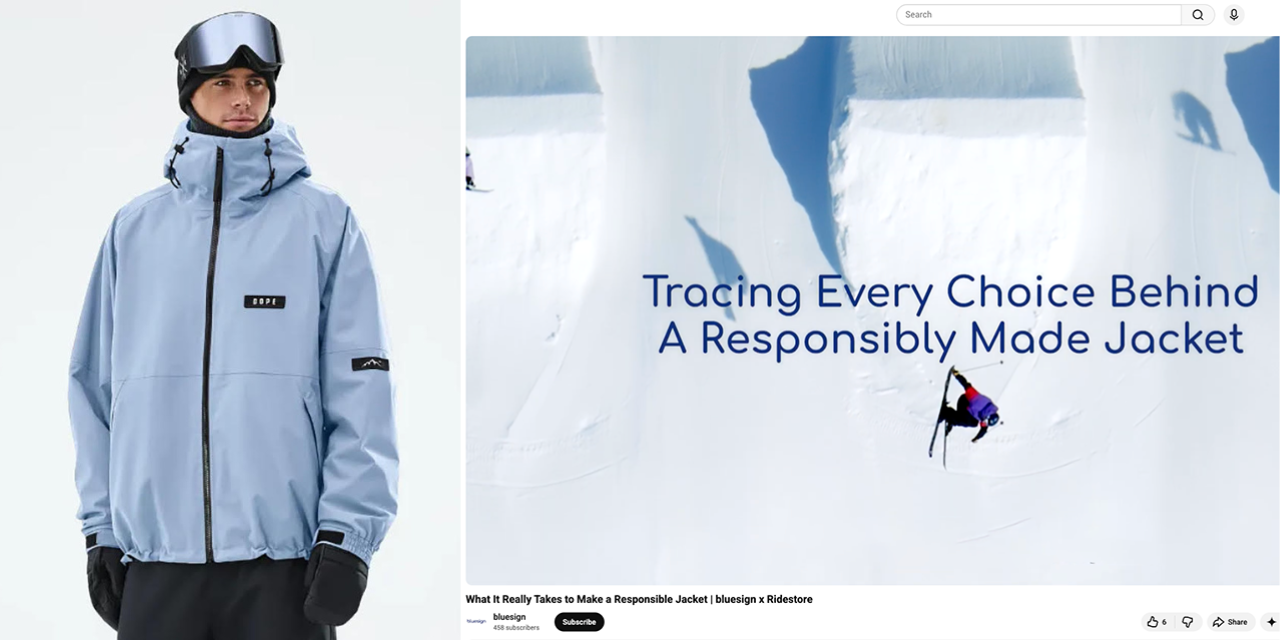
Creating responsible clothing goes far beyond selecting sustainable fabrics. In collaboration with Ridestore, the bluesign System highlights the complex, multi-layered process behind producing a truly responsible technical jacket—where every component, from coatings to trims, plays a critical role.
Beyond Fabric: The Complexity of Technical Outerwear
While consumers often associate sustainability with materials like recycled polyester or organic cotton, a technical ski jacket is far more intricate. It includes membranes, adhesives, coatings, zippers, cords, and heat-transfer labels, each involving distinct chemical processes and supplier networks.
Ridestore’s Spartan jacket exemplifies this complexity. Built with mechanically recycled stretch polyester, it also integrates a TPU membrane for waterproofing, PFAS-free durable water repellent (DWR) finishes, lamination adhesives, and coated trims—each requiring careful sourcing and chemical management.
“Everybody thinks about product impact being in the recycled fibers or in the final product, but it is actually a lot more than that.” Ashish Ahlawat, Head of R&D, Ridestore, Dope and Montec
The Role of the bluesign System
Unlike conventional certification approaches that test finished products, the bluesign System operates upstream. It focuses on managing chemical inputs, production processes, and environmental impact at the source.
By working directly with suppliers, bluesign ensures that environmental performance, worker safety, and chemical usage are continuously monitored and improved throughout the supply chain.
A Strategic Choice: Fewer Suppliers, Higher Standards
Operating within the bluesign System means working with a narrower pool of suppliers. Facilities must meet stringent requirements for chemical safety, environmental controls, and worker protection.
“When you have environmental considerations and chemical safety built into your product creation process, your pool of suppliers is not as wide. But it is wide enough that we can create the best looking garments, in the highest quality, without sacrificing the environmental or the safety concerns.” Ashish Ahlawat, Head of R&D, Ridestore, Dope and Montec
Ridestore’s approach involves onboarding its entire supply chain into the bluesign framework, ensuring consistency across weaving, dyeing, lamination, and trim production.
“Many of Ridestore’s partners within the supply network had already been part of our system. So we stepped in and supported onboarding the remaining facilities and other players in the network.” Antje, Head of bluesign Brand Services
Invisible Details That Matter
Much of what defines a responsible garment remains unseen. Components such as zippers, snaps, adhesives, and cords all involve chemical treatments and sourcing decisions that rarely appear in product descriptions.
Ridestore ensures that every high-impact component is sourced from bluesign-approved suppliers.
“We have bluesign® APPROVED prints. We have bluesign® APPROVED trims. They all look very good. You have to know your stuff. You have to know how to develop the material, who the suppliers are, and you need to have good relationships with them.” Ashish Ahlawat, Head of R&D, Ridestore, Dope and Montec
Durability as a Sustainability Metric
A key principle of responsible production is durability. Products must perform over time to reduce waste and environmental impact.
Ridestore subjects its materials to rigorous testing, including bond strength, water repellency, and stress resistance.
“We test all materials to failure, both in development and in actual production. The supplier knows what they are doing, and we know what to ask for.” Ashish Ahlawat, Head of R&D, Ridestore, Dope and Montec
The Spartan jacket also demonstrates strong water repellency using non-PFAS alternatives, aligning performance with reduced chemical risk.
What bluesign Enables
The bluesign System provides brands with verified visibility into their supply chains—covering environmental impact, consumer safety, and worker health.
“Without bluesign help, we are a bit blindsided. We don’t know what chemistry the supply chain uses and how they are using it. Whereas with bluesign, we can move ahead with confidence, knowing that the supply chain is not causing any unnecessary harm to the people or to the environment.” Ashish Ahlawat, Head of R&D, Ridestore, Dope and Montec
The Long Road to Responsibility
Developing a responsible jacket requires time, expertise, and continuous commitment. It involves deeper supplier relationships, stricter standards, and ongoing improvement processes.
“The process is long. It’s hard work. But it gives us confidence that what we are putting in the market meets the highest standards.” Ashish Ahlawat, Head of R&D, Ridestore, Dope and Montec
Conclusion
A responsible jacket is not defined by a single material or label. It is the result of hundreds of decisions across the value chain—from raw materials to final production. By integrating systems like bluesign, brands can ensure that these decisions are aligned with environmental responsibility, performance, and long-term sustainability.