Dr Ela Manoj Dedhia, PhD Guide, University of Mumbai
Director, Anveshanam Foundation
SDC Trustee UK (Society of Dyers & Colorists)
Introduction
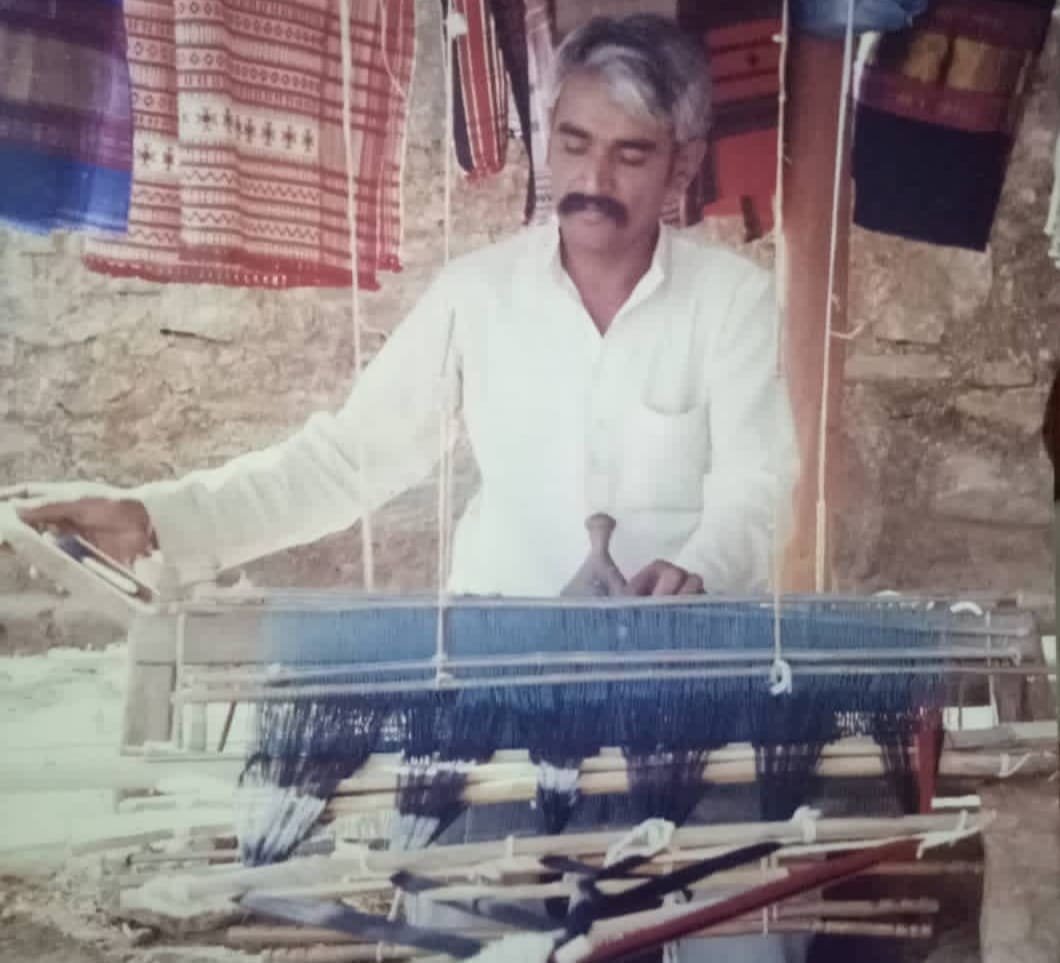 The Kutch Desert is home to a vast variety of artisanal production. ‘Bhujodi’ weaving/weave is named after a village ‘Bhujodi’, almost 8 kms near Bhuj ‘Kutch’, where hand weaving is practised in every home, and thus this village is famous for woven textile products such as shawls, traditional blankets, stoles, traditional skirts called ghaghra, and lungi. The weaving tradition in Bhujodi is the result of an age-old traditional best type of collaboration between Rabari and Vankar communities, and for generations, the two communities have been working together to produce traditional shawls which are worn by both the Rabari and Ayar men and women. Weaving is practised in more than 35 villages of Kutch; however, Bhujodi has gained popularity due to the proximity to the city of Bhuj and the experimental explorations of dyers and weavers of Bhujodi. This paper is based on research collaboration with weavers in Bhujodi.
Usage
Traditionally, for married women/ Suhagadi – black ludi/ ludki /odhni/ ba poti were woven in white by the weavers. They gave the khatri men /dyers to dye it black. Men used a white khes/shawl, draped on one side was white with a mostly black or red border. Headgear/pagh was woven white with a border and stripes woven in black. Black was obtained from a desi bavad / danad plant from Fabaceae (pea or legume family) called Babool or Acacia Arabica, from which leaves and stem are used for obtaining the black colour. Lac, an insect dye, was used for pink or red colour. Traditionally the women used to dye cloth themselves also.
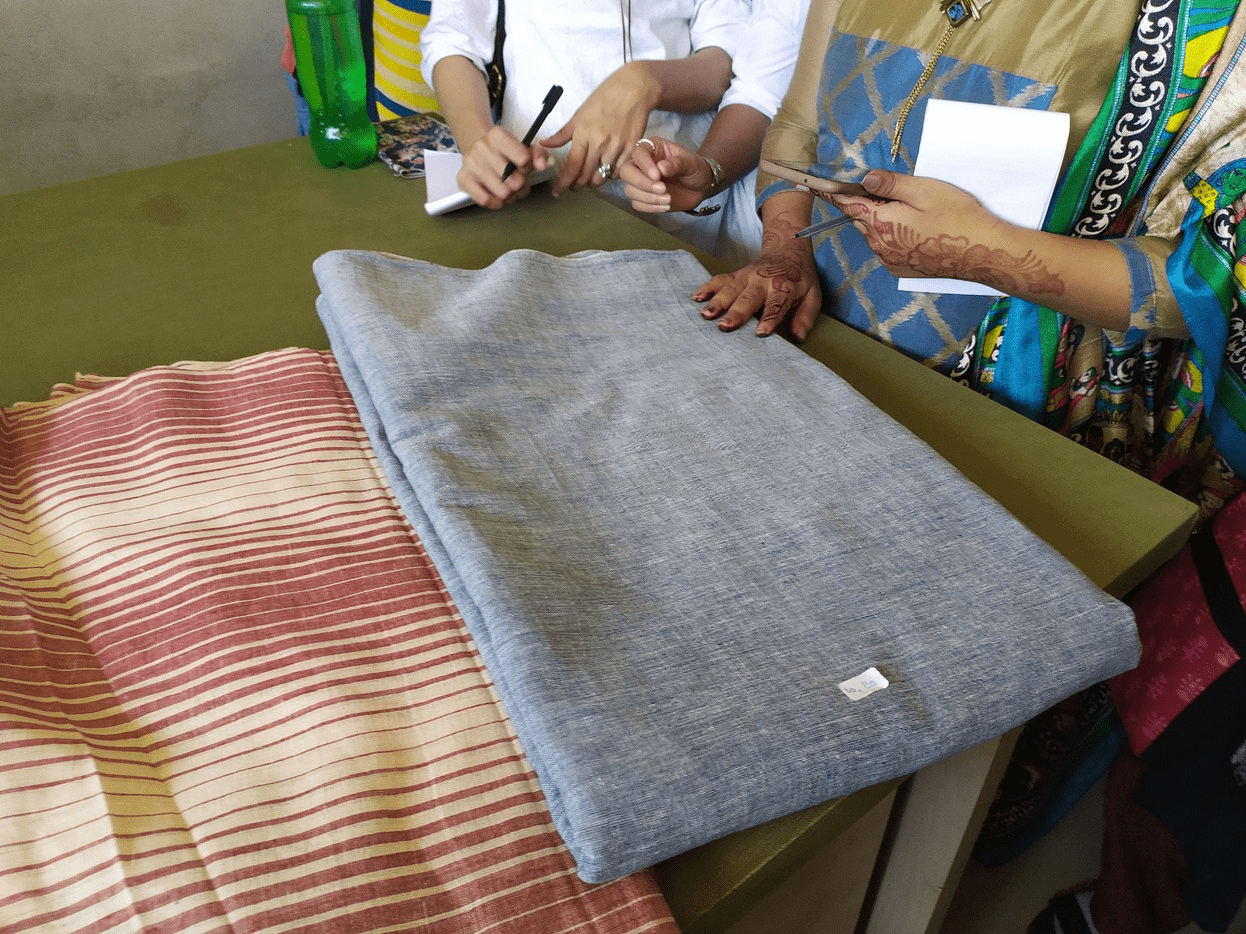
In Bhujodi, weavers who are highly accomplished in weaving mainly create shawls and stoles, carpets, mats, and running fabric to be used in different end uses, including garments. Traditionally, wool was used to make shawls for the harsh winters of Kutch for people living in Kutch. Since the last few years, cotton has also been used for various products, as it is used by people outside Kutch as well for garments and is used during summer even by people of Kutch. This ensures a demand for the spinners, dyers and weavers throughout the year.
Earlier, the weavers of Bhujodi also made paghdi, a traditional headgear or a turban known as Dhotali in Kutch. Traditionally, they were maroon and green, and later white. These paghdis were woven by many other weavers of other villages as well, but those woven by weavers of Bhujodi had their uniqueness and were worn by Rabari men after their marriage as part of their traditional attire. These paghdis are still woven in Bhujodi, but they are not so high in quality and design as the traditional ones.
Kala cotton fabric was used to make Judi and Joro the traditional wear of the locals.
Dhoti, which is a loose, draped pant also called Lang/pot, on which the upper wear called kediyo, over which they carried a shawl/ khes and the headgear was called pagh/turban, was the traditional attire of men. The Rabaris used woollen dhabda/shawl throughout the year.
850 years ago, the very rich Rabari community girls were given gifts when leaving their maternal homes after marriage. This practice was called kanyadan; thus, the rabari daughters were sent along with them, one cobbler /mochi, one weaver /vankar, whose needs would be taken care of by this rabari girl through the funds sent to her by her parents. She would give gold gifts to the vankar and cobbler, which is known as giving paghdi. Gold neck piece called Mandaniyo or gold earing or even animals such as goat were gifted during her wedding to the cobbler and weaver.
Only the barter system existed at that time and there was no money exchange. The cobbler and the weaver played drums in return during the weddings. One weaver and one cobbler then grew into large families and gradually an entire weavers and cobblers community got established in the villages where these rich Rabari girls went after marriage. The relationship between these communities thus grew very strong and continued for generations.
There are more than 35 villages in Kutch where the weaver families have established themselves, right from village Adhoi to Naransarovar. Their weaving technique is similar with little differences in design. GI Tag (Geographical Indication) is given to Woven Shawls of the Kutch region, not to any specific village of Kutch, but wherever it is practiced.
 Four weaving communities are there- charaniya, bharvada, maheshwari and gujar. These are marvadas from Jesalmer who are described as gat ganga, meaning that others become pure/pavitra when interacting with them. They were known as the Rakhiya kul / protector clan for the Rabaris. If anyone is sick, amongst the rabaris, they call them to perform rites/puja so that they get cured. In return, the Rabaris place offerings/ sokha to the rakhiyas in return, and also offer them lunch and gifts, and consider them like soldiers of god.
Recently, Harshi Bhagat from village Bidda, who was from the vaniya community, when dead, was buried was given samadhi in the ground in the farm/vadi rather than being burnt as per Hindu tradition, as he was considered a very important rakhiya/ protector. His samdhi /shrine is worshipped even today. Many of the weavers thus visit different places wherever they are invited by the Rabari community to sing bhajans and cure the sick.
Significance
The weavers weave the beautiful patterns and intricate designs completely by hand; therefore, it may take a few months for them to complete. Many of these artisans have received National awards and accolades to their credit. It takes around ten to fifteen days to weave a single shawl with simple designs and around six shawls of the same design are woven each time. The first award was presented in 1973 to Punjabhai Ramji of Vatan/village Vanora mota, which is next to Nagaur. Recognition to Bhujodi weaves came when Shri Vishram Valji Vankar, a senior weaver in Bhujodi cousin of Khengarbhai weaver, whose case study is mentioned below. Vishram Vankar received the President’s award in 1974 for an intricately designed and patterned shawl woven by him, which was completely created by him over an entire year. The recognition received through the award strengthened his determination that all his six sons, Amir, Ramu, Arjun, Shamji, Dinesh and Rajesh, should follow the family weaving craft. 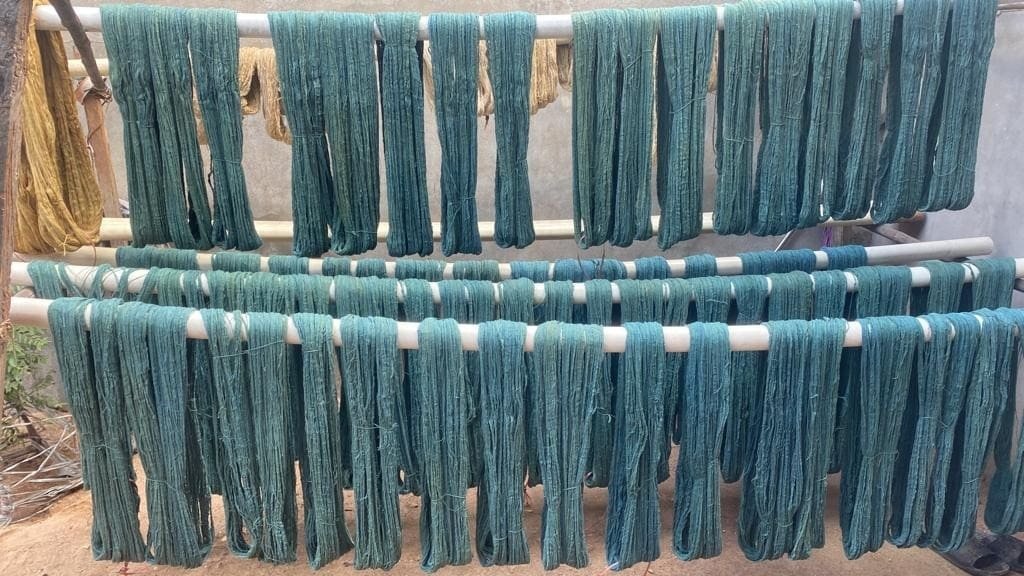
Maiwa, a foreign-based NGO, has been working with the sons, especially Master Weaver Shamji Vankar, for many years. Their work was featured in a weaving documentary prepared by Maiva named Tana Bana: Wisdom of the Loom, which was released in 2005. Shamji Vankar participated in the Maiwa Masterclass held in Bengal in 2011 to share the vital knowledge of natural dye that the family possesses. The family experiments beyond the traditional colors to an entirely new range of natural colors, which they dye themselves.
Contemporary work produced by the Vankars is a class of its own and the success of the Vankar family confirms that skill is the most effective trade protection for artisans, very difficult to copy. Fine cloth was gifted to the Maiwa Collection to showcase it to the public. It stands apart as an example of the best of Bhujodi weaving and dyeing. Shamji Vankar was invited in 2019 to present at the Maiwa School of Textiles and his masterwork was featured on the cover of the Course Calendar of the Maiwa School of Textiles. Several other weavers later received National recognition for their work.
‘Kutchi’ shawls have received the ‘GI (Geographical Indication) tag’.
Bhujodi weaving, like many other Indian crafts, is a family craft where all in the family are involved in the creation of every product. The distribution of work is decided based on the amount of physical work involved. Men weave on the looms, while the women are involved in yarn making and preparation of the looms. Traditionally, in the past, even women were involved in weaving, but with the passage of time, there has been a division of work. The intricate patterns and designs are woven by hand, in which the additional horizontal yarn/weft goes between the warp and weft, the vertical and horizontal threads, respectively. This unique technique of weaving motifs with the extra weft is done by manually lifting the warp with fingers without the use of punch cards, as is the case with Dobby or Jacquard weaves. This is the ‘Athh tako’ (8 stitches) technique (with four peddles in the loom) which is the specialty of these weaves. Every craftsman trains their next generation, their children, to weave right from their early age. There is no formal intentional training, but the children learn by watching their elders at work and also by helping them out all day, through, as it all happens in the home environment.
Myths & Legends
Popularly, it’s believed, as earlier mentioned, that kutchi weaving started about 800 years ago when the daughters of rich ‘Rabari’ families came to Bhujodi/other villages after her marriage. The parents of the daughters had sent one weaver along with her as part of her dowry, so that she could get any weave woven as per her desire. A large community of weavers gradually got established, as the family of this one weaver grew over centuries, and they were known as weavers of Kutch.
It is also believed these weavers/ vankars of Kutch were the Marwada weavers of the Meghwal community in Rajasthan who have migrated to Kutch more than 800 years back and their style of weaving has connection to the pastoral community the Rabari Tribe who travel across the rough mountains of Afghanistan and settled first settled in Rajasthan 1000 years back and later in Kutch.
Another tale says that the Hindu folk deity Ram Dev Peer of Rajasthan came on a pilgrimage from Rajasthan to Narayan Sarovar in Kutch. He was requested to bring his weavers’ troop from Marwar to take care of a temple made in honor of Ram Dev Peer. This is believed probably to be the first weaver community to settle in Kutch. It is believed that these Vankars were sent by Lord Shiva to tend to the camels owned by Parvati.
As the economy followed the barter system for long in India, it is believed that weavers made handspun blankets, traditional ghaghras (long skirts), and the wedding wear for the Rabari community, in exchange for handspun wool from their sheep and camels. Blankets were worn by Rabaris over their shoulders or around their waist, or both over the Pachedi. The Rabaris, being a pastoral community, also provided milk, milk products and grains to these Vankar families in barter for the woven products. The Rabari women were also embroiderers so they embellished these woven textiles.
History
More than 250 weavers are practicing this weaving craft in the village Bhujodi of Kutch. The Rabaris of Kutch which are the nomadic tribes that are always on the move needed warm clothing to withstand the harsh winters of Kutch. Traditionally, weavers used hand-spun woolen yarn which were provided by the ‘Rabaris’, the nomadic community of sheep and goat herders. The ‘Meghwals’ and ‘Marwadas’ also wove and they developed a distinctive style of weaving that provided the local people of kutch with blankets and fabrics for traditional dress. These were then known as ‘Vankars‘ or the weavers. The ‘Vankars’ slowly created designs as per the desires and demands of the ‘Rabari’ community, thus most of the designs developed the features of this particular clan. Such special design features make it easier to distinguish the weaves of various communities, although they worked interdependently as this craft grew over centuries. Most of the weavers continue to weave to pass the craft to their future generations.
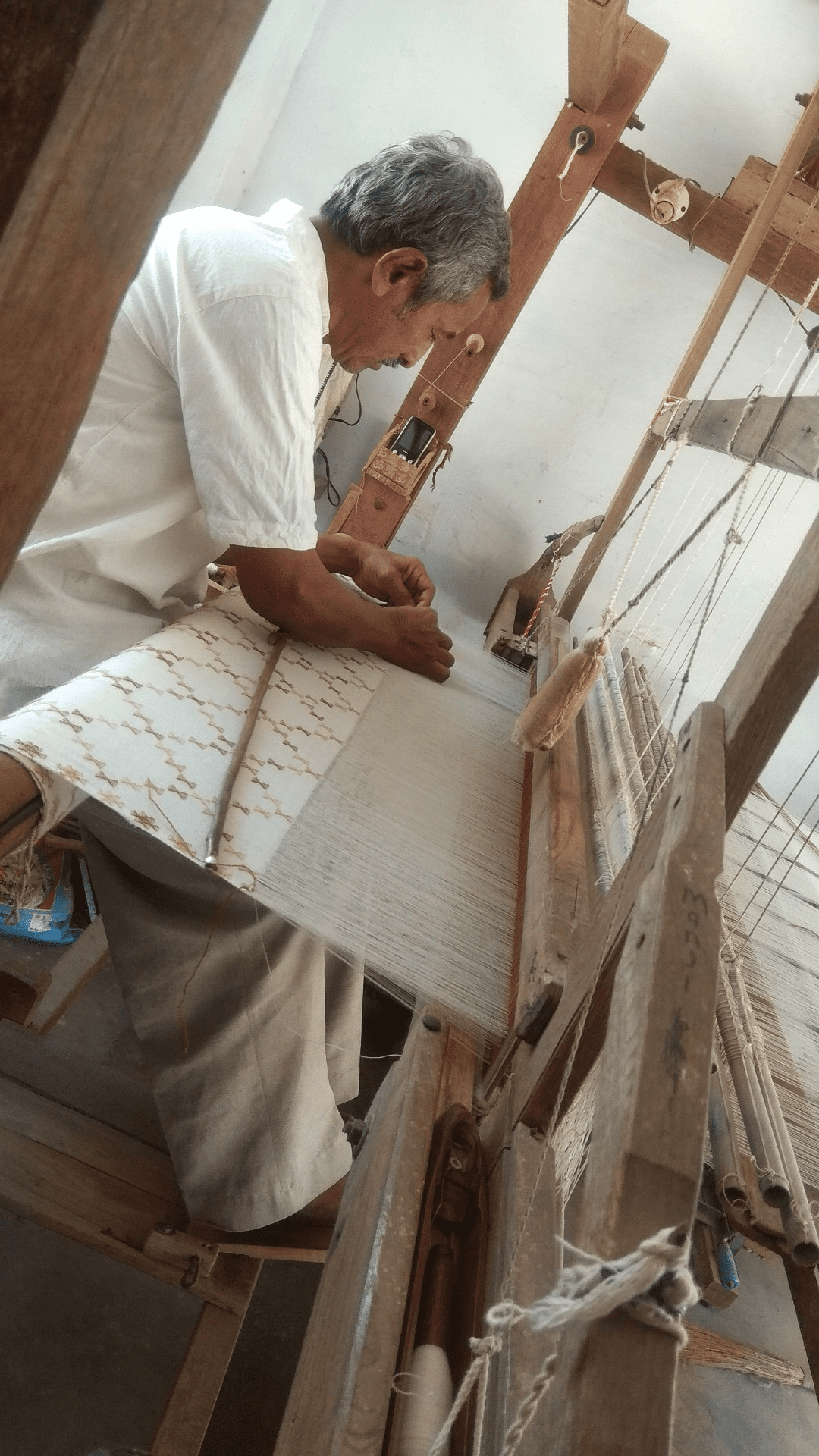
The Vankar community in Bhujodi was at its peak in the 18th Century when cotton production was thriving. Since cotton cultivation and its trade were later controlled by the British colonial Raj, who levied very high tariffs on Indian cloth and began exporting cheap mill-made yarn and cloth from their country to India, the weavers of Kutch were very badly affected as this caused a reduction in demand for handspun yarn and finally caused mass unemployment. Thus the entire economy of the weavers and spinners was disrupted. In the 1920’s the khadi movement initiated by Mahatma Gandhi, encouraged handspinning of yarn and hand weaving of fabric, trying to solve the issues of unemployment. Weavers Sammelan organization, led by Gandhian Ravishankar Maharaj, brought more than 5000 weavers together. This certainly improved the livelihood for the Vankar community, both culturally and economically and bythe 1960’s the beautiful and extraordinary work of these weavers started getting recognized. The Shree Bhujodi Cotton and Wool Handloom Cooperative Ltd was established on 25th March 1954 with the registration of 52 weavers, which provided the trademark ‘ Bhujodi Shawl’ across India and abroad, for which the weavers received awards at the State and National level. The Trust received grants from the government which supported weavers.
The weavers took great efforts in weaving elaborate and unique shawls, experimenting with novel designs, motifs and patterns and by 1961, the weavers mixed traditionally locally used wool with Merino wool imported from Australia and New Zealand, introduced by the Rajasthan Khadi board. This led to changes in techniques of weaving, texture, feel and weight of the woven fabrics also led to an increase in cost and thus price. Acrylic was introduced by the 1980s in the form of blends with merino wool, sometimes even some cotton, which lowered cost and thus price.
Effects of the Earthquake in 2001 and revival thereafter:
Kutch was completely devastated due to the massive earthquake that struck on 26th January 2001. Just like all other crafts, the woven craft of Bhujodi was also severely affected. The age-old relationships between landowners, sheep herders, spinners, dyers, weavers and the Rabari women were completely destroyed. The Shree Bhujodi Cotton and Wool Handloom Cooperative Ltd was completely closed down. Between 2002 to 2005, weaving was revived by NGOs and institutions like Abhiyan, Kala Raksha and a few others. Short Workshops and year-long training courses were conducted for weavers of Bhujodi to innovate new motifs and designs using symmetry and design.
Kala cotton, which was the indigenous local rain-fed cotton that has evolved under desert conditions and does not require excessive irrigation or pesticides to flourish in Kutch, was introduced by Khamir which was a registered society and public Trust established in 2005, which also contributed to the revival of the Bhujodi woven craft revival.
The Shree Bhujodi Cotton and Wool Handloom Cooperative Ltd was revived by the weavers of Bhujodi by 1st September 2016. The weavers who were entrepreneurs created sarees, dress materials, dupattas, stoles, scarves etc, with the help of designers through various aid agencies, central and state government and non-government organizations to attract young clientele. With the efforts of all these organizations, the weavers participated in exhibitions and fairs and interacted with prominent designers.
By 2008, these shawls and other woven products attracted tourists and local retailers. Nowadays, their work is recognized internationally as well and most are independent entrepreneurs or some do job work for these entrepreneurs. This old devastated village of Bhujodi has revived and today has more than 200 weavers. They diversified to make new products like carpets, placemats, etc. Shawls and stoles are also woven in contemporary styles. Tussar silk and cotton are used along with traditional wool. With changing time and efforts the weavers are now identified and termed as designers. There is a fusion of traditional motifs and patterns with contemporary simplicity in designs and color to attract the modern customers. The product line has expanded itself to new applications in home furnishings to include bedsheets, cushion covers, and curtains, which do require the use of different fibers and weights of yarn to suit the various end uses. These contemporary designs and products attract national and international markets through design collaborations, exhibitions and fairs. On the other hand they are struggling to survive in traditional local markets. Brands like Peepul tree help artisans to produce lightweight shawls and stoles in a range of colors. Thus the craft of Bhujodi weaving has struggled over last several decades; however has evolved over time from trunks of nomadic Rabaris to the modern wardrobes and homes of the modern clientele.
Case Study of an Artisan Family of Bhujodi
Some dyers and weavers, such as Khengarbhai Manjibhai Vankar, who practiced weaving at the age of ten, as his family had practiced weaving for generations. Their forefather Shahjan Vankar came to Bhujodi 850 years back, whose family grew and today there are more than 100 families from his own next generations.
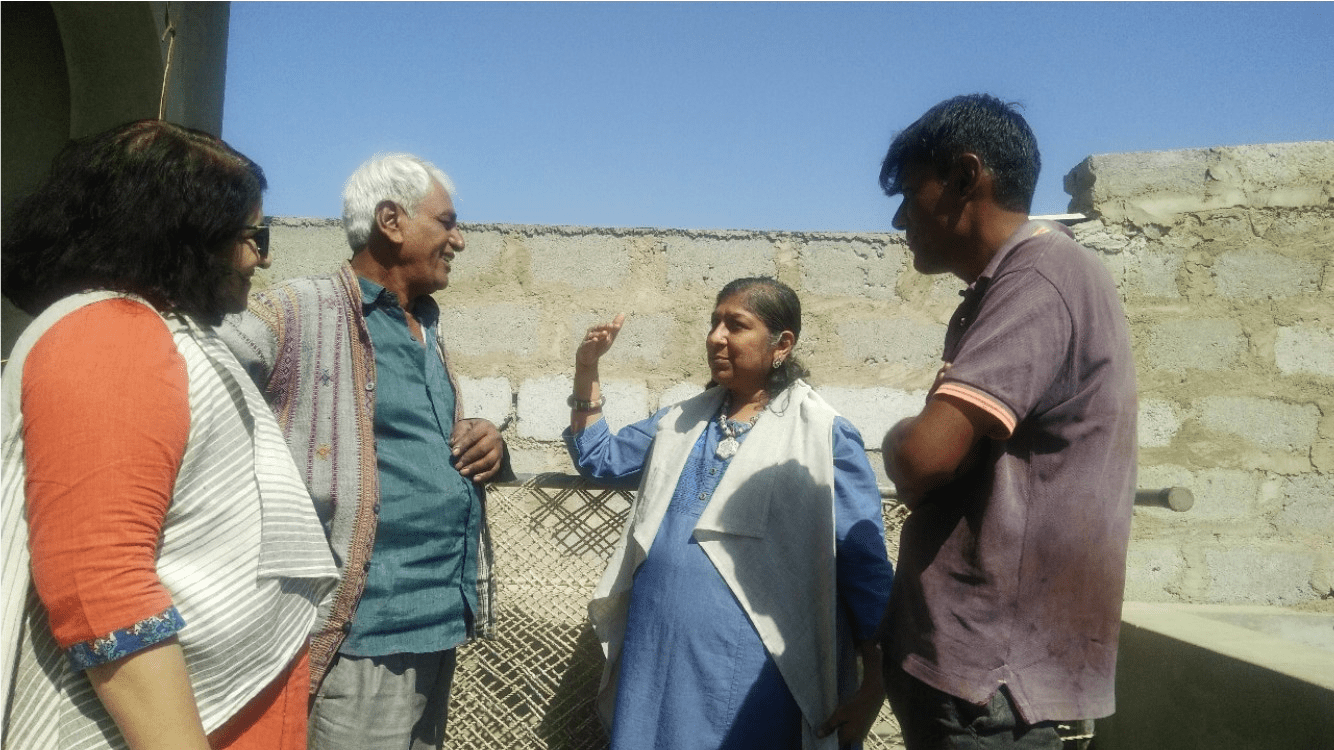
Khengarbhai and his son Naresh Khengar Siju, including their entire family, have developed a range of color ways from natural colors and also collaborated with designers and design institutes to participate in exhibitions and fashion shows. They have been presenting their range of natural dyed and hand-woven fabrics through modern attire on the ramp. They have gone through tough times like most artisans of Kutch have, due to natural calamities like the earthquake, drought and recent COVID times; however, this artisan family, like many in Kutch, are very positive about the Present. They wish to refer to the past only for lessons to learn, but not get depressed or regret any of it, as they feel that reality has to be accepted as it exists. There’s a lot to learn from each of them. They look forward to opportunities due to technology, the opening of trade and economics. The attitude of accepting the odds as part of the life cycle by such skilled artisans is worth appreciation. They focus on the preservation of culture at the same time, exploring innovations. Many such master craftsmen in Kutch play a very important role in the continuity of traditional crafts of Kutch and the creation of innovations in design, products etc., in spite of all challenges they face.
Earlier, Khengarbhai produced for Gurjari and a few other traders, but after the earthquake, he joined a Geneva-based trust that helped karigars/artisans for three years by providing what they needed, like sewing machines, printing tables, etc, by going to villages and identifying the needs of the artisans. Khengarbhai was involved in such rehabilitation work post-earthquake for three years.
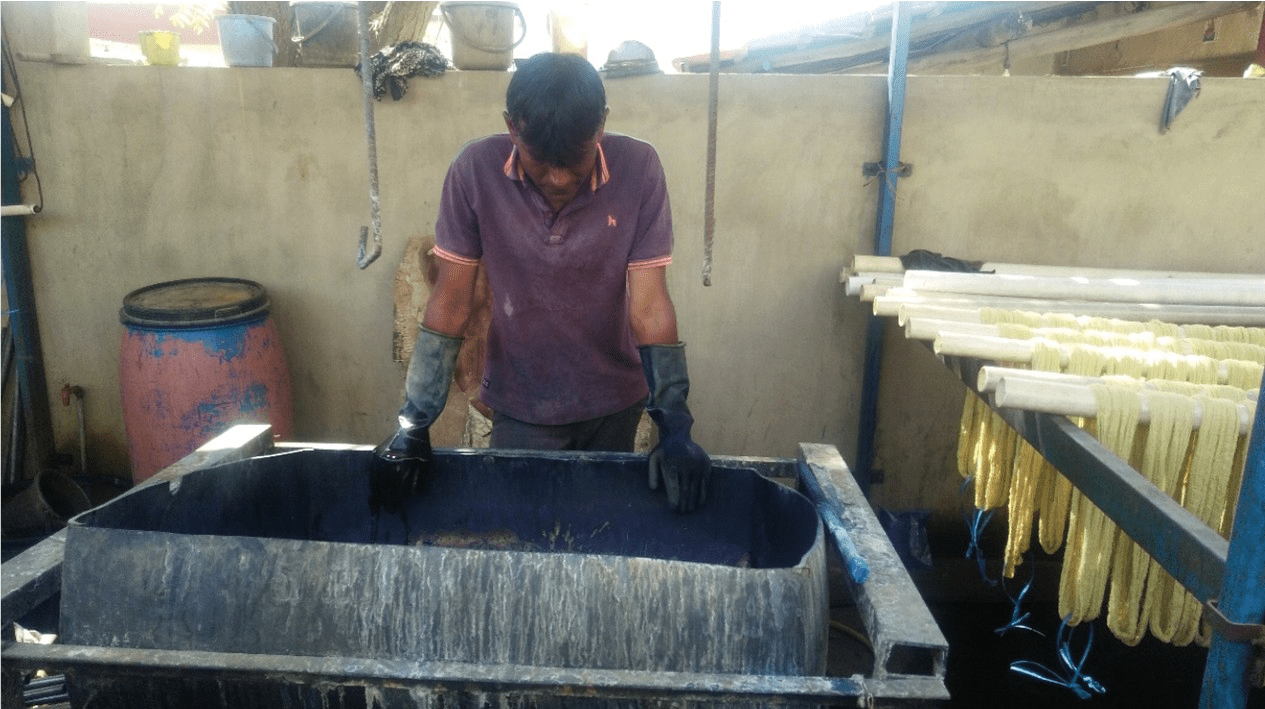
Later, Khengarbhai Manjibhai Vankar, his wife and one of their sons, Naresh Siju, who are hereditary dyers cum weavers, worked for Khamir for almost 12 years from 2005 to 2017. In 2005, they were exposed to chemical dyeing at Atul Industries at Valsad, but the family continued with natural dyeing. While in Khamir, they took care of weaving and natural dyeing departments, which took them initially five years to set it up. Initially, 2 to 5 kgs could be dyed, but later, 25 to 50 kgs and even more were possible. Khamir, an NGO situated between village Kukma and village Lakhond, thought it appropriate to train other artisans and thus, for four years, Khengarbhai went on his own at Khamir by renting a small unit where he spent hours of experimentation along with his son Naresh. But since his financial needs were not getting fulfilled, he returned to his village with his family. Along with their own orders received, they also supply to Khamir based on orders received from them. Khamir does try to give them job work, but that would depend on the orders received in turn by them, which may not be regular, but this family continues to dye for Khamir because 100’s of weavers would benefit through the dyed yarns supplied by them. Khengarbhais father, Manjibhai, also practiced dyeing and weaving, but only produced Ludki or odhni (half saree) for the Rabari women, as that was in great demand.
Their products are totally organic as they use locally grown kala cotton dyed with natural dyes. Cow Urine is used in the process while dyeing with Indigo. Indigo is purchased from natural dye sources, mainly from South India, Jaipur, or Ahmedabad. The price they pay for Indigo, for example, is Rs 11000 per kg. They have experienced adulteration with ash, lime, etc., when purchased from a few other sources, so they are confined to known sources only.
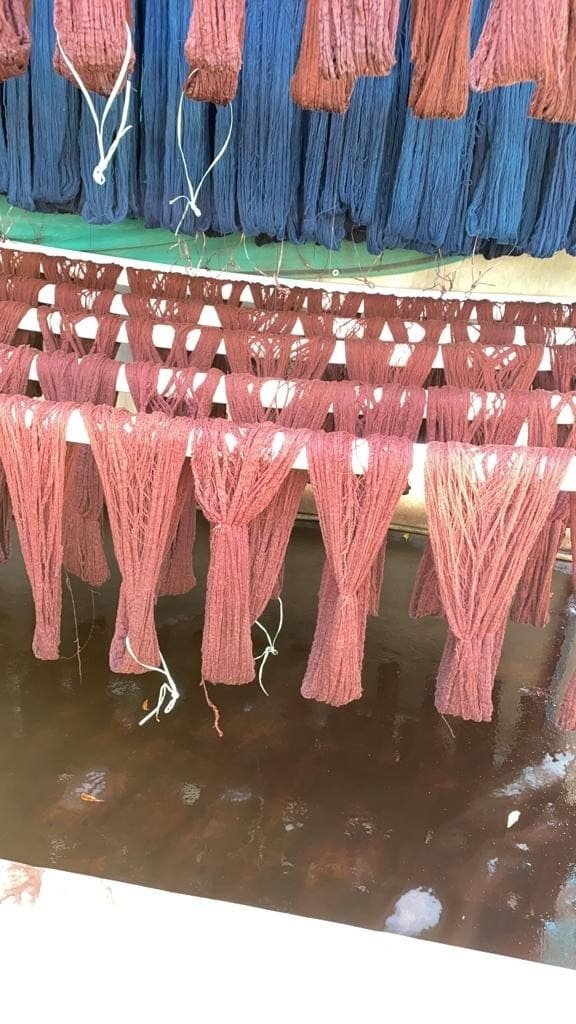
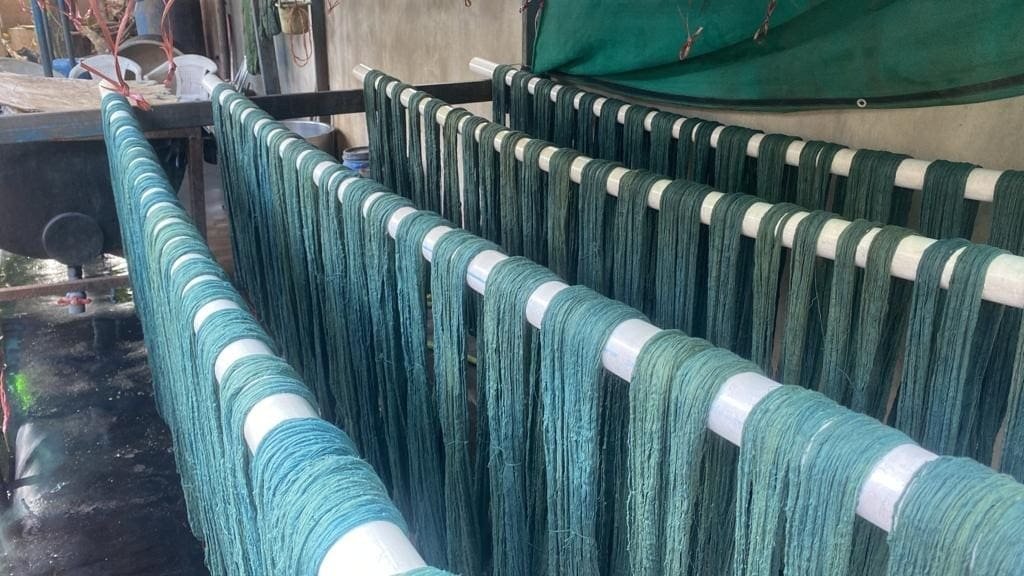
Pomegranate/anar, marigold, kesuda, onion shells are used to give yellows; indigo is used to give blues; manjistha is used to produce orange; lac or alizarine is used to give red and sometimes mixed with manjishta for different shades of pink/red; iron for giving blacks and grays; green with marigold for dark green / kesuda with indigo. New developments for pink and orange shades took four and a half years of experimentation and standardization with long hours of work. Every month now they complete 300 to 350 kg of yarn dyeing at home with 10 to 15 days per color. Currently, he is dyeing a 150 kg order of 6 to 7 different colors. They cater to orders for dyeing from awardee weavers, designers, students for their projects, local weavers etc. Currently, they fulfill weaving orders by giving job work to small weavers by providing samples of patterns and kala cotton dyed yarns. They are catering to requirements for stoles and running fabric for both genders. Light mill spun 20’s count cotton for shirts/upper wear. They use peti charkha spun 10 to 16 count for bottoms. This does give variable count as different women are involved, and each one’s skill varies. Amber charkha spun yarns of 19 or 20’s are used. Khamir is involved with the yarn spinning work as they receive grant from the government. Single ply is used in warp, while single or double ply may be used in the weft.
Yarns Used and Their Preparation
Fibers used: Traditionally, these shawls were always made from locally available wool but the craftsmen explore other materials like cotton, and nowadays wild silk like tussar, eri, and muga also. Wool initially was blended with acrylic, and slowly, a new category was developed whereby it was completely replaced by Acrylic fibers in shawls priced low.
Sourcing: Acrylic is mainly sourced from Ludhiana. Wool is sourced from local goats, camels and black and white sheep. Silk is sourced from Bengaluru, and cotton from West Bengal.
Spinning: The Traditional charkha was used for spinning the yarn.
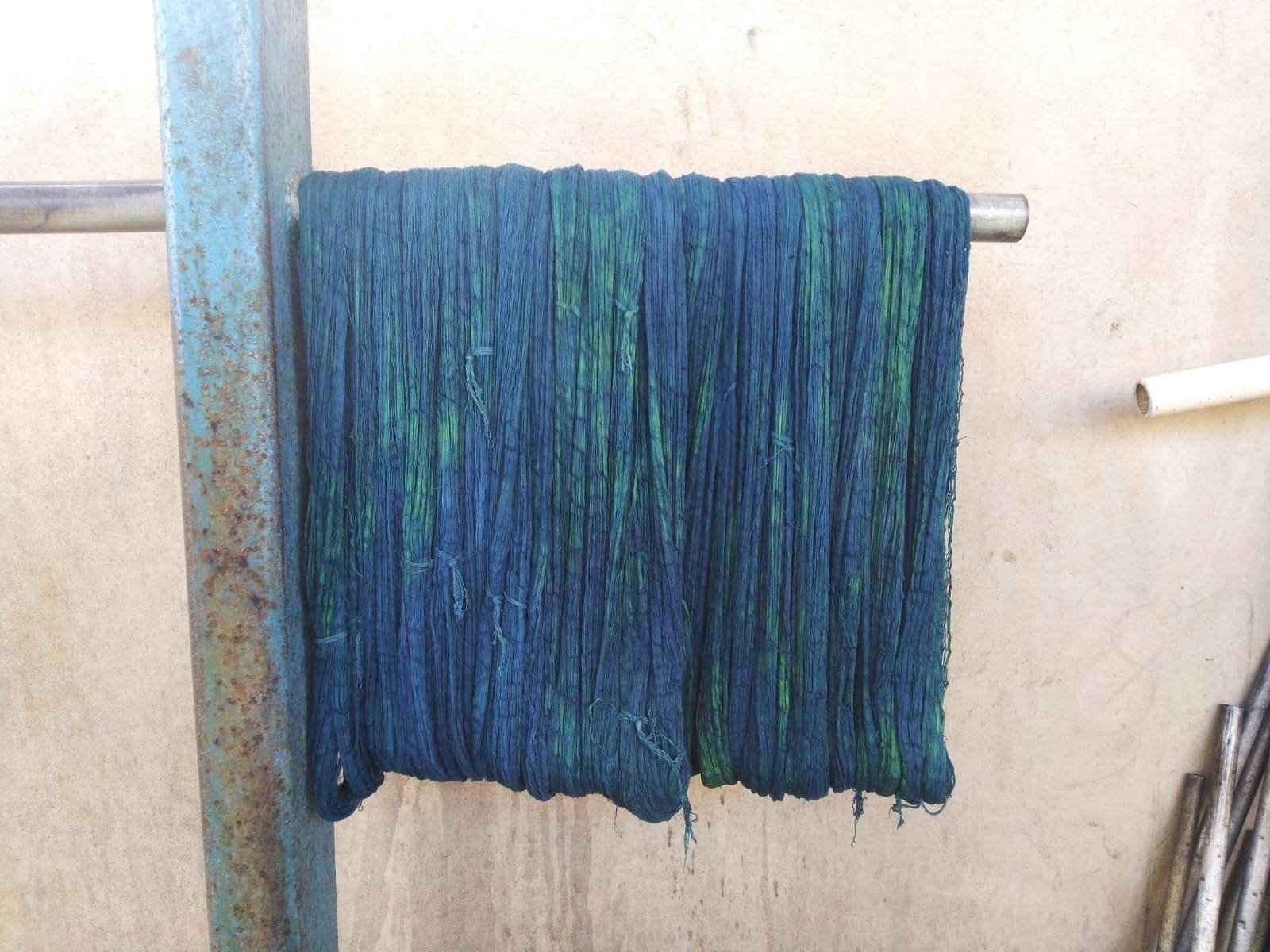
Dyeing: Most of the yarn used is left white in color, while the weft yarn used for the formation of the design is coloured. Dyeing is carried out at the yarn stage. Wool or cotton, if used, is dyed with rich natural dyes. Some of the common colors used are Indigo for blue, alizarine for red, pomegranate for yellow, a mix of blue and yellow for green, off white with light shades of yellow, iron rust for black, etc. Lighter shades of these, such as pink and grey, are also produced depending on the intensity of the natural dyes used.
Acrylic yarns, if used, are dyed with synthetic dyes for producing hues and shades to resemble those produced from natural dyes.
Preparation of yarns: The Woolen yarns are dipped in wheat flour paste before transferring them onto the looms for weaving.
Loom used: Kutchi weaving was carried out traditionally on a Vertical frame loom called Panja, but later on Pit looms in the weavers’ homes itself.
Design
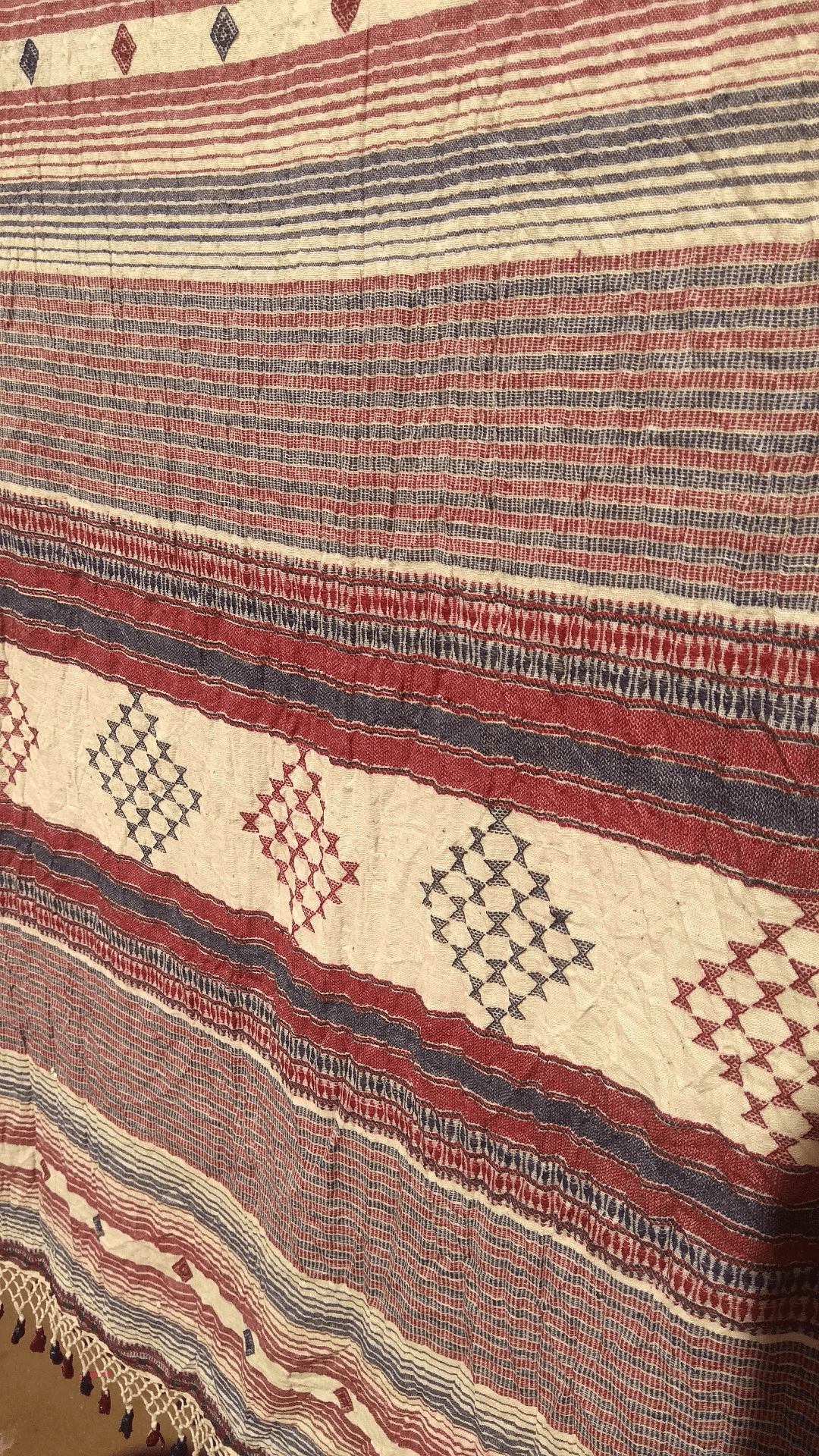
Traditionally, the designs are geometric in nature. According to weavers, the motifs are inspired by architectural design elements of the forts and Rani ki Vav in Patan, Gujarat. The craftsmen weave both traditional motifs as well as contemporary motifs as suggested to them by the designers/retailers. The shawls are usually woven plain with several borders on the shorter length side, which is the main area of adornment. Stripes or checkered patterns are woven, and the special feature of these shawls is that the design creates a bold texture on the background plain fabric, giving it a look of embroidery.
Most of the designs have linear patterns interspersed with motifs that are spread throughout the body of the shawl. These motifs are repeated in various patterns. The width of the border will vary from shawl to shawl. General sizes are 3”, 9”, or 18 inches. 18-inch borders are mostly used in shawls used by men, while smaller ones are used for those used by women.
The end finishing of the shawls or smaller ones called stoles is done with colorful tassels, which is a distinctive feature of the bhujodi weaving.
Types of Motifs inspired by rural scenes:
- Hiraghiryu – The traditional ‘Dhabda’ or Shawl is woven in two parts due to the small width of the looms available to them. Two pieces are joined together using traditional hand-stitches known as ‘khelavni’ machikanto in the center lengthwise of the shawl.
- Jhar – This motif resembles a tree known as Jhar/Jhal.
- Popati – Commonly used simple triangle motifs repeated in various patterns to form complex motifs.
- Chaumukh – Four-sided motifs made by lifting warp threads manually. This is a special feature of the bhujodi weaving style. It has a religious connotation and represents the Mandala. Four triangles of the popati motif joined together.
- Sachchi kor – A warp-based design having pointed temple-like motifs with a thick base- light jo thamblo. This is done as a black and white weave.
- Jesalmero dhabda – like a palace with black motifs
Motifs inspired by rural scenes:
-
- Panchko/ Peepul Tree – Two triangles in opposite directions joined in the middle
- Sathkhani – A pattern that requires seven steps while weaving in its making. Border-diamond
- Dholki – A drum-shaped motif.
- Wankia/Vakhiyo – Motif resembles a crooked or ‘zig-zag’ line like mountains-vel. Ayar-dhandha motenu. The inspiration for this is believed to be the pattern that is created by a cow as it walks on the soil.
- Macchar – Mosquito motif
- Lath – Stick motif- line
- Hathi- Elephant motif
When woven loose with woolen yarns, they serve as all-season wear – warm in winters and cool in summers.
Very often, other textile crafts are incorporated in the shawls or other bhujodi woven textile products for embellishment. Those patterned very commonly with bandhani resist (tie-and-die) are passed to a third group of artisans, the Khatris, who are specialized dyers. Commonly used value-added techniques are Batik, wax resist dyeing; Bandhani, tie and dye, embroideries such as Ahir, Rabari, Mutwa, Abhla -mirror work, Aari or Mochi -chain stitch, and Sindhi embroideries -Kutch work.
Opportunities and Challenges
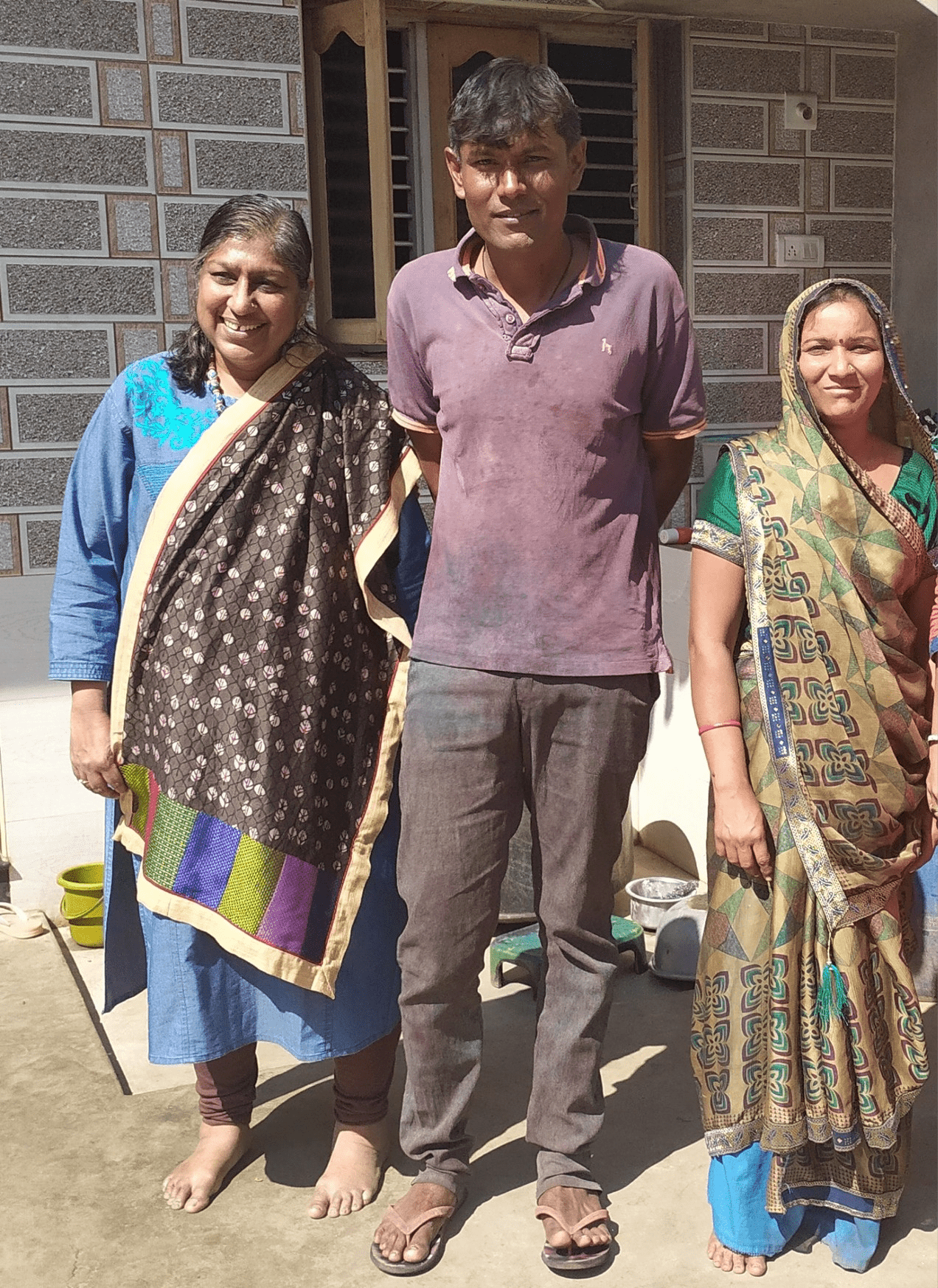
Bhujodi weaving demands a high level of concentration, skill, and expertise. It is a weaving craft that can be very physically strenuous that requiring the craftsman to hunch over his loom for long days and all days. In the past, it caused health issues to some weavers; however, currently, there are no such issues. It is a very time-consuming craft as it takes more than a fortnight of hand weaving at a stretch, for all the warp that is put around the drum at once to be woven into textiles. The weaver handpicks the warp and the weft based on designs and their count, which are in his memory, and any error or deviation will mean starting the whole process all over again.
Nowadays, it is flourishing as they get paid well. Earlier, they would get only Rs 10 for the same; they now get Rs 150 per shawl for the workmanship. Women are also getting recognized for their contributions. Many weavers are able to earn Rs 800 to Rs 1000 per day. This community is a very satisfied community. They consider it a meditative art and are very passionate about it. There was a period when mills started getting established in nearby villages, where the youngsters started going for work but soon as this craft picked up in demand, the weavers returned to their craft. The younger generation is now getting educated by traveling 3 km to Madhapur or 8 km to Bhuj, but they are well connected to their ancestral craft. The children in the family pick up this craft very easily in their families and no formal training is required.
Acknowledgements:
Weavers of Kutch Bhujodi for the information shared during the Interviews and Unpublished documents shared by them.