
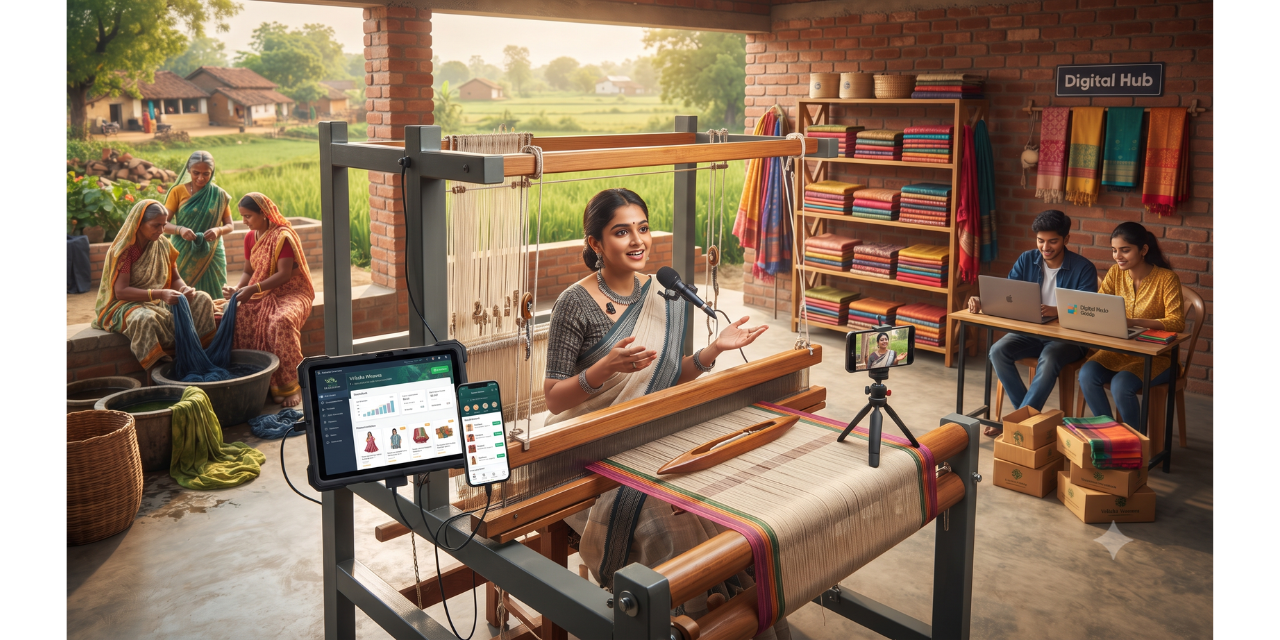
Dr Aasia Ahmed Radiowala,
In-charge Principal,
Anjuman-I-Islam’s Begum Jamila Haji Abdul Haq College of Home Science, Affiliated to S.N.D.T Women’s University
Gausia Valimohammed Rangila, Bandarkar Inas Taiseer, Choudhary Alina Jamil,
Third year students of Human Ecology & Community Science,
Anjuman-I-Islam’s Begum Jamila Haji Abdul Haq College of Home Science, Affiliated to S.N.D.T Women’s University
In India, the handloom industry is a blend of cultural tradition, rural production, and the involvement of women, as well as micro-enterprises; although it has immense potential for livelihoods is hindered by the lack of access to working capital and logistics, low digital literacy, weak bargaining power, and uneven market demand. This paper explores the potential of innovation, digital marketing and entrepreneurship as an integrated pathway for better rural livelihoods, instead of separate interventions. The paper builds an integrated analytical framework through a desk-based review of the Fourth All India Handloom Census (IAH); the various programmes initiated by the Ministry of Textiles; peer-reviewed research and documented digital-commerce cases. The evidence shows that there is a possibility to develop product relevance, ergonomics, quality and environmental performance while maintaining the artisanal identity, by means of “heritage compatible innovation”. Entrepreneurship can transform the use of digital marketing by turning it into pricing decisions, brand campaigns, funding and collective business decisions, and reducing information asymmetry, while at the same time increasing reach and introducing the concept of origin-based storytelling and demand intelligence. But that’s not enough to access the platforms. Successful outcomes require digital and business ability, producer organisations, authenticity systems, inclusive finance, reliable fulfilment, and governance to prevent algorithmic exclusion, imitation and over-dependence on platforms. The paper outlines a two-stage model for a rural handloom enterprise, with a cluster-level digital resource centre, service level sharing, women-led producer groups, traced branding, and public support based on outcomes. The main finding is that digitalisation is a livelihood-enhancing process not if it leads to more online visibility but if it empowers artisans to capture more value and increase their agency.
Keywords: handloom, rural entrepreneurship, digital marketing, innovation, women artisans, e-commerce, livelihoods, India
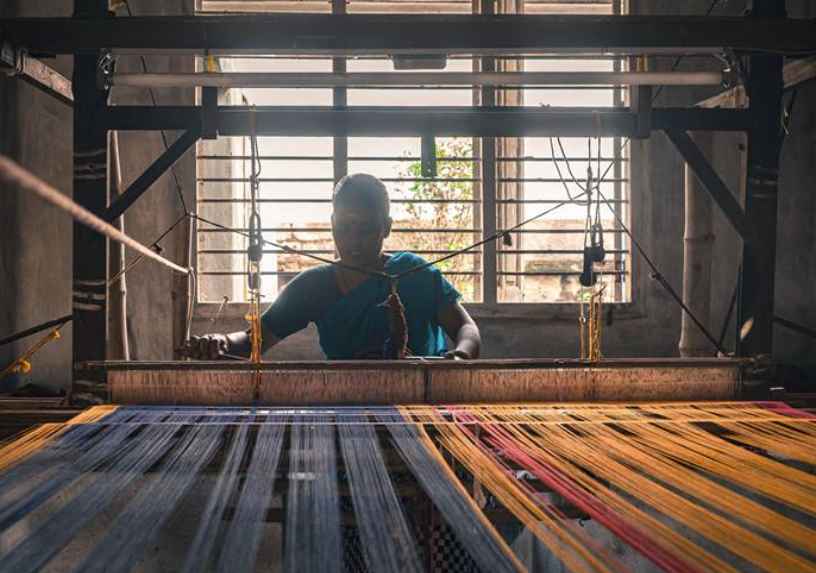
Note. Woman weaving a traditional saree in Chettinad, Tamil Nadu. Photograph by RidahZ (2019), Wikimedia Commons, licensed under CC BY-SA 4.0.
Figure 1
Key Highlights
- India’s handloom sector employs over 3.5 million people, with women comprising about 72% of the workforce and most weaving households located in rural areas.
- Innovation should preserve traditional craftsmanship while improving product design, ergonomics, sustainability, and quality.
- Digital marketing enables artisans to reach wider markets through storytelling, social media, e-commerce, and transparent product information.
- Entrepreneurship empowers artisans to capture greater value through branding, pricing, collective enterprises, and better market decisions.
- Women-led producer groups, youth engagement, digital literacy, and shared service centres are essential for sustainable growth.
- Challenges include digital exclusion, finance, logistics, platform dependence, and protection of authentic handloom products.
- The paper proposes an integrated framework linking innovation, digital marketing, entrepreneurship, and institutional support to improve livelihoods.
Conclusion
The study concludes that digitalisation alone cannot transform rural livelihoods. Sustainable progress depends on combining heritage-compatible innovation, effective digital marketing, entrepreneurship, institutional support, and women-centred development so artisans receive a fair share of the value they create.
References
- Banerjee, A., & Mazzarella, F. (2022). Designing innovative craft enterprises in India: A framework for change makers. She Ji: The Journal of Design, Economics, and Innovation, 8(2), 192–216. https://doi.org/10.1016/j.sheji.2022.04.001
- Hasanah, U., Sukoco, B. M., & Supriharyanti, E. (2023). Fifty years of artisan entrepreneurship: A systematic literature review. Journal of Innovation and Entrepreneurship, 12, Article 55. https://doi.org/10.1186/s13731-023-00308-w
- Hazarika, B., & Goswami, K. (2016). Do home-based micro-entrepreneurial earnings empower rural women? Evidence from the handloom sector in Assam. Asian Journal of Women’s Studies, 22(3), 289–317. https://doi.org/10.1080/12259276.2016.1205376
- Hazarika, B., & Goswami, K. (2018). Micro-entrepreneurship development in the handloom industry: An empirical analysis among the tribal women in Assam. International Journal of Rural Management, 14(1), 22–38. https://doi.org/10.1177/0973005218754437
- Khurana, R., & Gupta, R. (2025). Digital entrepreneurship by women in handloom fashion: A qualitative case-based study. Academy of Marketing Studies Journal, 29(2), 1–10.
- Majumdar, B., Basu, S., & Jain, S. (2021). Digital empowerment and Indian handlooms: Case-based policy recommendations. Economic & Political Weekly, 56(8), 52–59. https://www.defindia.org/wp-content/uploads/2021/04/Digital-Empowerment-and-Indian-Handlooms.pdf
- Ministry of Textiles, Government of India. (2019). Fourth All India Handloom Census 2019–20. Office of the Development Commissioner (Handlooms). https://handlooms.nic.in/assets/img/Statistics/3736.pdf


