The global textile logistics market is rapidly emerging as a crucial pillar of the apparel and textile supply chain, supporting an industry expected to exceed USD 2.28 trillion in textile production by 2026. The logistics ecosystem, which includes transportation, warehousing, packaging, and inventory management, has expanded significantly due to the globalisation of textile manufacturing and the rapid growth of e-commerce apparel retail.
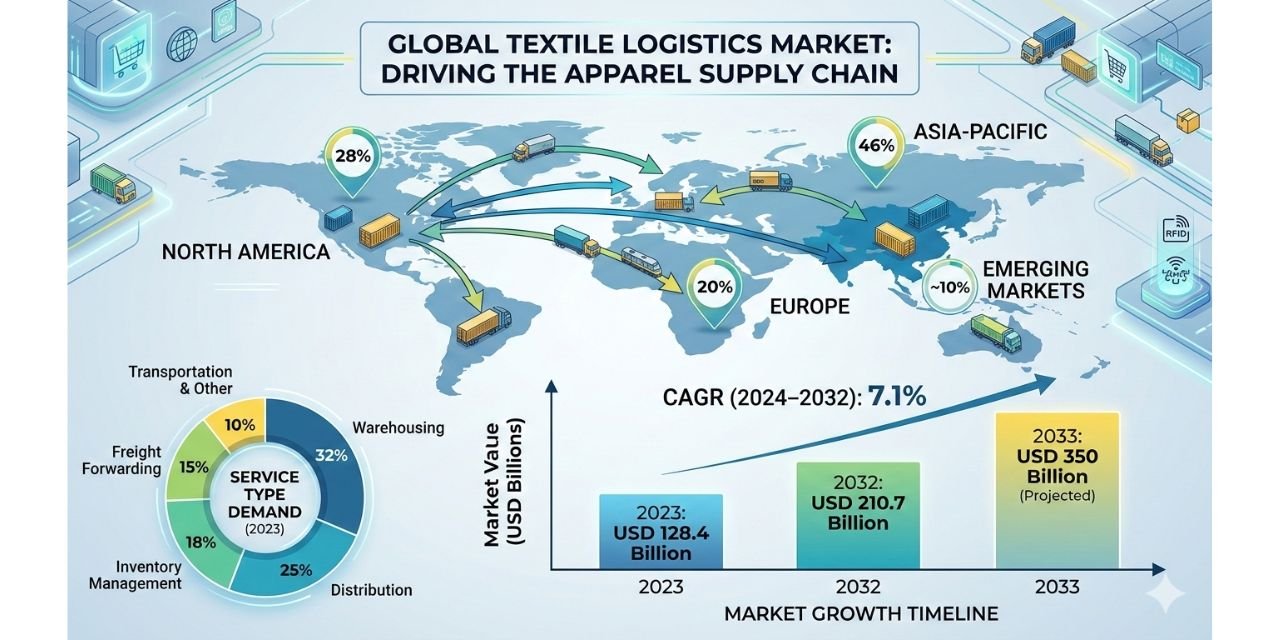
According to industry analysis by Marketintelo, the global textile logistics market was valued at USD 128.4 billion in 2023 and is expected to reach USD 210.7 billion by 2032, growing at a compound annual growth rate (CAGR) of 7.1 percent from 2024 to 2032. As global apparel trade and online retail continue to accelerate, logistics providers are investing heavily in automated warehouses, digital tracking technologies, and multimodal transportation networks.
Key Statistics Highlighting Market Expansion
Several key figures underline the scale and complexity of the textile logistics ecosystem:
-
Global textile logistics market reached USD 128.4 billion in 2023
-
Expected to grow to USD 210.7 billion by 2032
-
Forecast CAGR of 7.1 percent between 2024 and 2032
-
Apparel and garment shipments account for 61 percent of logistics demand
-
Asia-Pacific holds approximately 46 percent of global textile logistics volume
-
Global textile exports increased 22 percent between 2020 and 2023
-
E-commerce apparel logistics grew 34 percent from 2021 to 2024
-
Warehousing automation adoption increased 18 percent year-on-year in 2024
These numbers reflect the growing complexity of apparel supply chains as manufacturers and retailers adopt more digital and integrated logistics systems.
Historical Market Performance
The textile logistics sector has witnessed steady expansion over the past decade, closely aligned with the growth of global textile manufacturing and international trade.
Between 2016 and 2020, global apparel exports rose by more than 18 percent, encouraging significant investments in specialised textile warehousing and climate-controlled storage facilities.
Market Timeline
| Year | Global Textile Logistics Market Value |
|---|---|
| 2018 | USD 185 Billion |
| 2019 | USD 195 Billion |
| 2020 | USD 180 Billion (pandemic impact) |
| 2021 | USD 210 Billion |
| 2022 | USD 228 Billion |
| 2023 | ~USD 235 Billion |
| 2024 | ~USD 200–210 Billion |
The COVID-19 pandemic in 2020 temporarily reduced global textile shipments by 8–12 percent, disrupting supply chains and retail demand. However, recovery was swift as online apparel sales surged by more than 25 percent between 2020 and 2022.
Year-on-Year Growth Trends
Despite market disruptions, the textile logistics sector has shown strong resilience.
-
2020–2021: Market rebounded from USD 180B to USD 210B, a 16.7 percent increase
-
2021–2022: Growth of 8.6 percent, reaching USD 228B
-
2022–2023: Demand increased by 3–4 percent due to e-commerce expansion
-
2023–2024: Over USD 350 million invested in smart conveyor infrastructure in major textile manufacturing hubs
Automation, improved supply chain visibility, and integrated logistics platforms have been the main drivers behind this growth.
Regional Market Analysis
Asia-Pacific
Asia-Pacific dominates the textile logistics market, accounting for roughly 45 percent of global revenue in 2024.
Major growth drivers include:
-
Large-scale textile production in China, India, Bangladesh, and Vietnam
-
Strong export-oriented apparel manufacturing
-
Rapid adoption of digital logistics platforms
China represents more than 55 percent of Asia-Pacific textile logistics activity, while India holds around 68 percent of the South Asian market share. The region also operates over 12,500 automated conveyor systems in textile facilities, highlighting extensive logistics modernisation.
North America
North America accounts for approximately 28 percent of global textile logistics revenue.
Key factors supporting growth include:
-
High demand for e-commerce apparel distribution
-
Adoption of RFID tracking technologies
-
Advanced warehouse automation systems
The United States controls nearly 85 percent of the North American textile services market, reflecting its strong apparel distribution networks.
Europe
Europe represents about 20 percent of global textile logistics revenue, driven by fashion hubs in Germany, Italy, France, and the United Kingdom.
Key regional developments include:
-
Germany accounting for 22 percent of European textile services activity
-
Investments in sustainable logistics technologies rising by more than 30 percent since 2021
The region’s logistics infrastructure focuses heavily on cross-border distribution within the EU single market.
Emerging Markets
Emerging regions are also experiencing steady expansion:
-
Latin America: approximately 8–10 percent market share
-
Middle East and Africa: around 7–9 percent share
-
Oceania: smaller market with 92 percent of activity concentrated in Australia and New Zealand
These regions are expected to record CAGR above 6 percent through 2030 as textile manufacturing gradually shifts toward cost-efficient production hubs.
Service Segment Analysis
Textile logistics operations consist of several service segments that support the movement of textiles from factories to retail outlets.
Service Share by Type (2023)
-
Warehousing – 32 percent
-
Distribution – 25 percent
-
Inventory management – 18 percent
-
Freight forwarding – 15 percent
-
Transportation and other services – 10 percent
Warehousing is projected to be the fastest-growing segment, particularly due to rising inventory volumes in apparel distribution centres and the expansion of omnichannel retail.
Corporate Expansion and Industry Investments
Major logistics providers are expanding their capabilities to capture the growing demand for textile logistics services. Leading companies include:
-
DHL Supply Chain
-
DB Schenker
-
Kuehne + Nagel
-
CEVA Logistics
-
FedEx Logistics
Key industry trends include:
-
Logistics firms investing USD 1–3 billion annually in digital supply chain platforms
-
Warehouse automation adoption increasing by more than 40 percent since 2019
-
AI-driven logistics analytics improving shipment efficiency by 15–25 percent
In addition, blockchain-based tracking systems are being tested to reduce supply chain delays by nearly 20 percent.
Technology Transforming Textile Logistics
Technological innovation is significantly reshaping textile logistics operations.
RFID and IoT Tracking
Improves inventory accuracy from 65 percent to over 95 percent in apparel warehouses.
Automated Storage Systems
Robotics deployment can reduce labour costs by 25–35 percent.
AI-Based Demand Forecasting
Advanced analytics helps minimise stockouts by 15–20 percent.
Sustainable Transportation
Electric and low-emission vehicles can reduce logistics-related emissions by up to 30 percent.
These technologies are enabling faster, more transparent, and more efficient textile supply chains.
Future Market Outlook (2025–2033)
The long-term outlook for textile logistics remains highly positive as global apparel trade continues to expand.
| Year | Projected Market Value |
|---|---|
| 2025 | USD 215 Billion |
| 2027 | USD 255 Billion |
| 2030 | USD 300 Billion |
| 2033 | USD 350 Billion |
By 2033, the market is expected to expand by nearly 75 percent compared with 2022 levels.
Key drivers include:
-
Rising e-commerce apparel shipments
-
Expansion of global textile exports
-
Adoption of digital logistics platforms
-
Rapid growth of fast-fashion supply chains
Conclusion
The textile logistics market is becoming a strategic infrastructure component of the global apparel industry. From USD 228 billion in 2022, the market is expected to reach USD 350 billion by 2033, growing at a CAGR of 5.5 percent.
Asia-Pacific remains the dominant region with approximately 45 percent market share, followed by North America (28 percent) and Europe (20 percent). Warehousing leads the service segment with 32 percent share, while apparel manufacturers account for nearly half of logistics utilisation.
With increasing investments in AI, automation, and smart warehousing, the textile logistics sector will continue evolving toward highly digitised and integrated global supply chains. As global textile production moves closer to USD 4 trillion by 2034, logistics infrastructure will play an even more critical role in supporting international apparel trade.