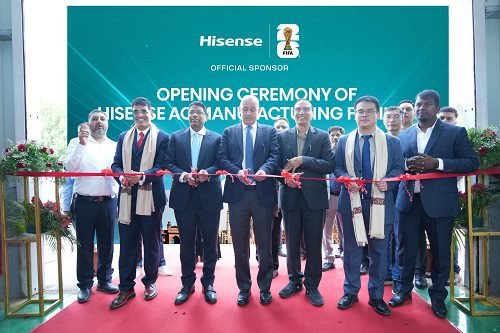
Hisense has opened its first Hisense India manufacturing plant in Sri City, Andhra Pradesh. The company partnered with Epack Manufacturing Technologies Private Limited (EMTPL) for this project. EMTPL is a wholly owned subsidiary of Epack Durable Limited (EDL).
This new facility marks an important milestone in Hisense’s India expansion. It also strengthens the company’s commitment to the Government of India’s Make in India initiative.
Hisense Invests Over $30 Million in Sri City
The new Hisense factory occupies a 10-acre campus inside EDL’s industrial park at Sri City. It stands alongside EDL’s existing ODM manufacturing plant.
Hisense and its partners invested more than USD 30 million in this project. The facility will strengthen local manufacturing and expand the company’s supply chain in India.
The plant will begin commercial production in February 2026. Initially, it will focus exclusively on Room Air Conditioners (RAC). It will handle 100% of Hisense India’s RAC production.
Phase 1: Hisense Air Conditioner Manufacturing
The company has already started pilot production at the Sri City facility. Phase 1 focuses on manufacturing Room Air Conditioners.
The plant will produce several models from Hisense’s global AC portfolio, including:
- F-Series
- Eco Series
- Intelli Perla Series
- Upcoming Intelli Pro Series
The first phase will deliver an annual production capacity of 0.75 million RAC units.
As a result, Hisense can strengthen its local supply chain. It can also improve product availability across the Indian market.
Phase 2: Washing Machine Production
Hisense plans to launch Phase 2 in Q2 FY27. This expansion will introduce washing machine manufacturing at the Sri City plant.
The facility will produce both top-load and front-load washing machines. This move will help Hisense expand its home appliances portfolio in India.
Phase 3: LED Television Manufacturing
The company plans to launch Phase 3 in Q3 FY27. This phase will introduce LED television production.
Consequently, the Sri City facility will support a wider range of consumer electronics and home appliances. It will also strengthen Hisense’s long-term manufacturing strategy.
Hisense Plant to Create Nearly 1,500 Jobs
The factory currently employs around 500 people. However, Hisense expects its workforce to grow over the next 12–24 months.
The company aims to create nearly 1,500 jobs as operations expand. Recruitment has already started across several departments.
These opportunities include:
- Supply chain
- Finance
- Administration
- Technical operations
- Skilled manufacturing
Furthermore, the expansion will support employment and industrial development in Andhra Pradesh.
Boosting Local Manufacturing and Exports
The Hisense India manufacturing plant will serve domestic and international markets.
Local production will help the company distribute products faster. It will also improve supply-chain efficiency and reduce import dependence.
Additionally, local manufacturing can improve cost efficiency. This will support more competitive pricing in India’s growing consumer durables market.
Sri City offers several advantages for large-scale manufacturing. The industrial hub hosts global and domestic companies across electronics, automotive and industrial sectors.
Therefore, Hisense can benefit from an established manufacturing and export ecosystem.
Hisense India CEO Highlights the Importance of Local Manufacturing
Pankaj Rana, CEO of Hisense India, highlighted the importance of the new facility.
He said:
“The new facility represents a pivotal step in Hisense’s evolution in India. Sri City allows us to strengthen our local production capabilities while aligning closely with the Make in India mission. This plant enables us to deepen control over quality, cost, and supply chains, while creating a strong platform to scale operations and customize products for Indian consumers. It reinforces our intent to build a locally rooted, manufacturing-led organisation in India.”
Epack Durable Welcomes the Partnership
Ajay Singhania, Managing Director and CEO of Epack Durable, also welcomed the collaboration.
He said:
“We at Epack Durable are proud to have partnered with Hisense India on its first manufacturing venture in India. This facility is a strong embodiment of the collaboration between Hisense’s technology and Epack Durable’s technical expertise in consumer durables. Adhering to global manufacturing standards, this facility will showcase India’s production capabilities and strengthen the country’s position as a preferred partner for global companies planning long-term expansion.”
Hisense Strengthens Its Manufacturing Presence in India
Before this investment, Hisense India relied on imports and manufacturing partners to serve customers.
Now, the Sri City facility marks a shift towards a more integrated local manufacturing model.
The new plant gives Hisense greater control over production, quality and supply chains. Moreover, its phased expansion will support future growth.
The company will evaluate further investments based on market demand and business performance.
About Hisense
Hisense India operates as a wholly owned subsidiary of Hisense Group. The global company specialises in consumer electronics and home appliances.
Its product portfolio includes:
- Televisions
- Air conditioners
- Refrigerators
- Washing machines
Today, Hisense operates in more than 160 countries.
According to Omdia data covering 2023 through Q3 2025, Hisense maintained its No. 1 global position in the 100-inch-and-above TV segment for consecutive years.
The company also identifies itself as the Origin of RGB MiniLED. It continues to develop next-generation display technologies.
Furthermore, Hisense serves as an official sponsor of the FIFA World Cup 2026™. This partnership strengthens its global sports marketing presence.
In February 2026, Hisense inaugurated its first manufacturing facility in India at Sri City, Andhra Pradesh. The investment reinforces its commitment to the Make in India initiative.
Meanwhile, the company continues to expand its offline retail network across India. It works with retail partners to improve customer access and after-sales services.