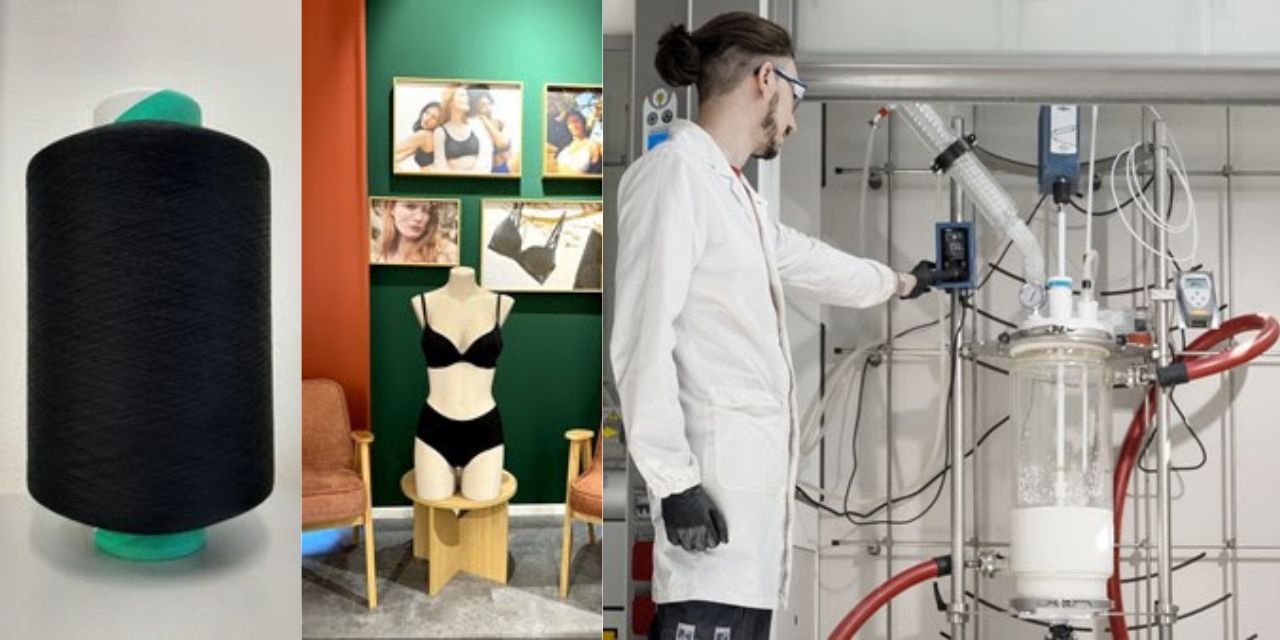
RadiciGroup, The LYCRA Company and Triumph have achieved a major breakthrough in circular fashion by successfully recycling mixed-fibre garments. The partners have demonstrated an economically and environmentally viable process that converts textile waste into a fully recycled lingerie set made from nylon and LYCRA® fibre.
Overcoming a Long-Standing Industry Challenge
Recycling garments made from blended fibres has remained one of the textile industry’s most complex challenges. Until now, the lack of effective separation technologies meant these products often ended up in landfills or incineration. However, Radici InNova, the research and innovation division of RadiciGroup, has developed a patented selective dissolution process that changes this reality.
This technology processes mixed textile waste such as swimwear, tights and leggings. It successfully separates and recovers both nylon and LYCRA® fibre, allowing them to be reused in new garment production.
Sustainable and Scalable Recycling Technology
The newly developed process uses non-toxic, non-flammable and environmentally compatible solvents. It works with the main nylon types, PA6 and PA66. Importantly, the system remains economically viable because it recovers nylon, LYCRA® fibre and the solvent itself, regardless of fibre ratios in the original fabric.
Collaboration Validates Closed-Loop Production
The partnership with The LYCRA Company and Triumph played a key role in validating the technology. Using recovered fibres, the collaborators produced a coordinated lingerie set made entirely from recycled materials.
“Thanks to this project, textile recycling enters a new dimension, demonstrating for the first time that it is possible to recover fibers from mixed fabrics and reuse them to produce new garments. This is an unprecedented innovation that opens up revolutionary development opportunities for the textile industry. As RadiciGroup, we are proud to have conceived and achieved this important milestone together with our partners, and we are ready to take the next steps,” said Stefano Alini, CEO of Radici InNova.
LYCRA® Fibre Retains Performance After Recycling
The project also confirmed that recycled elastane can maintain its performance qualities. Tests showed that LYCRA® fibre retains stretch, recovery and comfort even after reintegration into the spinning cycle.
“This innovative project highlights the role that elastane can have in helping to advance circularity in the apparel industry. Working closely with Radici InNova and Triumph, The LYCRA Company has demonstrated that LYCRA® fibres can retain their renowned stretch and recovery performance — providing comfort, fit and ease of movement — even when reintegrated into the spinning cycle,” commented Nicholas Kurland, Product Development Director, Advanced Concepts, The LYCRA Company.
From Textile Waste to New Lingerie
The initiative began four years ago with research into separating mixed textile fibres. After successful laboratory trials, Triumph supplied production surplus fabric containing 16 percent LYCRA® fibre. Radici InNova recovered both nylon and LYCRA® fibre from the material.
The LYCRA® fibre was re-spun by The LYCRA Company, while RadiciGroup transformed the recycled nylon into Renycle® yarn. Together, these yarns were used to produce a 60-metre fabric, which Triumph then converted into a bra and briefs set. This outcome clearly demonstrates a closed-loop process from waste to finished garment.
Laying the Groundwork for Industrial Scale-Up
At this stage, the lingerie set serves as a prototype designed to prove technical feasibility. However, it also establishes a strong foundation for future industrialisation and wider market adoption.
“Although still in its early stages, Triumph is proud to contribute to this pioneering initiative and to explore the potential of this innovative recycling technology for future applications. Our next step will focus on developing a capsule collection, while also working on solutions to ensure product identification, traceability and circularity systems, so that garments can remain in use for as long as possible and, once they reach the end of their life, can be recycled in the most appropriate way. At Triumph, we are committed to promoting innovation and collaboration in the field of sustainability. Being part of this project strengthens our belief that circularity for garments made from mixed textile fibers is possible, and we are proud to help turn this vision into reality,” said Vera Galarza, Global Head of Sustainability, Triumph.