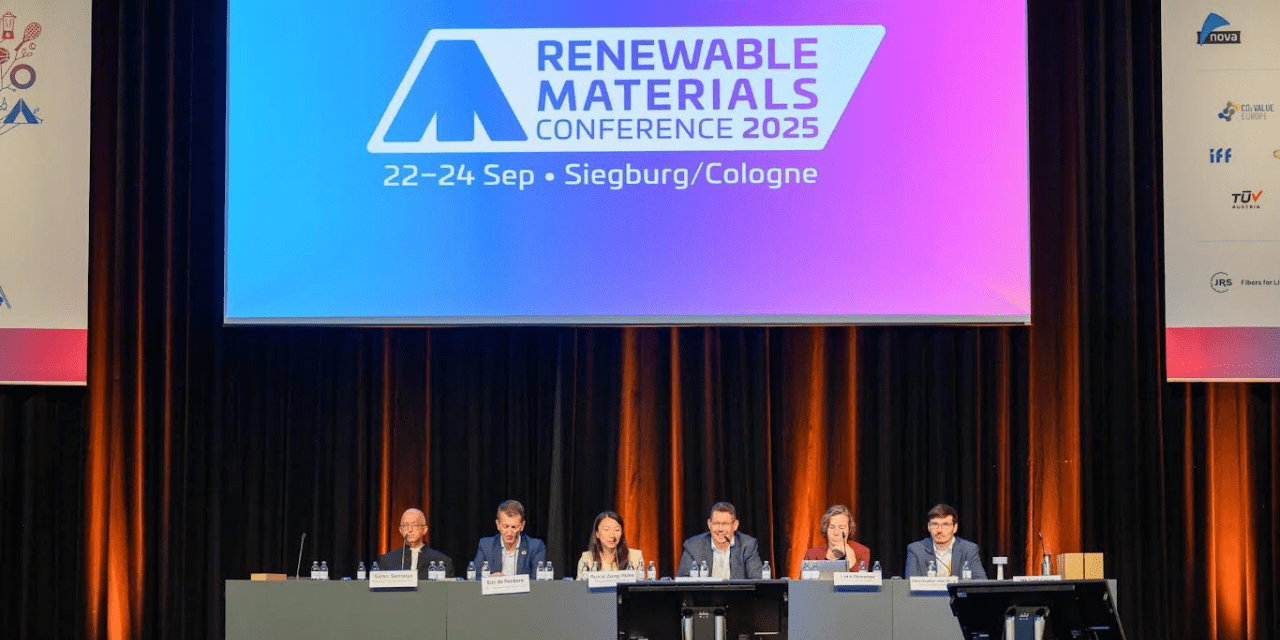
The Renewable Materials Conference (RMC) returns from 22–24 September 2026 in Siegburg/Cologne, Germany, continuing its rise as a major international meeting point for innovators, brands, investors and policymakers. Over the past few years, the event has grown steadily, and the organiser nova-Institute expects 400–500 attendees once again.
Why Defossilisation Matters Now
Fossil-resource extraction remains the largest driver of climate change, contributing to 90 percent of human-made greenhouse gas emissions. While the energy sector moves toward decarbonisation, the chemical and plastics industries face a deeper question: can they reach climate neutrality without phasing out fossil feedstocks?
Increasing global pressure, evolving policy frameworks and investor expectations have pushed defossilisation to the forefront. This shift replaces fossil carbon with renewable carbon from biomass, CO₂ and recycling. As a result, companies gain stronger long-term competitiveness, maintain market access and align with future regulatory demands.
At RMC 2026, organisations will explore how to remain future-ready by addressing key concerns such as:
– maintaining competitiveness while defossilising,
– meeting rising demand for fossil-free plastics,
– building sustainable carbon cycles, and
– understanding the role of biodegradation in a circular economy.
Three Days of Insight, Solutions and Collaboration
The conference will deliver expert-led presentations, hands-on workshops, poster sessions and a curated tabletop exhibition. Additionally, participants can vote for the “Renewable Material of the Year 2026” award, sponsored by Covestro (DE).
Conference Themes: Defossilisation Through Innovation
22 September – Transforming the Chemical Industry
The first day explores alternative naphtha, biorefineries, carbon capture and utilisation (CCU), waste valorisation and chemical recycling. It also highlights renewable feedstocks and circular systems. The sessions conclude with a high-level panel on “Competitiveness and Strategic Autonomy.”
23 September – Accelerating Fossil-Free Plastics
The second day focuses on more than 20 commercially available polymers made from biomass, CO₂ and chemical recycling. These solutions support packaging, textiles, automotive, consumer goods and several other sectors. The day ends with voting for the Innovation Award 2026.
24 September – Policy, Frameworks and Regenerative Models
The final day covers policy shifts, market expectations and emerging business models essential for a renewable carbon future. A dedicated segment examines scientific and regulatory developments in biodegradation, highlighting its growing relevance in circular systems.
Registration, Submissions and Key Dates
Registrations, exhibition bookings, and award submissions are now open.
Early Bird Discounts
-
20% discount available until 15 March 2026
-
10% discount available until 16 August 2026
Important Deadlines
-
Abstract submission: 16 March 2026
-
Innovation Award submission: 3 May 2026
Full details are available at www.renewable-materials.eu.
Information on sponsorship, workshops, exhibitions and advertising can be found in the Service Package 2026.
Video highlights from past editions and additional insights are also accessible online.