EU’s Extended Producer Responsibility (EPR) Law and Its Implications for India’s Textile Industry
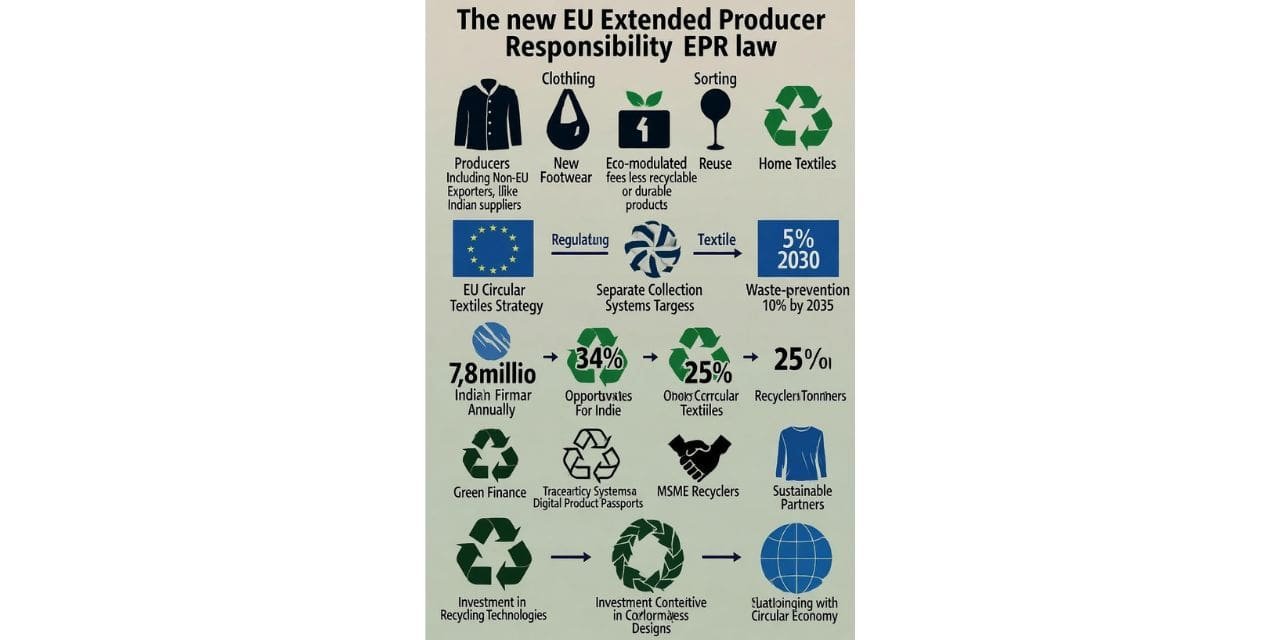
The European Union (EU) has approved a new Extended Producer Responsibility (EPR) framework for textiles, marking a major regulatory shift. This law makes fashion brands and producers accountable for their products’ entire lifecycle — from design and production through collection, sorting, recycling, and disposal. Notably, both EU-based producers and non-EU exporters supplying the EU market will face these obligations. For India’s fashion exporters, recyclers, policymakers, and investors, this development presents both challenges and opportunities.
Key Features of the Law
The EU textile EPR framework covers:
-
Clothing, footwear, and home textiles.
-
Producers (including importers into the EU) must finance the costs of collection, sorting, reuse, and recycling of their products.
-
Eco-modulated fees: higher levies will apply to products that are less recyclable, less durable, or designed for ultra-fast fashion.
-
Each EU Member State must implement a national EPR scheme within 18–30 months after adoption.
-
The initiative extends the existing waste-management, separate-collection, and product-design rules to textiles.
-
New obligations include separate collection of textiles for the first time and binding waste-prevention targets (e.g., 5% by 2030, 10% by 2035).
In short, producers exporting or selling to the EU will face additional regulatory requirements involving costs, administrative tasks, data tracking, material design, and end-of-life responsibilities.
Why This Matters for India
India occupies a strategic position in global textile supply chains. Its export-oriented, labor-intensive industry is now facing new pressures from circular-economy standards.
Export Exposure to the EU
India is a major exporter of apparel and home textiles to the EU. Recent data indicates that India’s textile and apparel exports to the EU account for a large portion of its outbound shipments (combined share to the USA and EU is around 47%). Consequently, EU regulatory changes will directly impact Indian suppliers, who must factor them into business strategies.
Textile Waste and Circularity Challenge
India generates approximately 7.8 million tonnes of textile waste annually, roughly 8.5% of the global total. Of this, only 34% is reused through repair or repurposing, and about 25% is recycled into yarn. The remaining 41% is down-cycled (19%), incinerated (5%), or sent to landfill (17%). Thus, aligning with circular practices is no longer optional for exporters.
Compliance Risk and Market Access
For Indian exporters, non-compliance with EU EPR requirements could lead to higher costs, administrative complexity, and even reduced market access. Since the EU remains one of India’s largest textile export destinations, ignoring the regulation could pose significant risks.
Competitive Advantage Shift
As regulatory burdens rise, firms that proactively adopt circular-economy principles — designing for durability, using recycled content, implementing take-back schemes, and generating product lifecycle data — may gain a competitive edge. Conversely, those that lag could face cost pressures and regulatory challenges.
Opportunities for India
While the EPR law imposes obligations, it also opens strategic opportunities:
-
Green Finance and Investment Mobilisation
The transition to a circular textile economy will require significant investments in collection infrastructure, sorting systems, recycling technologies (mechanical and chemical), digital traceability, and product design. Indian stakeholders, including industry, government, and investors, can leverage green financing, blended-finance models, and sustainability-linked loans. For example, existing recycling units can upgrade to fibre-to-fibre recycling, attracting international investment from private equity and impact funds. -
Strengthening Traceability and Transparency
The EU regulation requires tracking products across their lifecycle — from design to end-of-life collection and recycling. Indian manufacturers should invest in Digital Product Passports, blockchain, or other traceability mechanisms to satisfy brand requirements and regulatory scrutiny. By doing so, Indian firms can differentiate themselves and preempt similar global standards. -
Fostering MSME and Startup Ecosystems
Many Indian textile clusters are MSME-driven. These enterprises can participate in circular transformation by converting textile waste into new fibres, accessories, or upcycled products. Additionally, they can provide collection, sorting, and modular recycling services. Capacity-building and innovation support will help create a large supply chain for recycled feedstock, yielding higher margins with lower input risks. -
Aligning India’s EPR Policy with the EU Green Deal
India can use the EU regulatory shift as a catalyst to accelerate national policies on textile waste, circular economy, traceability, and sustainable production. By aligning with global standards, India will better prepare exporters for EU rules and position itself as a globally competitive, circular-textile manufacturing hub. -
Value-Chain Upgrade and Differentiation
Shifting from commodity textiles to higher-margin, circular-economy-aligned products offers differentiation. Specifically, manufacturers adopting recycled fibres, certifying sustainable production, and integrating take-back models can serve Europe’s rising demand for sustainable fashion. Meanwhile, low-cost, high-volume fast-fashion suppliers may face increasing costs under eco-modulated fees.
Implications for Stakeholders
Industry (Exporters, Brands, Manufacturers)
-
Integrate full lifecycle costs into business models, including collection, sorting, and recycling fees.
-
Shift material and product design to enhance durability, repairability, and recyclability.
-
Establish or collaborate on collection and return logistics in the EU.
-
Invest in digital systems, product passports, and blockchain for data and traceability.
-
Conduct risk and opportunity audits to identify high-fee product lines and adjust strategies.
-
Collaborate with domestic recyclers and startups to create internal circular loops.
Investors and Financial Institutions
-
Identify opportunities in collection infrastructure, textile-waste recycling, traceability systems, and circular-product brands.
-
Design blended-finance models to manage systemic transformation risks.
-
Consider regulatory risk in valuation for exporters exposed to EU markets.
-
Support capacity-building and innovation in MSMEs for long-term gains.
Policymakers and Industry Bodies
-
Develop a national textile-waste policy aligned with EU rules.
-
Incentivize circular-economy infrastructure, recycling units, and skill development.
-
Align trade policy with sustainability and export compliance requirements.
-
Facilitate public-private partnerships for take-back schemes, reverse logistics, and digital platforms.
-
Build awareness and capacity among MSMEs for compliance readiness.
Key Challenges and Mitigation
-
Fragmented Supply Chain and MSME Intensity
Many Indian MSMEs may struggle with EPR compliance due to data and lifecycle-management demands. Mitigation: Develop cluster-based shared compliance platforms, recycling hubs, and pooled take-back systems. -
Quality of Recycled Feedstock and Technology Gap
India’s mechanical recycling produces lower-value products, insufficient for EU standards. Mitigation: Encourage collaborations with global recycling tech providers and invest in higher-grade mechanical and chemical recycling. -
Traceability and Data Systems
Smaller firms may lack systems to track products across tiers. Mitigation: Build common digital platforms, adopt industry-wide standards, and aggregate cluster-level data. -
Cost Absorption and Margin Pressure
EPR may raise costs through fees and infrastructure investments. Mitigation: Pass costs strategically, collaborate with buyers, and focus on higher-value production. -
Timeframe and Regulatory Uncertainty
EU Member States may implement different EPR schemes. Mitigation: Develop flexible compliance mechanisms and centralised oversight. -
Consumer Behavior and Reverse-Logistics
Collection rates in Europe may be low. Mitigation: Partner with EU collection/sorting providers, integrate take-back models, and explore reuse/resale strategies.
Strategic Roadmap for India
Short-term (0–18 months)
-
Conduct compliance gap analysis for Indian exporters.
-
Launch awareness and training programmes on EU EPR and circular practices.
-
Pilot collaborations between manufacturers and domestic recyclers/startups.
-
Engage European buyers on take-back and reverse-logistics expectations.
-
Develop a national roadmap for India’s EPR framework.
Medium-term (18–36 months)
-
Invest in traceability systems and digital product passports.
-
Scale recycling infrastructure with upgraded mechanical/chemical units.
-
Launch circular-product lines for export with take-back programs.
-
Establish cooperation frameworks with European PROs.
-
Leverage green finance for infrastructure, technology, and MSME capacity building.
Long-term (36+ months)
-
Consolidate India as a globally competitive circular textile hub.
-
Explore cross-border circular loops for recycled feedstock.
-
Fully operational national EPR framework aligned with global standards.
-
Foster continuous innovation in upcycling, rental/resale, traceability, and sustainable materials.