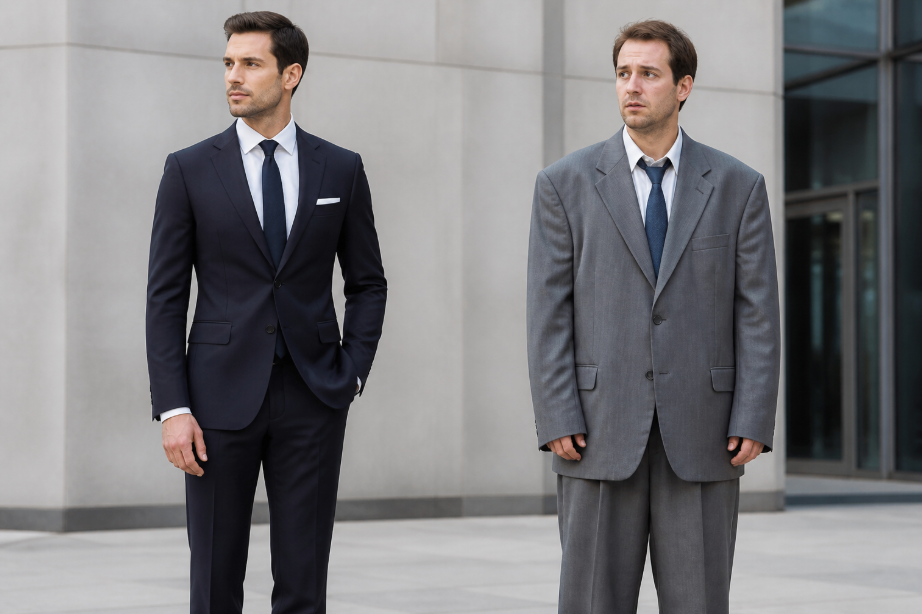
Picture two men walking into the same room. The first wears a modestly priced suit in a plain navy — no visible branding, no statement lining — but every line sits exactly where it should. The shoulders are clean, the chest closes without strain, and the trousers break neatly over his shoes. The second has spent considerably more on a suit that carries a well-known name, but the chest pulls at the button, the collar floats away from his neck, and the jacket sags slightly at the shoulders. Without being able to say precisely why, everyone in that room reads the first man as more composed, more credible, more in control.
This is the real question behind the tailored suit versus off-the-rack debate: is the extra time and expense of going bespoke actually what makes the difference, or is it something else? The answer is fit — not the label, not the fabric name, and certainly not the price tag visible to no one but you. This article unpacks what fit truly means, how observers subconsciously judge it, what separates a bespoke suit from a ready-made one, and when investing in a tailor like Patrick & Co will genuinely transform the impression you make.
Why the Fit of a Suit Communicates More Than Its Brand Label Ever Could
What proper suit fit really is — and what people read from it
Fit is not simply a question of size. A suit can carry the right chest measurement and still look wrong, because fit is really about proportion, balance and ease across your specific body: how the jacket sits on your shoulder bone, how the collar follows the back of your neck, how the waist and seat follow your natural lines, and how the whole garment moves with your posture rather than fighting it. A well-fitted suit creates a clean, sleek figure with no excess fabric pulling anywhere, which means it also resists creasing — the cloth simply has no reason to buckle or fold.
When those conditions are met, the effect on an observer is immediate, even if entirely subconscious. Clean lines — no divots at the shoulder, no lapels that bow away from the chest, no trouser hems gathering over the shoes — signal competence, self-respect and attention to detail. People cannot always articulate what they are responding to, but they respond to it within seconds of meeting you.
Poor fit broadcasts the opposite with equal efficiency. A collar that stands away from the neck makes the head appear to thrust forward, suggesting uncertainty rather than authority, while a chest that pulls at the button implies the wearer is uncomfortable, perhaps out of his depth. Sleeves that drown the hands, or excess fabric flapping at the back, read as careless or dated even on a brand-new suit. Nobody in the room sees the inside label, but everyone sees whether the suit appears to belong to you or to someone taller, shorter or broader — and they draw conclusions about your confidence and status on that basis.
Tailored suit vs off-the-rack: how they’re made, how they fit, how they age
Off-the-rack suits are mass-produced to a generic template in fixed sizes, designed to fit as many men as possible rather than any one man precisely. That is an inherently compromising brief. Even a well-chosen ready-made suit usually makes a trade-off somewhere: the chest may fit but the seat is tight, or the sleeve length is right but the shoulders collapse. Further alterations can improve things, but tailors are not magicians. Hems and sleeve length can be shortened or extended by small amounts, and mild waist suppression is usually manageable, but shoulder width, button stance, armhole height and overall jacket length are difficult or impossible to correct cleanly once the garment is cut. When you add the cost of substantial alterations to the purchase price, the financial case for off-the-rack can start to look less straightforward.
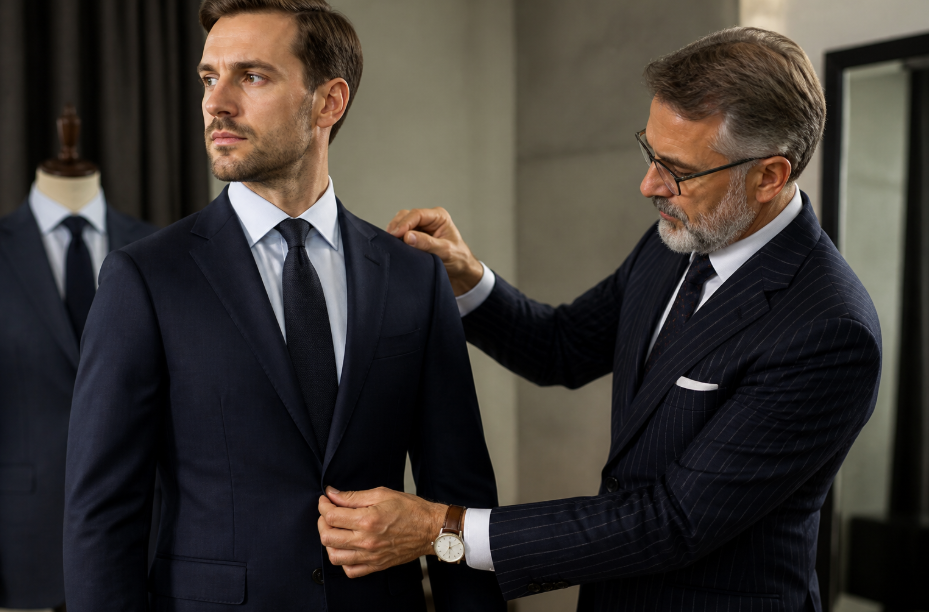
A bespoke or fully tailored suit starts from a completely different place. Rather than adapting your body to a stock block, the tailor takes detailed measurements and posture observations — noting whether one shoulder sits lower, whether you carry your weight forward, how long your torso is relative to your legs — and cuts a unique pattern from scratch. The result is a garment where the shoulder seam sits exactly at the edge of your shoulder bone, the collar hugs the back of your neck, the chest closes with ease, and the sleeve pitch follows the natural fall of your arm. Because the cloth is not fighting your shape, it also wears better over time: a well-cut suit in quality cloth moulds gently to you, whereas a compromised fit off the peg tends to crease where the body meets resistance, looking tired well before its time. When fit is built around your own measurements and posture rather than a generic block, a tailored suit will always outperform one bought off the rack in both appearance and longevity.
That said, honesty matters here. For a man whose proportions happen to be close to standard sizing, a carefully chosen ready-made suit with sensible alterations can look very good, particularly for infrequent use or lower-stakes occasions. Bespoke becomes transformative specifically when the body’s proportions, posture or the professional stakes make any compromise visible — and visible is the key word.
How good vs poor fit changes your perceived authority
Consider three scenarios: a board presentation, a job interview, your own wedding. In each one, imagine two men side by side. One is wearing a modestly priced suit that fits him precisely — clean shoulder line, a collar that sits against his neck, sleeves that show a centimetre of shirt cuff, trousers with a single neat break. The other has spent significantly more on a designer suit, but the chest buckles slightly at the button, the collar gaps, and the jacket sags at the back of the shoulder. Which man looks more senior? Which groom looks more at ease in the photographs that will exist for the next fifty years?
The answer is obvious, and the mechanism behind it is straightforward. What observers notice first, even if they do not register it consciously, is the shoulder line, the way the jacket closes, the length of the sleeve and the trouser. These details collectively read as calm, organised and in control. A gaping collar makes the head look forward and uncertain; a jacket that pulls at the button makes every movement slightly fussy, because the wearer is unconsciously accommodating a garment that does not accommodate him. Excess fabric at the back or pooling at the ankle introduces visual noise that distracts from the person wearing the suit.
The confidence question is also physical, not merely psychological. When a suit fits correctly, the wearer forgets about it. He stands naturally, sits without tugging the jacket, moves his arms without feeling resistance, and that ease reads as seniority and self-possession in a way no embroidered label ever could. In real rooms — boardrooms, courtrooms, reception lines — people remember whether you looked composed. They rarely remember, or even notice, which house stitched your inside pocket.
How good vs poor fit changes your perceived authority
A quick self-check: 6 ways to judge the fit of your current suit
Before deciding whether your existing suit is serving you well, run through these six checkpoints in a full-length mirror, with the jacket buttoned.
- Shoulders. The sleeve seam should sit exactly at the outermost edge of your shoulder bone — no further. If it hangs over and creates a dent or ridge down the upper arm, the jacket is too wide. If the fabric pulls upward and you see a ridge or divot on top of the shoulder, it is too narrow or the shoulder slope is wrong. This is the hardest fault to alter, so it matters most when buying.
- Collar. The jacket collar should rest flat against your shirt collar and the back of your neck with no visible gap and no bunching of cloth. A collar that stands away or rolls outward is immediately visible from behind and is very difficult to fix after the fact.
- Chest and waist. With the jacket buttoned, the fronts should lie flat. A gentle pull forming a very slight X at the button is acceptable; distinct strain lines radiating from the button toward the pockets, or lapels that bow away from the chest, indicate the chest or waist is too tight. Billowing fabric on either side means the opposite.
- Sleeve length. With your arms relaxed at your sides, the jacket sleeve should end at roughly the wrist bone, allowing around one centimetre of shirt cuff to show. More than that and the jacket looks short; less and the sleeve looks heavy and can visually shorten your hand.
- Trouser length. From the side, you want a single clean break where the front of the trouser just touches the shoe. Deep folds around the ankle or fabric pooling over the shoe look sloppy; no break at all can look deliberately cropped, which is a stylistic choice rather than a fit success unless you are going for that look intentionally.
- Seat and thigh. The cloth over your seat should be smooth when you stand, with no horizontal stress lines pulling under the pockets and no excessive sagging. Tightness here is uncomfortable and draws the eye; too much fabric bunches awkwardly and undermines an otherwise sharp silhouette.
When off-the-peg with alterations is enough — and when only bespoke will do
Off-the-rack plus sensible alterations is a perfectly reasonable approach in specific circumstances. If your proportions sit close to a standard size — meaning a good shoulder fit also gives you a workable chest and seat — then a well-chosen ready-made suit, with the hem and sleeve adjusted by a skilled local tailor, can look clean and appropriate for occasional wear or less formal professional settings. Speed and cost are genuine advantages when you need something quickly or wear a suit only a handful of times a year.
The case for bespoke becomes compelling, and often unavoidable, when any of the following apply. A significant drop between your chest and waist means standard suits either fit your shoulders and billow at the waist, or fit your waist and strain across the back. Very broad or narrow shoulders fall outside the range that stock patterns accommodate gracefully. A prominent seat, unusual height, or postural characteristics such as rounded shoulders or one shoulder sitting lower than the other will all produce visible compromises in a ready-made garment that no amount of hemming can resolve.
Professional context matters too. In client-facing roles, leadership positions, or fields such as law and finance where image directly signals competence, a suit that is chronically almost right can quietly work against you over months and years. A bespoke suit in that context is not an indulgence; it is a professional tool, in the same way a barrister invests in a quality brief or an architect in precise drafting instruments.
Then there are occasions where an excellent fit is not negotiable: your own wedding, a milestone event, a major speaking engagement. These are the moments that live in photographs and memories, and they deserve a suit that looks as though it was made specifically for you — because it was.
Patrick & Co approach this honestly. Their starting point is understanding where and how you will wear the suit, and they will tell you plainly whether what you already own can be improved with alterations or whether commissioning something new is the smarter move.
Making fit your signature: how a Patrick & Co commission raises your style authority
The bespoke process at Patrick & Co begins well before any cloth is cut. The first conversation is about how you actually live in a suit: where you wear it, how often, whether you spend most of the day seated in meetings or on your feet, what impression you need to make. That context shapes every decision that follows, from the structure of the jacket to the cut of the trouser.
From there, precise body measurements are taken alongside careful posture observations — the kind of detail that a stock pattern simply cannot capture. A unique pattern is then cut specifically for you, not adapted from a block designed for a notional average man. The early fitting checks the fundamental architecture: shoulder line, jacket length, the balance of the back. Later fittings refine the collar, waist, seat and sleeve, working until the garment moves cleanly with you whether you are sitting across a boardroom table, standing at a lectern, or on a dance floor at the end of a wedding evening.
One of the less-discussed advantages of this process is what happens next. Once your pattern exists and your preferences are understood, future commissions become more efficient, and you build a wardrobe of pieces that fit reliably and consistently, rather than a rail of suits that each require a different set of compromises.
The goal throughout is not visible luxury or ostentatious branding. It is the quiet authority that comes from wearing something built around your body and your life — which means you forget you are wearing it and simply get on with being present.
Start by running through the six fit checkpoints on the suit you wear most often. If the shoulders sit right and the collar lies flat, smart alterations may be all you need. If you spot two or more problems that fall outside what a tailor can easily fix, or if you have a significant occasion approaching, book a consultation with Patrick & Co. The difference between a suit that fits and one that was made for you is something you will feel in the first five minutes, and something everyone around you will read for years.