Tanvi Munjal
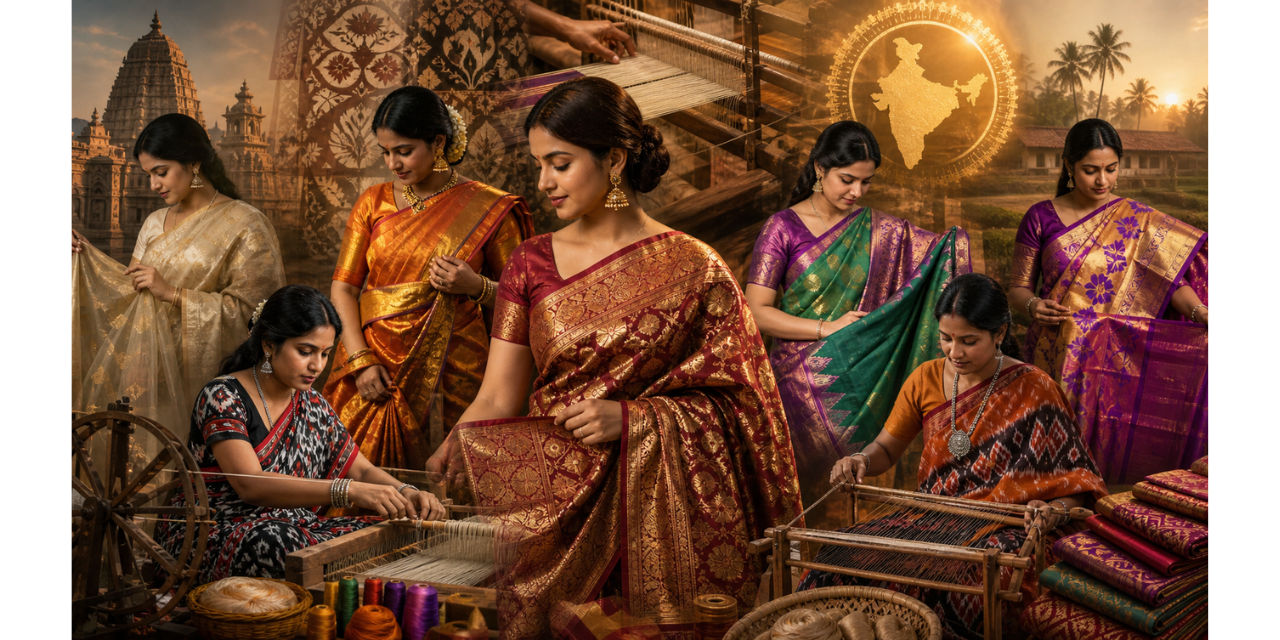
A weaver in Banaras spends weeks crafting a single saree. Every thread of intricate zari work is placed with precision, techniques passed down through generations. Yet, without a GI tag, that authentic creation often sells for the same price as machine-made imitations. This is the reality many traditional weavers face. But things are changing, slowly but decisively, through a two-word legal framework: Geographical Indication.
A GI tag is more than a sticker or a certificate. It is a legal seal that certifies a handloom product’s origin, authenticity, and the traditional methods used to create it. For Banarasi sarees, Kanjivaram silk, Sambalpuri ikat, and dozens of other handwoven treasures, a GI tag unlocks doors to premium markets, better prices, and the economic security weavers have long deserved. As of August 2026, 106 handloom products [1] across India carry registered GI status, protecting both heritage and livelihoods.
Understanding GI: The Basics
GI stands for Geographical Indication, a form of intellectual property protection governed by India’s Geographical Indications of Goods (Registration and Protection) Act, 1999. It recognises that certain products gain their unique character from their geographic origin and the traditional knowledge embedded in how they are made.
When a handloom receives GI registration, it means only producers from that specific geographic area, using defined traditional techniques, can legally use that product name. A Banarasi saree can only be called “Banarasi” if it is woven in the designated districts of Varanasi and its adjoining regions (Varanasi, Mirzapur, Chandauli, Bhadohi, Jaunpur and Azamgarh) using traditional brocade techniques. A Kanjivaram can only carry that name if it is made in Kanchipuram, Tamil Nadu, with the distinctive korvai method of interlocking borders.
This protection works internationally too. India is a signatory to the Paris Convention for the Protection of Industrial Property and the World Trade Organization’s TRIPS Agreement, meaning Indian GI products enjoy recognition in major export markets like the UK, Italy, UAE, and the USA.
The Numbers Tell the Story
The scale of GI handlooms in India is significant and growing:
| Handloom GI Products | Number | Key Detail |
| Total GI-registered handloom products | 106 | As of August 2026 |
| Registrations supported under Handloom Marketing Assistance (NHDP) | 53 | Direct government support |
| Total GI products across all sectors in India | 800+ | Handlooms represent ~13% |
| GI registrations granted since 2014 | 607 | Massive growth decade |
| Leading state in GI registrations | Uttar Pradesh | 81 products (as of Dec 2025) |
| Second highest state | Tamil Nadu | 76 products |
| Third highest | Maharashtra | 55 products |
Uttar Pradesh leads because of clusters like Varanasi (Banarasi sarees, brocades, meenakari work), Lucknow (chikankari embroidery), and others. Tamil Nadu’s strength lies in Kanchipuram silk sarees and other textile traditions. This concentration shows how GI builds on existing heritage clusters, turning local specialisation into legally protected assets.
Meet the Major GI Handlooms
Some of India’s most celebrated handloom traditions now carry GI protection:
Banarasi Saree (Uttar Pradesh)
The oldest and most recognisable. Created using the brocade technique where motifs are woven directly into fabric using supplementary weft. Varieties include pure silk Banarasi, meenakari (with colored silk), and organza. Weavers can spend weeks on a single saree. GI registration protects the name and ensures traditional methods remain central to production.
Kanjivaram Silk Saree (Tamil Nadu)
Woven in Kanchipuram for centuries, these sarees use pure mulberry silk with real gold-coated silver zari. The defining technique is “korvai”, where the border is woven separately then interlocked with the body. You can identify authentic Kanjivaram by the ridge visible on the reverse side. GI protected since 2005.
Sambalpuri Ikat (Odisha)
Made in western Odisha districts, Sambalpuri uses bandha ikat technique where both warp and weft threads are tie-dyed before weaving, creating characteristic blurred-edge patterns. Traditional motifs include shankha (conch), chakra (wheel), and phula (flower). The technique requires extraordinary precision.
Pochampalli Ikat (Telangana)
Woven near Hyderabad, Pochampalli also uses resist-dyeing but creates geometric diamond and chevron patterns. What makes it distinct is how dyed threads must align perfectly during weaving. The geometric precision is unmistakable, and each saree is uniquely aligned. GI registered in 2004.
Paithani Saree (Maharashtra)
From Paithan in Aurangabad, Paithani is famous for the tapestry-woven peacock motif in its pallu. Uses oblique interlocking weft technique, creating a double-sided appearance. Pure Paithani can take weeks to months to complete. GI protects sarees from Aurangabad and Nashik districts specifically.
Chanderi Saree (Madhya Pradesh)
Known for sheer, lightweight texture created by blending silk warp with cotton weft. This unusual combination gives Chanderi its characteristic translucency and fluid drape. Traditional motifs include coins, florals, and peacocks woven in fine zari. Both silk and cotton Chanderi variants are GI-protected.
Jamdani (West Bengal)
A discontinuous supplementary-weft technique in which motifs are manually inserted into a fine muslin base using fingertip and shuttle — pure handwork with no mechanical aids. Related Indian variants (including Tangail) carry GI protection. The traditional art of Jamdani weaving was inscribed by UNESCO as Intangible Cultural Heritage of Humanity in 2013 for Bangladesh.
Kota Doria (Rajasthan)
Defined by a distinctive square check pattern called “khat” created by alternating cotton and silk squares in warp and weft. Results in an extremely lightweight, breathable, semi-transparent fabric. Perfect for summer wear. GI registration in 2005.
| GI Handloom | State/Region | Key Technique |
| Banarasi | Varanasi region, UP | Brocade weaving with supplementary weft |
| Kanjivaram | Kanchipuram, TN | Korvai (interlocked borders) |
| Sambalpuri | Western Odisha | Bandha ikat (tie-dye) |
| Pochampalli | Pochampally (near Hyderabad), Telangana | Geometric ikat |
| Paithani | Aurangabad & Nashik, MH | Tapestry weaving with peacock motif |
| Chanderi | Madhya Pradesh | Silk-cotton blend with motif inlay |
| Jamdani | West Bengal | Manual supplementary weft insertion |
| Kota Doria | Rajasthan | Square check pattern |
Why GI Matters: Impact on Weavers
The numbers behind GI protection are compelling. According to the Ministry of Textiles, a GI tag can increase rural artisans’ incomes by 20 to 30 percent [1]. This is not theoretical. Real changes happen when protection kicks in.
Economic Benefits:
- Authentic GI-tagged handlooms command premium prices in domestic and international markets
- Weavers gain access to direct export opportunities previously blocked by middlemen
- Better bargaining power when buyers know the product’s legal status and authenticity
- Reduced competition from cheap machine-made imitations using the same names
Market Protection:
- GI prevents misuse of traditional product names by unscrupulous manufacturers
- “Banarasi-style” machine-made sarees cannot be sold as “Banarasi”
- Similar products made in other regions cannot claim origin from the protected geographic area
- Legal framework allows weavers to take action against counterfeits
Cultural Preservation:
- Forces producers to maintain traditional techniques and quality standards
- Younger generations see economic value in learning family trades
- Documentation of traditional methods ensures knowledge preservation
- Global recognition adds prestige to local crafts
Government Support: Making It Real
Government backing transforms GI from legal concept to practical livelihood tool. As of June 2026, structured support programs directly assist handloom GI products.
Financial Assistance Available:
The Ministry of Textiles provides support through multiple channels:
- Up to Rs 1.5 lakh for enforcing GI rights and legal protection
- Up to Rs 2 lakh under MSME Innovative Scheme for GI registration (100% reimbursement)
- Rs 5,000 crore allocated for PM Ekta Malls where GI products get dedicated retail space
- Direct financial assistance through National Handloom Development Programme (NHDP)
Market Access Initiatives:
- PM Ekta Malls (Unity Malls): Dedicated retail spaces across states selling One District One Product (ODOP) items and GI-tagged products. This removes the traditional barrier where weavers never saw end-customers.
- One Station One Product (OSOP): Railway GI booths showcase and sell regional handlooms and GI products at major stations. Direct market access without middlemen.
- GI Trails: Integration of GI clusters into tourism itineraries. Visitors can see weavers at work, understand traditional techniques, and buy directly. In June 2026, Assam launched the Muga Silk Trail with a Silk Tourism Park, positioning the state as a heritage tourism destination.
Fee Reduction (2025 Amendment):
A critical recent development: the 2025 amendment reduced GI application filing fees by 80 percent. Renewal fees dropped from Rs 3,000 to just Rs 500. This removes financial barriers for small weaver associations applying for GI protection.
How to Verify: Consumer Safeguards
Not all products claiming to be Banarasi or Kanjivaram are genuine. A buyer’s checklist:
Look for These:
- Holographic GI sticker with unique serial number (tamper-proof)
- Silk Mark label (confirms pure silk for silk sarees)
- Weaver’s cooperative society tag (shows it came from an approved weaver)
- Cross-check via GI Registry website (ipindia.nic.in)
Physical Inspection:
- Examine reverse side of saree for technique-specific markers
- Kanjivaram: ridge visible at border join (korvai mark)
- Paithani: double-sided motif appearance
- Sambalpuri: blurred-edge ikat pattern consistency
The Price Premium: What You’re Actually Paying For
Understanding GI saree pricing helps explain why authentication matters:
| Product | Genuine GI Price | “Style” Machine-Made Price | Difference |
| Kanjivaram Silk | Rs 5,000-2,00,000 | Rs 800-3,000 | Pure silk, real zari vs art silk |
| Banarasi Silk | Rs 4,000-50,000 | Rs 500-1,500 | Handwoven brocade vs screen print |
| Paithani | Rs 8,000-40,000 | Rs 1,500-5,000 | Months of weaving vs machine work |
The price difference reflects genuine materials (pure silk, real zari), authentic craftsmanship (weeks of labour per piece), and the economic survival of weaving communities. A GI saree is an investment with cultural and monetary value retained over decades.
The Road Ahead: India’s 2030 Vision
India has set an ambitious target: 10,000 GI registrations by 2030. Handlooms are central to this strategy. Why? Because handlooms represent centuries of accumulated knowledge, existing production clusters, and global market recognition.
Current trajectory: With 607 GI registrations granted since 2014 and over 800 now registered, India is accelerating. New Free Trade Agreements incorporate GI protections. New Zealand recently committed to registering Indian GI products, joining the European Union in providing formal protection.
Export markets are expanding. In 2026, APEDA (Agricultural and Processed Food Products Export Development Authority) opened new international markets for GI-tagged products. While their focus is agricultural products, the model applies to handlooms: direct farmer (or weaver) access to international buyers, better prices, and cultural pride.
A Weaver’s Perspective
The real measure of GI success is individual. A weaver in Banaras who once sold week-long work for Rs 2,000-3,000 can now, with GI certification and direct market access through government platforms, get Rs 8,000-15,000 or more. That difference means children stay in school instead of learning a dying trade. That difference means the weaver doesn’t have to accept whatever middlemen offer.
GI is not a magic solution. It requires weavers to join cooperatives, meet quality standards, and maintain traditional techniques. It requires buyers to seek authenticity. But it reframes a relationship that has historically favoured everyone except the craftsperson.
Conclusion
When heritage meets law through GI protection, handlooms stop being just beautiful objects. They become legally protected assets, documented traditions, and the foundation of dignified livelihoods. With 106 GI-registered handloom products currently supported, growing government backing, and expanding international recognition, India’s handlooms are entering a new era.
The weaver in Banaras crafting that intricate saree is no longer invisible. The GI tag sees them, protects them, and ensures the world knows exactly where that beauty comes from.
Sources: