
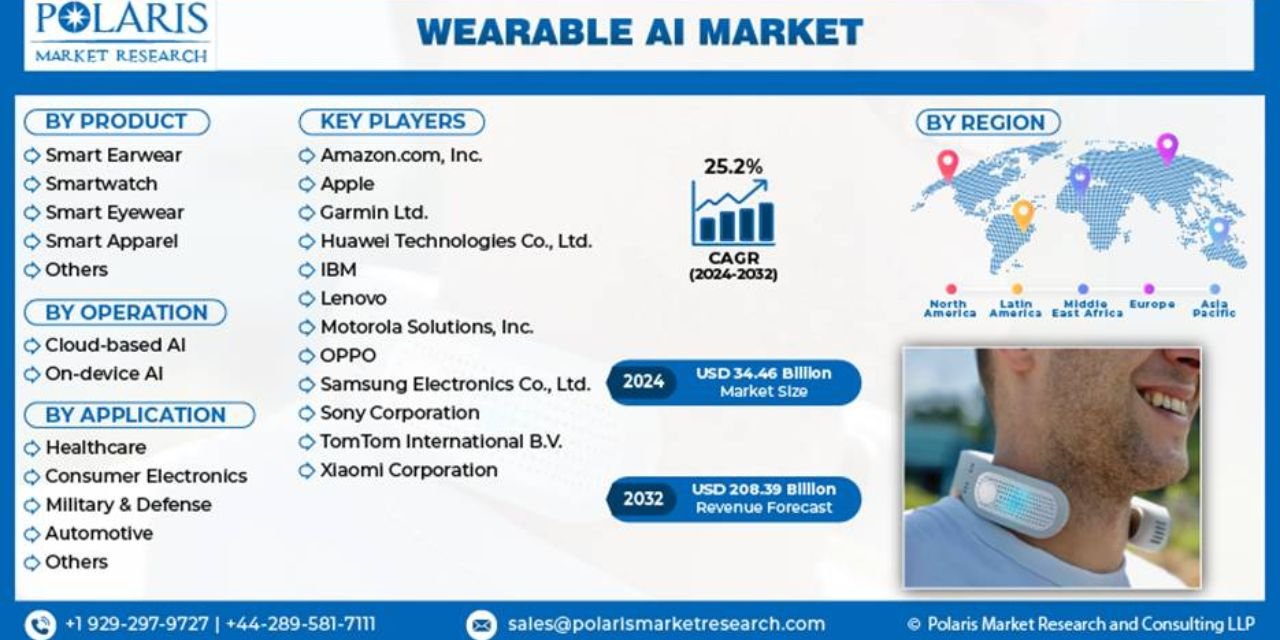
The Wearable AI market is rapidly becoming one of the most dynamic segments within the Information and Communication Technology sector. Growth is being propelled by rising consumer interest, advances in artificial intelligence, and expanding use across healthcare, consumer electronics, and enterprise environments. AI-enabled wearables are transforming how people engage with technology by delivering real-time data, predictive insights, and connected experiences across devices.
The global market is forecast to grow at a CAGR of 25.2 percent between 2024 and 2032, increasing from about USD 34.46 billion in 2024 to USD 208.39 billion by 2032. This strong expansion highlights the shift from basic tracking devices to intelligent wearables that provide personalized guidance, automation, and actionable analytics for both individuals and businesses.
Technological progress plays a central role in this momentum. The integration of advanced AI models, compact high-accuracy sensors, and stronger on-device processing has enabled capabilities such as continuous health monitoring, contextual awareness, predictive support, and automated assistance. As a result, wearables have evolved into essential daily tools rather than optional accessories.
Smartwatches continue to lead the segment because of their versatility and broad user base. At the same time, smart glasses, earwear, and AI-integrated clothing are gaining ground, expanding consumer choice and enhancing interaction. These devices monitor key health indicators including heart rate, oxygen saturation, sleep patterns, and activity levels. Machine learning then converts this data into tailored insights, helping users make better wellness and lifestyle decisions. Growing attention to preventive care and chronic condition management further strengthens demand, positioning wearable AI as a critical health companion.
Adoption is also rising beyond healthcare. In consumer settings, AI-powered devices support voice interaction, virtual assistance, and personalized services. Products such as smart earbuds with live transcription and augmented reality eyewear are redefining digital experiences and boosting day-to-day efficiency.
Enterprises are using wearable AI to improve safety, productivity, and operational visibility. These devices track environmental conditions, employee fatigue, and performance metrics in real time. The resulting insights help optimize processes, lower risk, and enhance workplace safety, especially in sectors like manufacturing, logistics, and field operations.
From a regional perspective, North America leads the market due to strong consumer uptake, higher spending capacity, and a mature healthcare ecosystem. Meanwhile, Asia-Pacific is emerging as a high-growth region, supported by expanding digital adoption, competitive manufacturing, and growing awareness of AI-driven solutions in countries such as China, Japan, and India.
Competition remains intense, with major technology firms and agile startups continually advancing the field. Companies are prioritizing R&D to launch next-generation devices with improved AI capabilities, better integration with digital ecosystems, and superior user experiences. Factors such as longer battery life, on-device intelligence, and adaptive algorithms increasingly influence purchasing decisions.
Despite strong momentum, the industry must address data privacy and security concerns. Wearables handle sensitive personal information, making secure data management, clear consent practices, and regulatory compliance essential. Organizations that build trust through transparent data policies are likely to gain a competitive advantage. At the same time, new application areas in education, sports performance, augmented reality, and enterprise optimization present substantial growth potential.
Looking ahead, wearable AI will extend beyond traditional wrist-based devices. Smart garments, AI-enabled accessories, and intelligent eyewear are gaining traction, signaling a future where embedded intelligence becomes part of everyday objects. Continued advances in local AI processing, contextual computing, and adaptive learning will further enhance performance and usability, supporting adoption across diverse user groups.
With revenues expected to exceed USD 208 billion by 2032, wearable AI stands at the forefront of ICT innovation. These technologies promise to reshape digital interaction by delivering constant intelligence, forward-looking insights, and improved productivity. The sector is not only expanding but redefining how individuals and organizations use technology, making AI-driven wearables a foundational element of the connected future.


