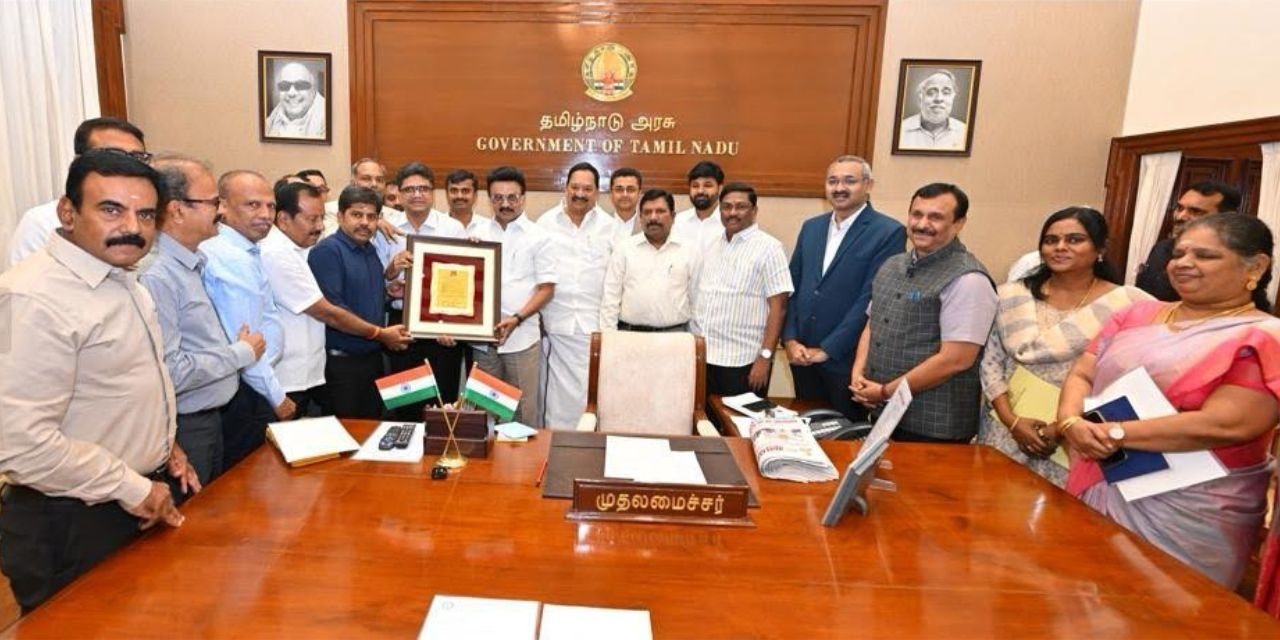
The Tamil Nadu Textile Industry expresses its sincere gratitude to the Government of Tamil Nadu, led by the Hon’ble Chief Minister, for creating a separate Department for Textiles, a first in Indian history. This visionary move aims to strengthen a modern, sustainable, and globally competitive textile sector with focused thrust on technical textiles, spinning, and garmenting. On behalf of the entire textile value chain, the industry conveys its heartfelt thanks for this progressive leadership.
Major Tamil Nadu Textile Policy Reforms
Key reforms introduced by the state government include:
-
Removal of 1% market committee cess on seed cotton, cotton waste, and cotton lint, in force since 1959, and advisory to CCI to commence depot sales benefiting small and medium spinning mills.
-
Implementation of the PM MITRA Park at Virudhunagar, one of seven approved by the Ministry of Textiles.
-
Expansion of the mini textile park scheme to include machinery along with infrastructure, making it more investment-friendly.
-
Launch of a Sustainable Cotton Mission to improve cotton production and productivity in Tamil Nadu.
-
Announcement of a mega Viscose Staple Fibre production facility near Tuticorin, strengthening a value chain where Tamil Nadu accounts for nearly 70% of VSF consumption.
Tamil Nadu New Integrated Textile Policy 2025–26
Released by the Hon’ble Deputy Chief Minister Thiru Udhayanidhi Stalin on 29 January 2026 in Coimbatore, the policy offers unique benefits, including:
-
6% interest subvention on spinning machinery.
-
20% capital subsidy for modernising up to 1,000 looms into shuttleless looms with electronic jacquard.
-
50% capital subsidy to upgrade 3,000 powerlooms into rapier shuttleless looms.
-
5%–25% subsidy for worksheds in powerloom clusters.
-
25% capital investment subsidy for new textile processing units and for expansion, modernisation, and upgradation of existing units and IETPs.
-
25% subsidy for manufacturing non-conventional fibres such as banana, bamboo, water hyacinth, hemp, flax, and pineapple fibre.
-
Allocation of ₹15 crore to promote technical textiles and ₹25 crore for research and business development in technical textiles and man-made fibres.
-
50% capital subsidy for fully computerised cutting machines with CAD/CAM software.
Power-Related Reforms
The government has also introduced critical power reforms, including continuation of annual banking for wind power, extension of banking for windmills over 20 years old, increased free electricity units for handloom and powerloom sectors, waiver of peak hour charges for LT industrial consumers, and extended concessions for rooftop solar users.
Support Through Central Government Engagement
Through continuous engagement with the Government of India, several measures have benefited the industry, including withdrawal of import duty on long-staple cotton, relaxation of QCO regulations on MMF and yarns, reduction of GST on MMF and MMF yarn, and financial relief during COVID, global recession, and periods of high US tariffs.
For implementing these historic and landmark initiatives, the Tamil Nadu textile industry once again places on record its sincere gratitude to the Hon’ble Chief Minister of Tamil Nadu. The acknowledgment is jointly conveyed by leading industry bodies including CITI, TEXPROCIL, MATEXIL, PDEXCIL, SIMA, SITRA, CII – Textiles Division, TEA, KTMEA, TASMA, SISPA, RTF, ITF, OSMA, DAT, and RSF, representing the strength and unity of the state’s textile ecosystem.