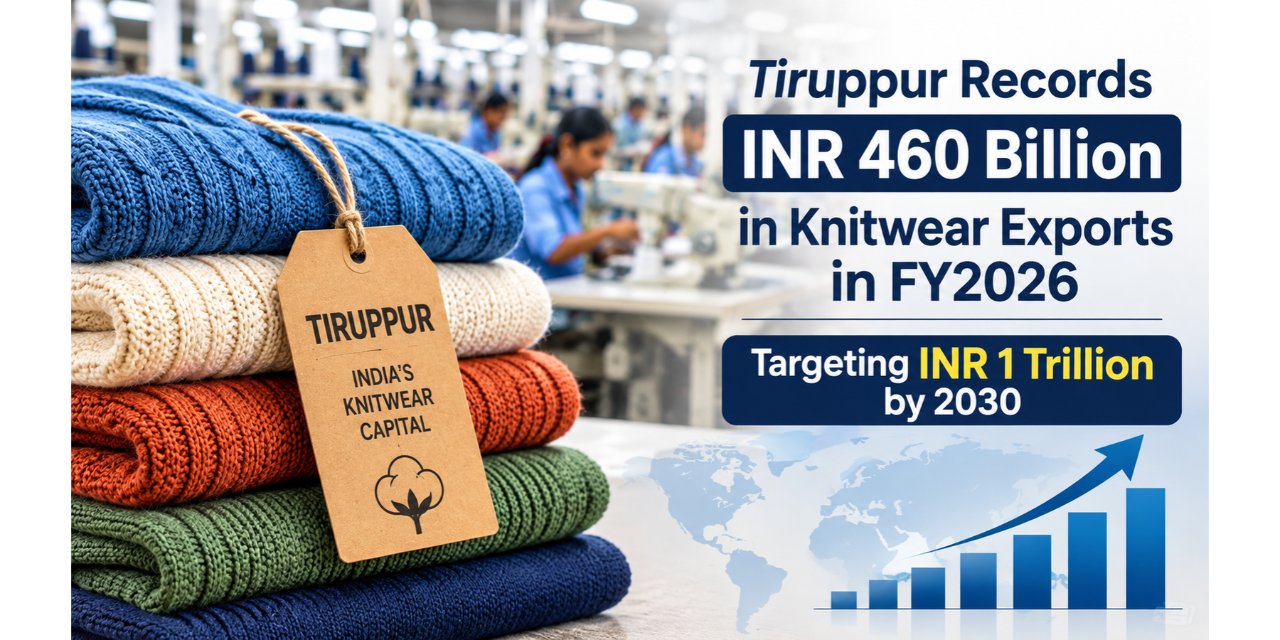
Tiruppur Records INR 460 Billion in Knitwear Exports in FY2026
Rubix Data Sciences report highlights Tiruppur’s position as India’s leading knitwear export hub, with the cluster targeting INR 1 trillion in exports by 2030.
Tiruppur, popularly known as India’s ‘Knitwear Capital’, continues to strengthen its position as a major textile and apparel manufacturing hub. According to the latest report by Rubix Data Sciences, the cluster recorded its highest-ever knitwear exports of INR 460 billion in FY2026. This represents a 3% increase over INR 447.5 billion in FY2025.
Tiruppur accounts for around 60% of India’s knitwear exports and nearly 90% of its cotton knitwear exports. These figures underline the cluster’s significant contribution to India’s textile export industry.
Integrated Manufacturing Ecosystem Drives Growth
Tiruppur’s strength lies in its specialised and integrated manufacturing ecosystem, which comprises more than 20,000 units across knitting, dyeing, printing, embroidery and garmenting. Through this network, specialised enterprises access complementary capabilities and respond to changing customer requirements.
Consequently, the cluster achieves production turnaround times of around 21 to 28 days. It directly employs more than 6 lakh workers and exports to over 50 countries. In terms of export markets, around 35% of its production goes to the European Union, while another 35% is shipped to the United States.
Product Diversification and Sustainability Offer Growth Opportunities
The Rubix report identifies product diversification and sustainability as key opportunities for Tiruppur’s future growth. Currently, man-made fibre (MMF) products account for around 10% of the cluster’s turnover. However, the industry aims to achieve a 50:50 mix of cotton and MMF-based products.
At the same time, Tiruppur has established itself as a leader in sustainable textile manufacturing. It became the world’s first textile cluster to implement 100% Zero Liquid Discharge (ZLD).
The cluster operates 18 Common Effluent Treatment Plants (CETPs) and 60 Individual Effluent Treatment Plants (IETPs). Together, these facilities treat around 130 million litres of effluent daily. Furthermore, they achieve approximately 96% water recycling and reuse.
Alongside its water management initiatives, Tiruppur has developed around 1,950 MW of renewable energy capacity. These investments further support its efforts to strengthen sustainable manufacturing practices.
Labour Shortages and Rising Costs Pose Challenges
Despite its strong export performance, the cluster faces several operational challenges. These include an estimated 20% labour shortage, rising raw material costs and technology gaps among smaller manufacturers.
Moreover, the report notes that knitwear production costs increased by up to 15% by the end of September 2026. Rising cotton yarn prices contributed to this increase, putting additional pressure on exporters’ margins.
Commenting on the findings, Tushar Bhaskar, President, Rubix Data Sciences, said:
“Tiruppur’s strength lies in its specialised MSME ecosystem, export capabilities, and collaborative manufacturing model. As global sourcing requirements evolve, product diversification, technology adoption, and sustainable practices will be critical to strengthening the cluster’s competitiveness and achieving its long-term export ambitions.”
Tiruppur Targets INR 1 Trillion in Exports by 2030
Looking ahead, Tiruppur is expected to contribute USD 11.5 billion towards Tamil Nadu’s textile export target of USD 21 billion. This ambition aligns with India’s broader goal of achieving USD 100 billion in textile exports by 2030.
With its established manufacturing network, international market reach and sustainability initiatives, Tiruppur is positioned to play a significant role in India’s future textile export growth.