
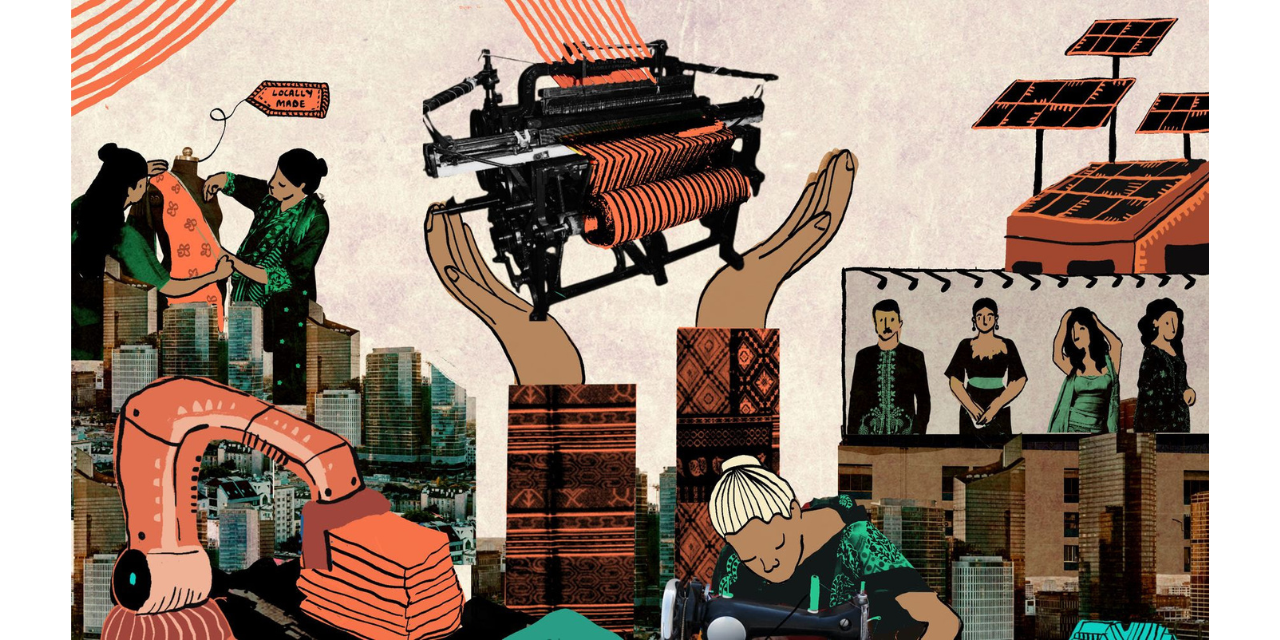
Textile Futures 2040: Four Scenarios Explore the Industry’s Future
Forum for the Future and the H&M Foundation have launched Textile Futures 2040, a new initiative exploring four possible futures for the global textile industry. Released on 11 November 2026, the project examines how forces such as corporate consolidation, emerging markets, local repair economies and artificial intelligence (AI) could shape the industry by 2040.
The scenarios challenge current assumptions about growth, technology, consumption and responsibility. They also explore different supply chain models, ranging from highly interconnected global networks to localised production systems.
The initiative aims to help industry leaders assess their strategies against different possible futures. By considering a range of outcomes, organisations can identify risks, explore opportunities and make better-informed decisions towards a just transition and climate goals such as net zero.
Why the Textile Industry Needs to Prepare for 2040
The textile industry accounts for around one in eight workers worldwide. At the same time, companies across its value chain are increasingly committing to climate action. According to the press release, 88% of brands reporting to Textile Exchange now have formal targets.
However, the transition towards a more sustainable industry will take place amid changing economic conditions, geopolitics, regulations and social expectations. New technologies and business models will also influence how the sector operates.
Foresight can help organisations prepare for these changes. Rather than planning around a single expected outcome, businesses can explore several plausible futures, challenge existing assumptions and identify potential risks early.
Textile Futures 2040 builds on Forum for the Future’s earlier fashion scenarios, beginning with Fashion Futures 2030 in 2010.
Four Scenarios for the Textile Industry
Each scenario presents a possible version of the textile industry in 2040. It also includes a day in the life of someone living in that future and a textile artefact developed through speculative design to make the scenario more tangible.
1. New Age Corporate Empire
In this scenario, corporations become more powerful than governments, while manufacturers gain greater influence. Technology improves efficiency, but inequality increases and decarbonisation takes a back seat to profit.
Everyday clothing becomes more durable and climate-adaptive. Meanwhile, digital layers become an important part of personal style.
2. Power Shift
Economic and cultural influence shifts towards Asia. State-backed innovation, improved labour conditions and rising consumption reshape the textile industry.
Handmade craftsmanship gains greater value. In addition, consumers can trace the people involved in making their garments.
3. Global Storms, Local Shields
Climate and resource pressures disrupt global supply chains, making local production, repair and reuse essential. Communities become increasingly self-sufficient, while circular business models emerge as a major source of growth.
As a result, repair professionals become highly sought after.
4. The New Noosphere
Artificial intelligence drives rapid decarbonisation and supports nature restoration. However, algorithms also gain greater influence over what gets produced, how resources are used and how people live.
Recycled fibres become the primary material input, while some clothing products are designed to be planted.
Industry Stakeholders Contribute to the Scenarios
The scenarios draw on expert interviews, focus groups and scenario-testing workshops involving more than 60 stakeholders. Participants included global and local brands, manufacturers, unions, labour rights advocates, futurists, designers, foundations, academics and students.
Bhajinder Kaur, Founder of purpose-driven luxury womenswear brand Wolf & Byrd, shared an insight from the sessions:
“A more sustainable and resilient fashion and textile industry cannot be built by individual businesses working in isolation. By exploring possible futures together, we can identify opportunities, challenge existing practices, and develop more thoughtful solutions that benefit both people and the planet.”
Zoe Le Grand, Managing Director, UK and Europe, Forum for the Future, highlighted how the scenarios challenge assumptions about growth and technology. She explained that exploring different futures can help organisations understand how decisions may lead to different outcomes. She also emphasised the importance of a just and regenerative transition that considers livelihoods and nature alongside emissions.
Toolkit Helps Businesses Test Their Strategies
Alongside the scenarios, the initiative offers an openly available toolkit of workshop materials. Organisations can use it to conduct their own sessions and assess existing strategies, investments and decisions against the four possible futures.
Forum for the Future and the H&M Foundation encourage organisations across the textile value chain to use the scenarios to explore potential changes and make decisions that remain relevant across different outcomes.
Anna Gedda, CEO of the H&M Foundation, said:
“None of us knows what the textile industry will look like in 2040, but decisions made today will help shape it. We supported Textile Futures 2040 to help industry actors challenge assumptions and make better-informed choices on the path to net zero.”


