
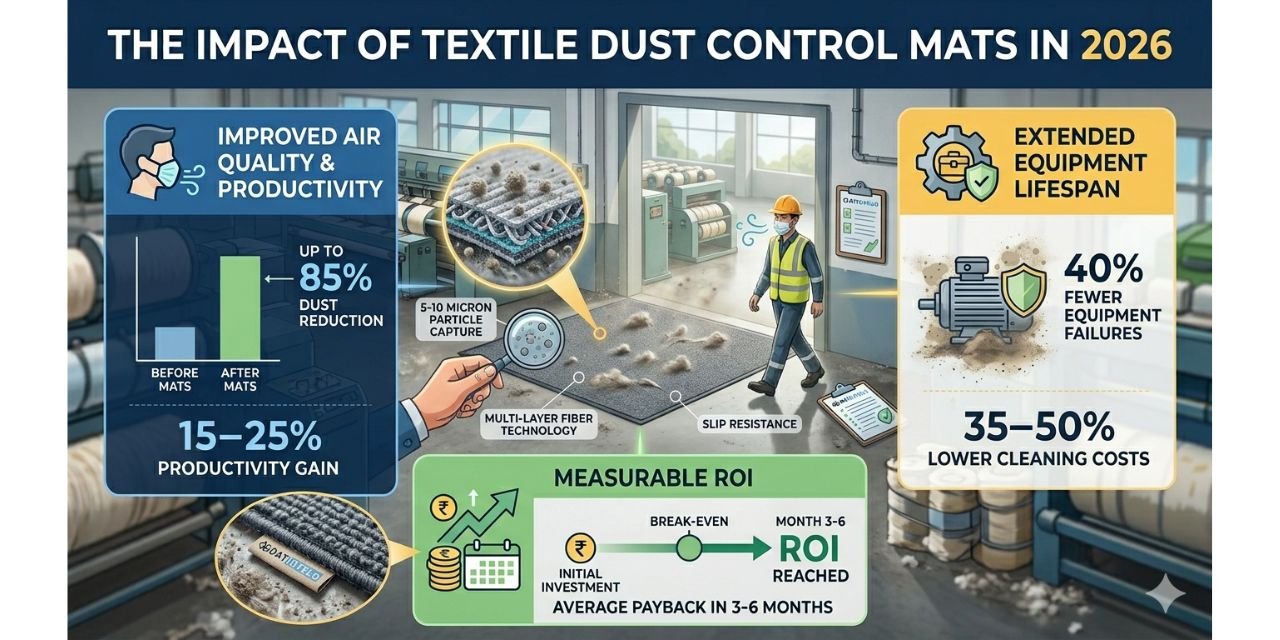
The global textile dust control mats market has reached an estimated valuation of USD 1.9 billion in 2026, driven by rising demand for industrial hygiene, workplace safety, and operational efficiency. With a projected CAGR of 18–22%, the segment is rapidly emerging as a critical component in textile manufacturing, cleanrooms, and commercial facilities.
As regulatory standards tighten and automation increases, businesses are adopting advanced dust control solutions to enhance productivity, reduce costs, and ensure compliance.
Growing Importance in Industrial Environments
Textile dust control mats are engineered floor coverings designed to trap and retain airborne particles, significantly improving indoor air quality and reducing contamination risks. Widely used across garment units, spinning mills, warehouses, and cleanrooms, these mats now capture particles as small as 5–10 microns, a major advancement over older technologies.
Recent studies indicate that modern mats can reduce airborne dust levels by up to 85%, depending on the environment, making them essential for maintaining controlled production conditions.
Measurable Operational Benefits
The adoption of textile dust control mats delivers quantifiable business advantages:
- Dust Reduction: 60–85% decrease in airborne particles
- Cost Savings: 35–50% reduction in cleaning labour costs
- Equipment Efficiency: Up to 40% fewer failures due to reduced dust accumulation
- Productivity Gains: 15–25% improvement in worker output
- Air Quality Improvement: 20–30% better indoor air quality scores
These benefits translate into significant financial gains, with many facilities achieving full return on investment within 3–6 months.
Cost and ROI Analysis
The average cost of high-quality textile dust control mats ranges from ₹120 to ₹350 per sq. ft. in 2025–2026. Despite increased pricing due to technological advancements, performance improvements of over 30% ensure higher long-term value.
Typical ROI metrics include:
- Initial investment: ₹3–8 lakh
- Annual savings: ₹10–25 lakh
- ROI: 150–300% within the first year
This makes dust control mats a high-impact, cost-efficient investment for mid to large-scale facilities.
Technology Advancements
Modern textile dust control mats incorporate multi-layer fibre technology, offering enhanced durability and performance:
- Particle capture: 5–10 microns
- Lifespan: 2–4 years
- Wash cycles: 250–400
- Slip resistance: Improved by up to 45%
- Static control: Reduced electrostatic attraction by up to 35%
These advancements contribute to better safety, reduced maintenance, and extended product life.
Market Growth and Key Drivers
The market has grown from USD 1.2 billion in 2022 to USD 1.9 billion in 2026, with projections reaching USD 3.1 billion by 2028.
Key growth drivers include:
- Stricter workplace safety regulations
- Increased adoption of automation and dust-sensitive equipment
- Rising ESG and sustainability compliance requirements
- Growing awareness of indoor air quality and worker well-being
Real-World Impact
Case studies from textile manufacturing units highlight tangible results. A Maharashtra-based facility reported a 78% reduction in dust levels, 42% drop in cleaning costs, and 19% productivity increase within six months of implementation, achieving ROI in under five months.
Conclusion
Textile dust control mats have evolved into a strategic investment rather than a supplementary product. With proven benefits including up to 85% dust reduction, significant cost savings, and rapid ROI, they are becoming indispensable across industrial environments.
As the market continues to expand and technology advances, businesses prioritising efficiency, compliance, and sustainability will increasingly adopt these solutions to stay competitive.


