The Khadi Seminar at the College of Home Science Nirmala Niketan, held on September 20, 2025, was a lively and memorable gathering that truly brought the spirit of Khadi to life. The venue buzzed with energy as partners Textile Value Chain (TVC), Anveshanam Foundation (AF), and the Alumni Association of College of Home Science Nirmala Niketan (AACHSNN) came together to create an experience that was both educational and inspiring for every attendee.
Introduction
The event commenced with the lighting of the lamp by all the dignitaries, marking an auspicious beginning. This was followed by a welcome address by Dr Ela Dedhia, Managing Trustee & President, AACHSNN; Director, Anveshanam Foundation; and Curator of the event.
Dr Dedhia warmly welcomed the Chief Guest, Ms Roop Rashi Mahapatra, Additional Secretary to the Government of India and CEO, Khadi and Village Industries Commission (KVIC), Ministry of MSME, whose visionary leadership has brought new direction and strength to India’s handloom and Khadi sector.
She also extended a warm welcome to the researchers of Khadi fabric, garments, and made-ups; spinners and artisans; heads of institutions; faculty members; student delegates from various colleges; as well as the Manager, Principal, Director, Heads of Departments, and students of the host institution.
In her address, Dr Dedhia emphasised that Khadi is not merely a fabric but a symbol of self-reliance, simplicity, and sustainability. She provided an overview of the seminar and highlighted the collective role of all participants in advancing the timeless relevance of Khadi, integrating it into modern living and education to help uplift rural communities, especially women.
She explained that the seminar is designed to beautifully reflect the day’s theme, bringing together education, tradition, and innovation. Speakers and participants will explore how learning can bridge the gap between age-old practices and modern developments, from Meghalaya’s heritage of Eri silk and the hand-spinning traditions of rural artisans to emerging techniques in natural dyeing, eco-finishing, and sustainable design.
Through live demonstrations, interactive displays, and open discussions, students and faculty will experience how Khadi continues to evolve not as a static heritage craft, but as a living ecosystem of creativity, community, and entrepreneurship. The sessions aim to highlight how local wisdom, scientific understanding, and youthful imagination can together reweave Khadi’s narrative for a modern, environmentally conscious world.
Ms Noella Dias, Manager of the College of Home Science, Nirmala Niketan, warmly welcomed the speakers and audience, sharing her thoughts on Khadi as a way of life.
Dr Asha Mathew, Principal of the College, also extended a warm welcome to all and spoke on Khadi as the National Fabric, emphasising its cultural and historical significance.
Chief Guest Address

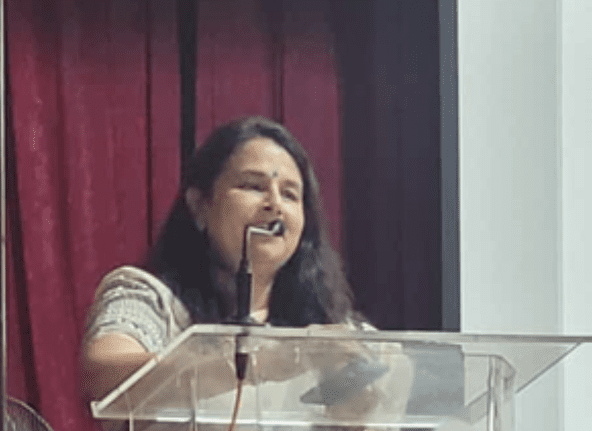
Roop Rashi Mahapatra
Additional Secretary to Govt. of India,
Chief Executive Officer,
Khadi Village Industries Commission, Ministry of MSME
Ms Roop Rashi Mahapatra began her address by expressing her happiness at being among educators, researchers, and students who are deeply engaged in reviving and promoting Khadi not merely as a fabric, but as a movement of self-reliance and sustainable living. She congratulated the organisers for curating an event that combined academic inquiry with hands-on appreciation of India’s heritage textiles.
She reminded the audience that Khadi is not just cloth; it is a consciousness, born out of India’s freedom struggle and rooted in the values of simplicity, the dignity of labour, and sustainability. She reflected on how Khadi was envisioned as a means of empowering rural communities while nurturing self-respect and harmony. Today, she said, the same spirit can guide India’s journey towards Atmanirbhar Bharat (self-reliant India).
Ms Mahapatra highlighted how KVIC has been modernising the Khadi ecosystem, from supporting artisans with better technology and design inputs to creating new marketing avenues and connecting rural producers with urban consumers through digital platforms. She shared that Khadi has now found a global presence, with increasing exports and collaborations that showcase India’s craftsmanship on international platforms.
She emphasised that Khadi represents a perfect balance between tradition and innovation. While it carries the warmth of hand-spun yarn and natural dyeing traditions, it also aligns perfectly with the global demand for eco-friendly, ethical, and sustainable fashion. She encouraged young designers and researchers to reimagine Khadi in contemporary forms, for professional wear, youth fashion, and lifestyle products, while maintaining its authenticity.
Addressing students and faculty, she urged them to become ambassadors of Khadi, integrating it into their daily lives and academic work. She invited educational institutions to collaborate with KVIC and MSME initiatives to promote entrepreneurship, research, and skill development linked to Khadi and village industries.
Ms Mahapatra concluded with an inspiring message, “Khadi is not a relic of the past, it is the fabric of the future. It connects our hands, hearts, and heritage. When we choose Khadi, we choose India, an India that is self-reliant, sustainable, and proud of its roots.”
Her words left the audience deeply moved, rekindling pride in Indian craftsmanship and a renewed sense of responsibility to promote Khadi as a way of life.
Speakers and Their Topics
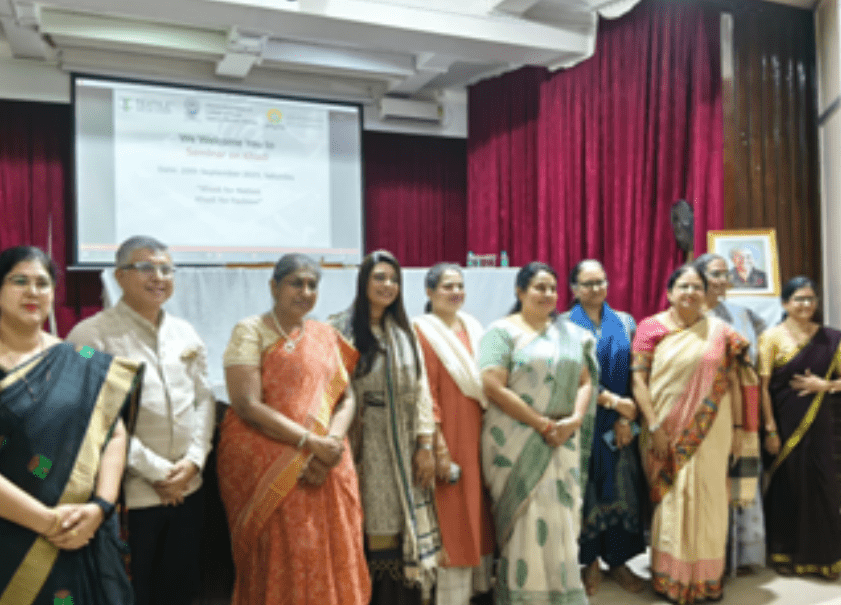
- Dr Ela Dedhia: She presented on the scope of Khadi as a uniform fabric for schools and for other professions and as work wear, elaborating with a live case study of the Uniform fabric of Shishuvan School, Mumbai, where it’s been used for the past 23 years.
- Dr Padma S Vankar: She explained advancements in natural dye technology — particularly plasma-mediated dyeing of Khadi cotton and silk — using rare earth metal salts as mordants, which enhances colour while keeping processes eco-friendly and safe for artisans.
- Prof. Dr Monika Aggarwal: Her talk revealed the intricate processes and design traditions of Meghalaya’s Eri silk Khadi, emphasising how deeply woven heritage can support rural livelihoods and create sustainable futures through innovative textile production.
- Dr Jinal Sanghani & Dr Ela Dedhia: They discussed “Khadi Couture,” a movement weaving heritage into fashion by combining traditional handicraft with contemporary style, demonstrating Khadi’s relevance in high-end, eco-friendly design.
- Tasneem Merchant: Tasneem shared insights from a decade-long journey exploring alternative fibres for Khadi, with a focus on sustainable solutions, such as banana fibre, highlighting both environmental benefits and the transformation of traditional weaving practices.
Rushin Vadhani: He presented an exploratory study of the Indian Khadi industry, focusing on how marketing and promotional strategies are evolving to build Khadi’s brand equity, expand market reach, and connect with younger consumers and global markets.
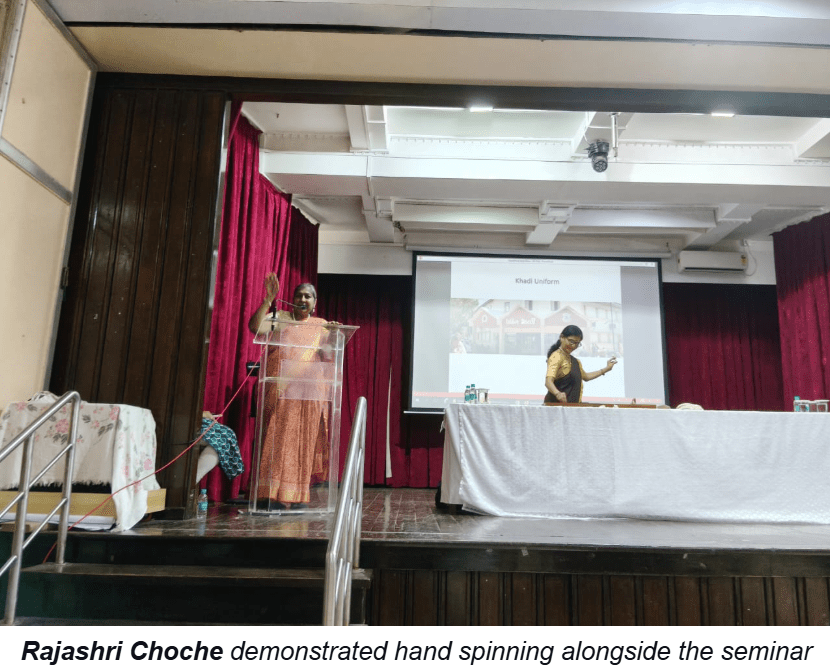
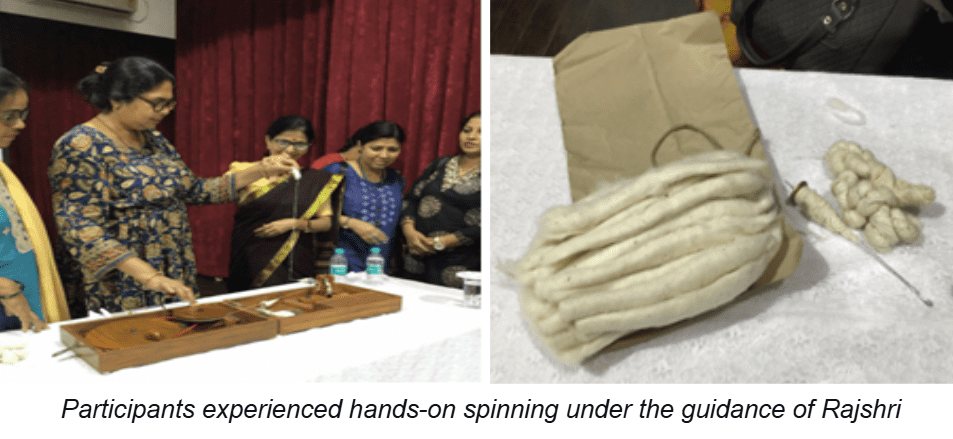
Workshop on Hand Spinning was led by Rajashri Choche, who facilitated everyone to experience the rhythm of spinning cotton by hand, sharing not just skills, but a sense of calm and connection to Khadi’s roots.
Audience
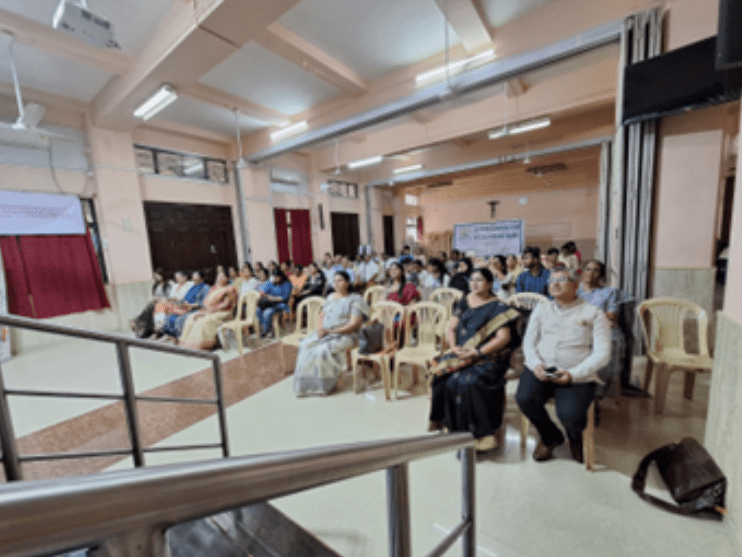
The audience was diverse and passionate: students eager to learn, teachers sharing wisdom, and industry leaders looking for fresh ideas. This was more than just a seminar; it was a space where Khadi’s story was told, lived, and carried forward—by everyone there.
Attendees explored stalls filled with handmade wonders, produced by the Sahara Self Help Group, learned time-honoured spinning techniques, and exchanged ideas about Khadi’s journey from humble homespun to global sustainable fashion.
For everyone who believes in the power of tradition and sustainable progress, this seminar felt like a celebration. Khadi, rooted in the freedom struggle yet looking boldly to the future, was the thread that connected conversations, stalls, and workshops. From the very first session, students, teachers, and industry leaders found themselves part of something bigger: a movement that honours craft and reimagines its place in today’s world.