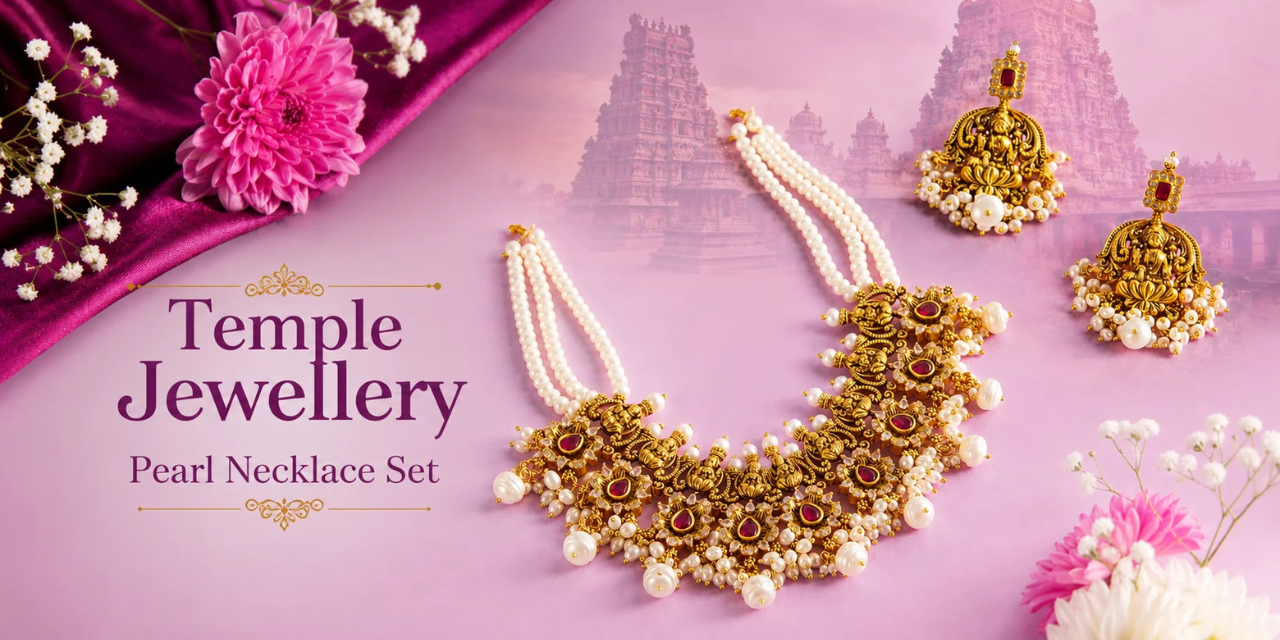
Long before it showed up on wedding registries and gift lists, temple jewellery lived on the deities themselves. South Indian temples commissioned elaborate gold pieces to adorn their idols, and over centuries the same motifs (Goddess Lakshmi, a dancing Krishna, peacocks, gopuram towers) made their way onto brides, and eventually onto anyone who loved the look. Silver temple jewellery is the modern, more affordable branch of that tradition: the same iconography, cast in 925 sterling silver instead of solid gold.
The trouble is that demand has outpaced honest supply. For every genuine piece on the market, there’s a brass imitation dressed up to look identical in a product photo, complete with a fake “925” stamp and a price that should have been the first warning sign. If you’re buying south indian temple jewellery for a wedding, a festival, or just because you love the craftsmanship, it’s worth spending ten minutes learning what separates the real thing from a good-looking knockoff. That’s what this guide is for.
What Actually Counts as Temple Jewellery
Not every silver piece with a goddess on it qualifies as temple jewellery. Genuine temple jewellery designs borrow directly from temple architecture and iconography: Lakshmi seated on her lotus, Krishna mid-dance, peacocks with fanned tails, the tiered silhouette of a gopuram. Traditionally these motifs were rendered in solid gold, sometimes set with uncut diamonds or gemstones, for temple deities and royal households.
Silver versions recreate that same artistry using 925 sterling silver as the base, often finished with gold plating or an antique, oxidised look. What sets the good pieces apart is the technique behind them: Nakshi, or repoussé, work, in which an artisan hammers the design out from the reverse side of the metal to raise the figures in high relief. It’s a slow, hands-on process, and it’s exactly why 925 sterling silver jewellery, rather than pure silver, has become the standard for fine temple designs. The alloy holds detail in a way pure silver simply can’t.
Why It Has to Be 925, Not “Pure” Silver
The number “925” means the metal is 92.5% pure silver alloyed with 7.5% copper or another metal. That’s not a compromise so much as a necessity. Pure, 99.9% silver is soft: too soft to hold intricate raised detail without bending, and too soft to survive daily wear as a bangle or a layered necklace.
This is also where a lot of the fakery hides. A piece priced well below what 925 silver would reasonably cost is almost never silver at all. It’s usually silver-plated brass, or a base alloy with no silver content whatsoever. Pieces like that pass a casual glance and photograph just fine, but they tarnish within weeks, can irritate sensitive skin, and are worth nothing if you ever try to resell or exchange them. 925 sterling silver, on the other hand, actually improves with age — it can be polished, fixed, and re-plated for as long as you own it.
How to Actually Verify 925 Silver
None of these checks is foolproof by itself, but run through a few together and a fake gets hard to hide.
Start with the BIS hallmark. In India, BIS hallmarked silver jewellery is certified by the Bureau of Indian Standards, and hallmarking has been mandatory for precious metals since 2021. A real hallmark carries the BIS logo, the purity grade (925), the assay centre’s mark, and a jeweller identification code, all of which you can cross-check yourself through the BIS Care app or website. A seller who gets vague when you ask about certification is telling you something.
Look for the 925 stamp itself. It should be engraved or laser-etched into the metal, not printed on a tag or sticker, and it usually shows up on the inner band of a bangle, the back of a pendant, or an earring post. Shopping in person, a jeweller’s loupe or magnifying glass makes it easy to find. Shopping for temple jewellery online, zoom right into the product photos. A seller with nothing to hide will usually show you this stamp up close, unprompted.
Try the magnet test, with a caveat. Silver isn’t magnetic, so a piece that clings to a magnet contains iron, nickel, or another base metal and definitely isn’t real. But don’t treat a “pass” as proof of anything: brass and several other fake-silver materials aren’t magnetic either, so this test can only rule pieces out, not rule them in.
Pay attention to weight and how it feels. Genuine silver has real heft for its size, and it conducts heat quickly: a silver bangle feels cool the moment you touch it, then warms fast against your skin. A piece that feels suspiciously light, and doesn’t have that quick cool-to-warm shift, is more likely aluminium or a mixed alloy.
Watch how it ages. Real silver tarnishes, and that’s normal; a light, dark patina polishes right off. What real silver doesn’t do is flake or turn green. A piece that peels to reveal copper or brass underneath, or takes on a greenish tinge, was never silver to begin with.
Reading the Craftsmanship
Once you’ve confirmed the metal, look at the work itself.
Hand-hammered Nakshi pieces have a slightly uneven, dimensional quality: small irregularities that give away a human hand behind the tools. Machine-cast imitations look flatter and suspiciously uniform by comparison, with edges that are a little too clean.
The motifs matter too. Authentic pieces stick to a specific, recognisable vocabulary: Lakshmi, Krishna, peacocks, gopurams, not generic “ethnic” florals that borrow the aesthetic without the meaning behind it.
If you’re choosing temple design silver bangles for women, the real ones usually close with a screw mechanism or a traditional hook-and-eye rather than a modern spring clasp, and they carry noticeably more weight than fashion bangles because of the carved detail. Measure your wrist before you order; these bangles are far less forgiving than an adjustable cuff.
For necklaces and layered harams, look for individually linked or woven chains rather than cheap snake-chain construction, and check that the pendant (a Lakshmi centrepiece is the classic choice) is fully carved and double-sided, not hollow or flat on the back.
Buying Temple Jewellery Online, Without Getting Burned
Shopping online gives you access to artisans and sellers you’d never otherwise reach, but it also means you can’t run a magnet test before you pay. A few things worth checking first:
Good signs:
- Close-up, high-resolution photos that clearly show the 925 stamp and hallmark
- Video of the piece from multiple angles, not just one styled studio shot
- An exact weight in grams, not a vague range
- A return or exchange window of at least 7–10 days
- Reviews that include buyer-uploaded photos, not just star ratings
- BIS hallmark certificates or a third-party assay report available on request
Warning signs:
- A price that doesn’t come close to matching the day’s silver rate: if a 50-gram necklace is priced at a fraction of what 50 grams of silver alone would cost, it isn’t silver
- Product photos that turn up on other sellers’ listings when you reverse-image-search them
- Descriptions that say “silver-coloured” or “tribal silver” instead of naming 925 sterling silver specifically
- No mention of hallmarking or purity anywhere on the listing
- A seller who won’t get on a video call or send a close-up photo when asked
Sellers who are genuinely confident in what they’re selling tend to make this easy: they publish hallmark details and show the making process, not just the finished shot. HS925 is one example of a brand built around that kind of transparency, with BIS-hallmarked pieces and documentation shown upfront rather than handed over only when a buyer asks.
Living With Silver Temple Jewellery
Detailed pieces need a little upkeep. Store them in anti-tarnish pouches or an airtight box with a silica gel packet, and keep them away from perfume, hairspray, and household cleaners, all of which speed up tarnishing and can wear down gold plating over time.
Clean with a soft silver polishing cloth, and skip liquid cleaners entirely on hollow pieces or anything with a gemstone setting. If your piece has a 24K gold-plated finish, having it professionally re-plated every few years brings the original warmth right back. That’s really the advantage of a 925 silver base over a brass one: it can be re-plated again and again, where brass just wears through for good.
The Bottom Line
Buying silver temple jewellery well isn’t complicated, but it does take a bit of diligence: check the hallmark, find the 925 stamp, and buy from sellers who show you the proof instead of asking you to take their word for it. Whether you’re after a set of temple design silver bangles for women, a full bridal haram, or a single pair of jhumkas, that verification step is what turns a nice-looking purchase into something you’ll still be wearing, and maybe handing down, decades from now.
This guide comes from the team at HS925, who work with BIS-hallmarked 925 sterling silver temple collections and believe every buyer deserves to know exactly what they’re wearing.