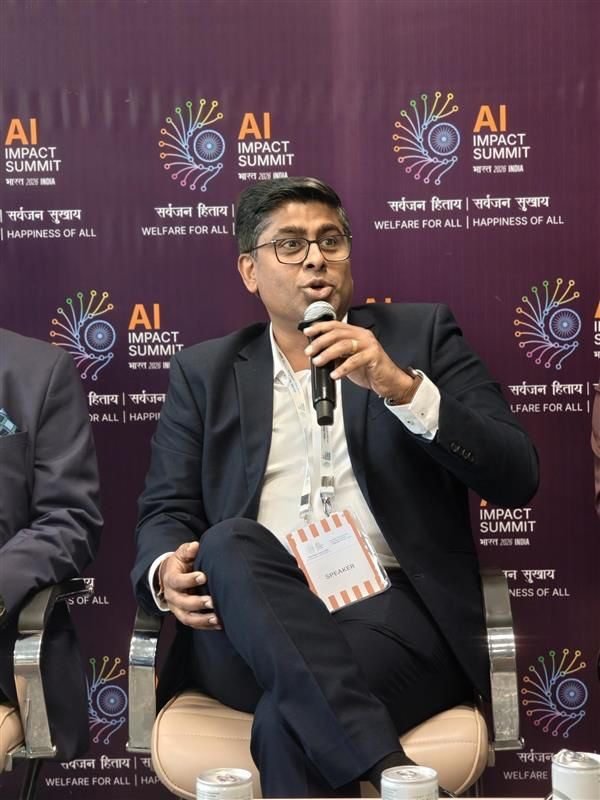
The India AI Impact Summit 2026 brought global technology leaders to New Delhi to discuss the future of artificial intelligence. At the event, EC-Council Founder and CEO Jay Bavisi highlighted India’s opportunity to build a skilled AI workforce. He also stressed the importance of responsible AI adoption, cybersecurity and governance.
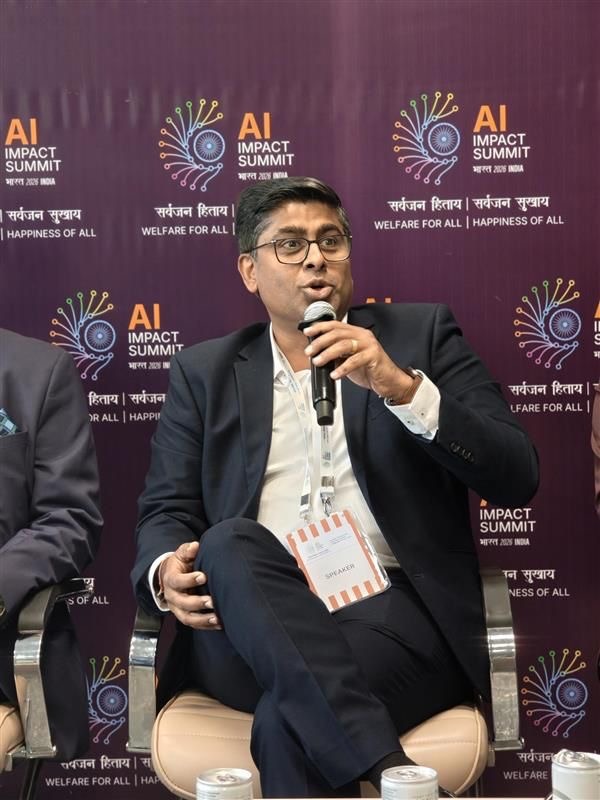 |
Jay Bavisi speaks at the India AI Impact Summit 2026, calling on India’s IT industry to lead the national AI workforce transformation
The Government of India hosted the India AI Impact Summit 2026 under the India AI Mission at Bharat Mandapam, New Delhi. The Summit focused on the principles of People, Planet and Progress.
It explored how artificial intelligence can support people, promote inclusive economic growth and strengthen sustainability.
The event attracted more than 300,000 attendees within its first three days. It brought together global technology leaders, including Jensen Huang of Nvidia, Sundar Pichai of Google, Bill Gates and Sam Altman.
The Summit came at a critical time for the global technology services industry. Concerns about AI-driven disruption had already affected investor confidence.
AI Disruption Creates Challenges for India’s IT Industry
Before the Summit, fears about AI-driven disruption triggered a sharp decline in major IT services stocks.
India’s Nifty IT index fell nearly 19% over eight trading sessions. This wiped out approximately Rs. 4.8 to Rs. 5 lakh crore in combined market capitalisation.
Several leading Indian IT companies recorded double-digit declines. One industry giant briefly fell below the Rs. 10 lakh crore market capitalisation mark for the first time since December 2020. Other companies reached fresh 52-week lows.
The decline also affected overseas-listed shares of leading IT companies. Some fell nearly 10% in a single New York trading session.
Investors reassessed the future of the labour-intensive outsourcing model that has supported the industry for decades.
India’s IT-BPM industry remains a major contributor to the national economy. It generated approximately $283 billion in revenue in FY2025. The sector contributes over 7% to India’s GDP and directly employs nearly 5.8 million professionals.
As AI changes enterprise operations, companies must prepare their workforce for new roles and responsibilities.
India Has an Opportunity to Lead the Global AI Workforce
AI is changing traditional service delivery models. At the same time, it is creating demand for professionals who can deploy, secure and govern AI systems.
India now faces an important question: Can it prepare its 5.8 million technology professionals to lead this transformation?
Jay Bavisi addressed this challenge at the Summit. He is the Founder and CEO of EC-Council and the creator of the Certified Ethical Hacker (CEH) credential.
Bavisi highlighted the need to move beyond AI experimentation. He called for stronger execution, workforce capabilities and responsible technology practices.
He also spoke at the panel titled “Responsible AI at Scale: Governance, Integrity & Cyber Readiness.”
The discussion focused on the growing role of AI in financial services, healthcare, manufacturing, digital governance and national security.
Bavisi stressed that organisations need skilled professionals to manage AI responsibly across these sectors.
Jay Bavisi Highlights Responsible AI Adoption
Bavisi described the Summit as an important global platform for discussions on artificial intelligence.
“This is an amazing summit that has been organized in India, the AI Impact Summit. I have not seen a summit of this size. The number of people, the number of thinkers who are here from all across the world – it is a very successful event and a dialogue that is extremely important in a world that is being transformed by AI,” he said.
He also warned about the risks of adopting AI without proper safeguards.
“AI has the potential to cause mayhem if it is not implemented properly,” he stated. “When AI becomes embedded into systems, responsibility becomes critical.”
Bavisi said India could play a leading role in supplying skilled AI professionals to global markets.
“India has a phenomenal opportunity to be a supplier of talent to the world. Indian professionals are known globally for their technical ability. In the world of AI right now, it is time to wake up and serve professionals to the world who are able to adopt, govern, and defend,” Bavisi said.
He also welcomed India’s growing role in AI development.
“The fact that India is taking leadership in AI is a phenomenal step in the right direction,” he added. “India is one of the very few countries with professionals who are proficient in language models, and technology at scale. This is a moment for India.”
EC-Council Expands Its AI Training and Certification Portfolio
Under Bavisi’s leadership, EC-Council has expanded its AI training and certification programmes. These programmes focus on practical skills that organisations need to adopt, secure and govern AI.
The Enterprise AI Credential Suite and the updated Certified CISO v4 mark the largest expansion in the organisation’s 25-year history.
EC-Council developed these programmes to address the growing gap between AI adoption and workforce readiness.
Its proprietary Adopt. Defend. Govern. (ADG) framework provides the foundation for the AI credential suite.
The suite includes:
-
Artificial Intelligence Essentials (AI|E)
-
Certified AI Program Manager (C|AIPM)
-
Certified Offensive AI Security Professional (C|OASP)
-
Certified Responsible AI Governance & Ethics Professional (C|RAGE)
Together with Certified CISO v4, these credentials support AI deployment, governance, security and executive leadership.
Strong Engagement at Bavisi’s Summit Session
The response to Bavisi’s session reflected strong interest in AI skills and cybersecurity.
The discussion room reached capacity, with some attendees standing. Participants continued their interaction well beyond the scheduled session time.
Many attendees identified themselves as Certified Ethical Hackers (CEHs). This reflected the credential’s continued global recognition at an event focused on advanced AI technologies.
Bavisi said technological progress must go hand in hand with workforce development.
“We often measure progress in numbers,” Bavisi said. “But the larger impact lies in shaping professionals who go on to defend companies, governments, and communities. Workforce development is not transactional. It is generational.”
About EC-Council
EC-Council created the Certified Ethical Hacker (CEH) programme and provides cybersecurity education and certifications. Founded in 2001, the organisation aims to deliver training and certifications that help cybersecurity professionals protect organisations from cyber threats.
EC-Council offers more than 200 certifications and degrees across cybersecurity fields. These include digital forensics, security analysis, threat intelligence and information security.
The organisation holds ISO/IEC 17024 accreditation and has certified more than 350,000 professionals worldwide. Its clients include government agencies and Fortune 100 companies.
EC-Council’s certifications are trusted by the U.S. Department of Defense, Army, Navy and Air Force, as well as leading global corporations.