Prof. Dr Monika Aggarwal
Dean Chanakya Foundation
Rewilding Heritage for Future Fashion
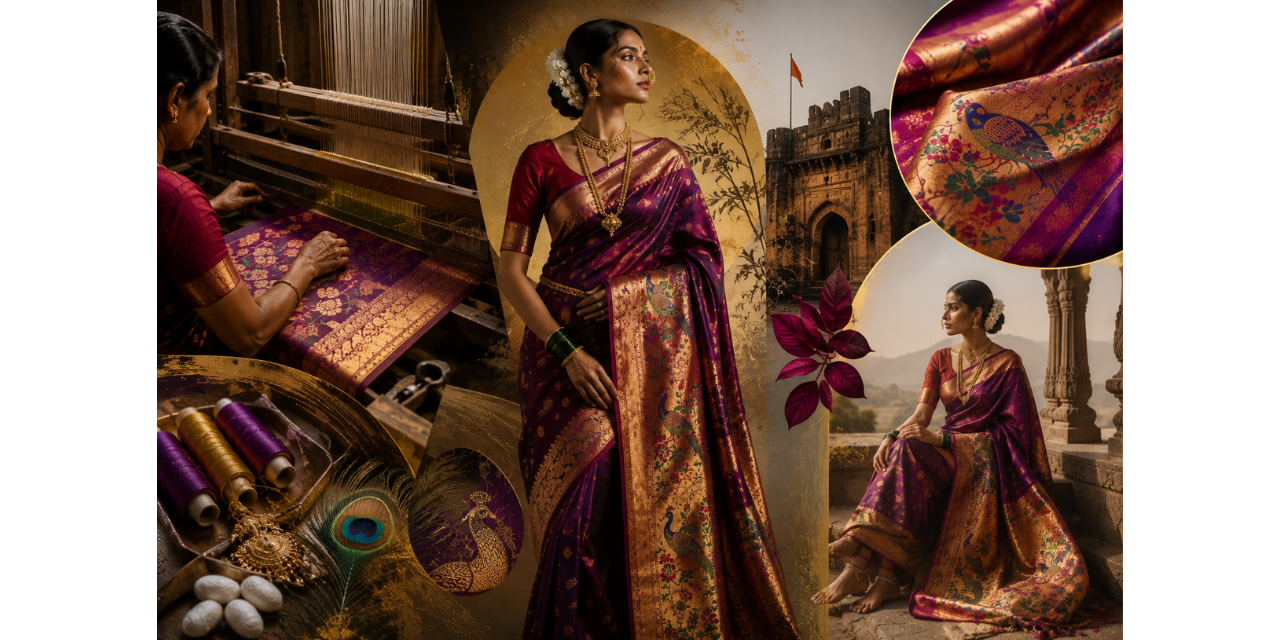
The global textile and apparel industry is increasingly embracing regenerative approaches that move beyond sustainability towards restoring ecological systems and strengthening local communities. In India, traditional handloom textiles provide valuable examples of circular production, material efficiency, and intergenerational knowledge systems. Among these, Paithani occupies a unique position as one of Maharashtra’s most celebrated woven textiles, historically associated with royal patronage, ceremonial occasions, and exceptional craftsmanship.
Originating from the ancient town of Paithan and later flourishing in Yeola, Paithani weaving is characterised by handwoven silk fabrics featuring elaborate zari borders and tapestry-style motifs depicting peacocks, parrots, lotuses, vines, and other elements inspired by nature. Each saree represents months of meticulous craftsmanship, making it an embodiment of slow fashion long before the concept gained international recognition.
Core Features of Paithani Handloom Textiles
| Feature | Description | Cultural value |
| Base material | Fine silk, Zari | Conveys luxury and ceremonial importance |
| Weaving method | Tapestry-style hand weaving | Enables detailed patterning |
| Borders | Oblique square or geometric borders | Signature design identity |
| Pallu | Peacock or floral-heavy pallu | Strongest visual marker of the textile |
| Motifs | Lotus, peacock, mango, floral forms | Links textile to nature and heritage |
Today, however, artisans face multiple challenges, including mechanised imitation, rising raw material costs, declining skilled labour, and changing consumer preferences. Rather than viewing tradition as static, the concept of rewilding fashion futures encourages reconnecting craft, ecology, innovation, and community to create resilient textile ecosystems. Contemporary adaptations in handloom are regenerating handloom textiles.
Contemporary Adaptation\
| Adaptation strategy | Description | Effect on the craft |
| Product diversification | Beyond sarees to other textile products | Broadens market reach |
| Design updates | Fresh colors and modern styling | Appeals to younger consumers |
| Branding and packaging | Heritage and luxury positioning | Enhances value perception |
| Market expansion | Wider retail and digital visibility | Increases access and sales |
| Collaborative revival | Design, training, and community initiatives | Supports sustainability |
| Digital retail | Online sales and social media | Expands reach beyond local markets |
| Designer collaboration | Fusion products and curated collections | Increases relevance for younger buyers |
| Cooperative organization | Shared production and marketing | Supports scale and consistency |
Modern Era: Preservation and Innovation (21st Century)
|
The enduring legacy of Maharashtrian designers is reinventing traditional styles, blending them with modern aesthetics to appeal to contemporary audiences. Contemporary designers are drawing inspiration from this rich heritage, creating a fusion of traditional and modern styles that grace the runway. |

Saree draping contemporised styles |
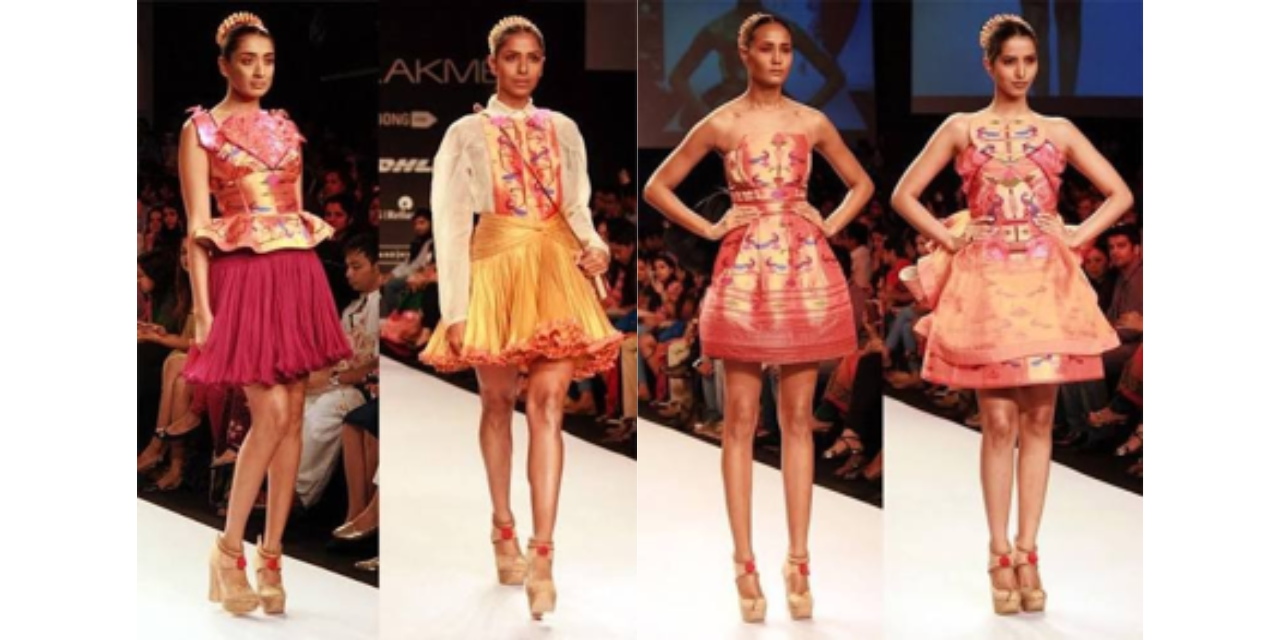
Paithani Dresses showcased at runway show |
Regenerative Style through Innovation
Regenerative style focuses on renewing environmental, cultural, and economic systems instead of simply reducing negative impacts. Paithani naturally aligns with this philosophy through handcrafted production, long product life, repairability, and cultural permanence. Recent innovations are strengthening this regenerative potential.
The revival of natural dye experimentation using indigenous botanical resources is reducing dependence on synthetic chemicals while reconnecting artisans with regional biodiversity. Digital archives and AI-assisted motif documentation are preserving centuries-old weaving knowledge and enabling younger designers to reinterpret traditional vocabulary without compromising authenticity.

Emerging blockchain-based traceability systems provide consumers with transparent information regarding artisan identity, production processes, and material sourcing. Such digital passports enhance consumer confidence while ensuring recognition of artisan contributions throughout the value chain.
The increasing use of 3D textile visualisation, virtual sampling, and digital merchandising reduces unnecessary physical sampling and material waste. Simultaneously, GI protection and e-commerce platforms have expanded market access for artisan clusters, allowing direct engagement with national and international consumers.
Another important innovation is product diversification. Beyond traditional sarees, Paithani motifs are now adapted into scarves, stoles, jackets, accessories, home furnishings, wall art, footwear, jewellery, and luxury lifestyle products. This diversification creates year-round employment opportunities while attracting younger consumer segments interested in contemporary design rooted in heritage.
Building Circular Fashion Ecosystems
Paithani demonstrates several principles of the circular economy that are increasingly recognised within sustainable textile production. Handloom weaving requires comparatively low energy, produces minimal manufacturing waste, and encourages careful use of premium raw materials. The exceptional durability of Paithani ensures that garments remain in use for decades, often becoming treasured heirlooms passed across generations.
Repair, restoration, and conservation practices further extend product life, contrasting sharply with fast-fashion consumption patterns. Localised production within artisan clusters strengthens regional economies while reducing transportation-related environmental impacts. Storytelling around artisans, craftsmanship, and cultural heritage also enhances product value, encouraging mindful purchasing instead of disposable consumption.
Future regenerative value chains may further incorporate renewable energy-powered weaving units, biodegradable packaging, QR-enabled authenticity certificates, digital artisan profiles, and carbon footprint assessment tools. Such innovations can enhance competitiveness without undermining traditional craftsmanship.
Circular Economic Initiatives in Paithani Handloom
| Circular Initiative | Maharashtra Handloom Example | Circular Economy Impact |
| Natural dye and low-impact production | Traditional handloom weaving processes using natural dyes and water-conscious production techniques | Reduces pollution, conserves water, and minimises resource consumption |
|
Long-life textiles |
Paithani sarees and other heirloom-quality handloom textiles | Extends product lifespan, reduces textile waste, and promotes sustainable consumption |
| Local cluster production | Paithan handloom weaving cluster and artisan cooperatives | Shortens supply chains, lowers transportation emissions, and strengthens local livelihoods |
| Repair, reuse, and inheritance | Handloom textiles repaired, reused, and passed down through generations | Encourages reuse, reduces disposal, and preserves cultural heritage |
| Heritage-led premiumization | Premium positioning of Paithani and other traditional Maharashtra handloom products | Promotes slow fashion, enhances product value, and encourages responsible ownership |
| Policy and institutional support | Maharashtra handloom development programmes, textile policies, and artisan welfare initiatives | Strengthens sustainable craft ecosystems, supports artisan livelihoods, and encourages circular production |
|
Story-based marketing |
Branding and awareness campaigns highlighting artisan narratives, cultural heritage, and craft authenticity | Increases consumer awareness, builds demand for ethically produced textiles, and supports responsible purchasing |
Conclusion
Paithani handloom textiles illustrate how heritage crafts can become powerful drivers of regenerative fashion futures. Rather than representing relics of the past, these living traditions offer practical solutions for creating resilient, culturally meaningful, and environmentally responsible textile systems. By combining centuries-old weaving knowledge with digital technologies, circular design strategies, transparent supply chains, and sustainable innovation, Paithani demonstrates that heritage and innovation are complementary rather than contradictory. Rewilding fashion therefore becomes a process of restoring relationships among artisans, materials, ecology, and consumers. As the fashion industry increasingly seeks authentic, traceable, and regenerative alternatives, Paithani provides an inspiring model where cultural heritage generates environmental value, economic resilience, and social inclusion. Its future lies not only in preserving tradition but in continuously adapting that tradition to build ethical and circular fashion ecosystems for generations to come.
References
- Textiles Committee, Ministry of Textiles, Government of India. (n.d.). Study and documentation of Paithani sarees & dress materials.
- Goswami, S. (2024). Sustainable practices adopted by Paithani weavers of Maharashtra.
- Mahajan, S. (2021). Challenges and scope of development: A case study of Paithani weavers of Maharashtra (India).
- Sustainable practices adopted by Paithani weavers of Paithan https://ijcrt.org/papers.
- Paithani Saree & Fabrics (Maharashtra) (GI Regn No. https://textilescommittee.nic.in/paithani-saree-fabricsmaharashtra.
- Reading the Weave: The Meaning Behind Paithani Motifs https://www.avantisarees.in/journal/paithani-motifs.html
- The Cultural Heritage And Significance Of Paithani Sarees https://www.samyakk.com/blog/cultural-heritagesignificance-paithani-sarees.
- The tradition and art of making Paithani saris – Times of India https://timesofindia.indiatimes.com/lifestyle/fashion/buzz/the-tradition-and-art-of-making-paithani-saris/articleshow.
- Paithani Saree: Motifs and Meanings – Sahapedia https://www.sahapedia.org/paithani-saree-motifs-and-meanings