Apurva Kanyalkar
Senior Planner, Coach,
&
Ravindra V. Adivarekar
Institute of Chemical Technology,
&
Saptarshi Maiti
Assistant Professor,
Dept of Fibres and Textile Processing Technology,
Institute of Chemical Technology
Abstract:
The Leather and Fabric Goods Industry (L&FGI) projected tremendous growth leading challenges in supply chain responsiveness, cost efficiency, environmental impact, processing and finishing operations. A dual framework of Responsible Luxury and Responsive Value Chains is proposed to address these challenges. By adopting future growth with sustainability can be achieved while enhancing agile, resilient supply chains.
Keywords: L&FGI, responsive and responsible supply chain
1. Introduction
The fashion industry designs, produces the goods and manages its distribution, marketing, retailing, advertising and promotion. In 2023, its estimated worth was $1.7 trillion [1], and it is expected to grow globally 2-4 percent/year between 2025-2027 [2]. By 2029 expected to grow from 1-1.5 trillion USD (Figure 1).
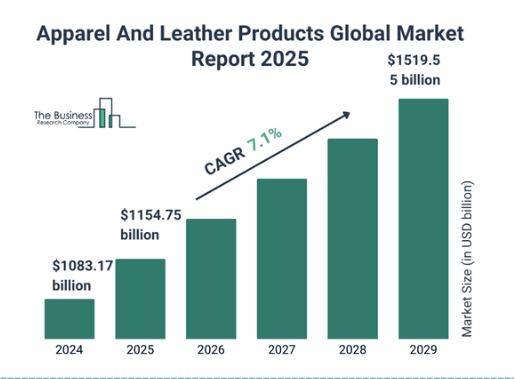
Figure 1. Expected growth of the L&FGI market [3]
Herewith, L&FGI supply chain management needs to address each of its components/processes by identifying areas of improvement to become ready for the projected growth.
Our article focuses on the characteristics of the L&FGI supply chains, understanding the role of each of its members and the processes followed. The last section will identify various levers that can be applied to each of the components to improve the efficiency and effectiveness of the supply chain as an opportunity.
2. Leather & Fabric Good Industries (L&FGI) Value Chain
The raw leathers/hides are processed into a variety of leather, based on the animal source and the tanning procedure followed. Post-tanning, the material is dyed, printed, oiled and finished by applying a protective coating. The textile fabrics are made up of fibres, plant/animal-based natural (Cotton, Silk, etc.) or synthetic (Polyesters, Nylon). They are converted into fabrics based on the selection of fibres and manufacturing processes, creating variation in their texture, strength, colour patterns, breathability, and durability. The processed fabrics/leathers are assembled to final product, followed by finishing, quality inspections, packaging, and then dispatched to the distribution centre.
Members Of The L&FGI Value Chain
The value chain constitutes multiple members, from sourcing quality materials across the globe, assembling the final product and then distributing. The value chain is represented in Figure 2.
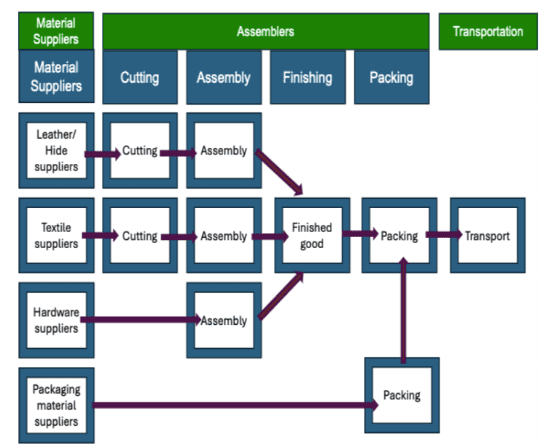
Figure 2: L&FGI value chain
Fashion designers/product development – They are responsible for identifying current fashion trends, latest materials and designing/refining products, giving an aesthetic look aligned with the brand’s heritage.
Material suppliers – Provide the required materials to the Assembly factories. They are:
- Leather/Hide suppliers – who process leathers/hides based on the designer’s requirements, viz., colours, prints, embossing. These suppliers need to maintain exclusivity for the brand by ensuring traceability control over prepared materials, and rejected materials need to be destroyed.
- Textile suppliers – The produced fabrics and requisite standard threads are supplied to the assembler based on the order while maintaining complete traceability.
- Hardware suppliers – Specific to the material and based on order, they supply a variety of hardware like buttons, metallic brand logo, etc., used in assembling the final products.
- Packaging material supplier – The packaging materials can be fabric/plastic bags, polystyrene foam, corrugated boxes, etc., specific to brand image, colour, GSM and printing patterns.
Assembly – Based on the order and brand specifications, the assembly process, viz., glueing, stitching or riveting, is carried out. The major steps are:
- Cutting – The textiles/leathers cut manually/by cutting press/by advanced computer-controlled machines, as per the specifications and order.
- Assembly – Carried out by skilled/experienced artisans and craftsmen, at multiple stations, or by a single artisan completing a single unit and assembled in a sequential manner to produce the finished product.
- Finishing – may involve pressing/folding, applying specific coatings, etc.
- Packing – involves applying brand-relevant tags and covering product surfaces to avoid damage during handling and transportation. The final boxes need to be labelled /barcoded appropriately to indicate the product inside.
Transportation – The packed products are properly palletised and transferred using various transport systems via road/sea/air to the hubs and distributed further to the retail/outlet shops.
The continuous variation in trends based demand allows the entire process to start only once an order is received. The average order-to-delivery lead time for textile products can be 4-8 weeks, while for complex/private labels it’s 8-24 weeks. Sometimes the total value chain lead time can get extended to 9-12 months. For leather goods, delivery can be within a few weeks and for complex/private labels, the lead time can run in several months. This impacts responsiveness and supply disruptions, causing huge opportunity losses along with escalating manufacturing costs of the finished product.
Consequently, to capture the growth opportunity, L&FGI should focus on responsiveness, supply security and improving costs while reducing the environmental impact.
3. Levers/Areas Of Improvements For Future Ready – Responsible Luxury And Responsive Value Chain
Eventually, L&FGI to support the projected growth, needs to align with “Responsible Luxury” by working towards the usage of biodegradability and vegan materials and “Responsive value chains” by usage optimisation, delayed differentiation, etc. Tables 1 and 2 show various possible levers.
Table 1: Levers for Responsible Luxury
| Lever | Applicability to L&FGI |
| Use of Optimisation in Material Consumption | Digital pattern-making, AI-based cutting optimization reduce wastage of leather/fabrics, lowers costs and minimises scrap. |
| Use of Recycled Materials | Recycled polyester, cotton blends, or regenerated leather fibres, recycled linings and metal hardware are increasingly viable. |
| Product Recyclability | Designing goods with easy-to-separate (detachable) components enables recycling at end-of-life, requires design-for-disassembly. |
| Biodegradability | Natural fibres and vegetable-tanned leathers degrade faster than synthetics. Biodegradable adhesives reduce environmental impact. |
| Animal-Free Materials | Vegan leather alternatives from pineapple leaves, cactus, or mushroom-based mycelium provide consumer demand for cruelty-free goods. |
| Water & Chemical Footprint Reduction | Low-water tanning, waterless dyeing, and bio-based chemicals minimise environmental harm. |
| Traceability & Transparency | Tracking hides/fabrics digitally builds consumer trust. Blockchain-based traceability and QR-enabled product passports are becoming industry norms. |
| Circular Business Models | Luxury products lend themselves to resale, repair, and refurbishment. Extending life cycles reinforces exclusivity and lowers environmental burden. |
| Packaging Material Reduction | Lightweight, recyclable, or compostable packaging materials reduce environmental footprint. Minimalist packaging communicates responsible luxury without diluting brand appeal. |
| Waste-to-Value | Off-cuts can be repurposed into small leather goods, accessories, or composite panels, turning waste into a revenue stream and reinforcing sustainability positioning. |
| Energy Efficiency | Using renewable energy sources in tanneries, weaving mills, and assembly facilities reduces carbon emissions. |
Table 2: Levers for Cost and Responsive Value Chains
| Lever | Applicability to L&FGI |
| Material Standardization | Standardising linings, zippers, or buckles reduces procurement complexity and creates economies of scale. |
| Alternate Materials | Replacing exotic or costly leathers with embossed calf, coated fabrics helps balance cost and design flexibility. |
| Multiple Sources | Dual sourcing of leather/fabrics and hardware reduces supply risk while maintaining cost advantage. |
| Inventory Management | Using demand forecasting and POS-linked replenishment ensures leaner but more flexible inventories, critical in seasonal luxury goods. |
| Single-Unit Flow | Moving from batch processing to one-piece flow in assembly reduces work-in-progress, improves quality, and shortens lead times. |
| Delayed Differentiation (Postponement) | Producing semi-finished bases allows last-minute customisation, reducing lead times. |
| Near-Shoring | Locating part of production closer to consumer markets improves responsiveness. |
| Fast Transportation | Selective use of air freight for high-value seasonal launches balances responsiveness with cost. |
| Use of Digital Tools & Analytics | AI-driven demand sensing, forecasting, and supply chain visibility platforms improve agility and reduce errors. |
| Flexible Workforce | Cross-training assemblers in cutting, stitching, and finishing enables rapid scaling up/down, ensuring responsiveness to market swings. |
| Supplier Collaboration | Early involvement of suppliers in product development enables innovation, reduces design-to-market lead time, and improves sourcing reliability. |
4. Application Of The Levers to the L&FGI Value Chain
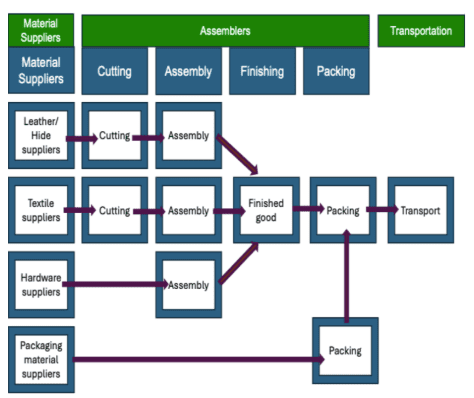
The applicability of levers to various elements of the value chain of L&FGI is represented (Figure 3).
| Lever | Material Supplier | Cutting | Assembly | Finishing | Packing | Transportation |
| Responsible Luxury Levers | ||||||
| Use of Optimisation in Material Consumption | Yes | Yes | ||||
| Use of Recycled Materials | Yes | |||||
| Product Recyclability | Yes | Yes | Yes | |||
| Biodegradability | Yes | Yes | ||||
| Animal-Free Materials | Yes | |||||
| Water & Chemical Footprint Reduction | Yes | Yes | ||||
| Traceability & Transparency | Yes | Yes | ||||
| Circular Business Models | Yes | Yes | Yes | |||
| Packaging Material Reduction | Yes | |||||
| Waste-to-Value | Yes | Yes | ||||
| Energy Efficiency | Yes | Yes | Yes | |||
| Responsive Value Chain Levers | ||||||
| Material Standardization | Yes | |||||
| Alternate Materials | Yes | |||||
| Multiple Sources | Yes | |||||
| Inventory Management | Yes | Yes | Yes | Yes | Yes | Yes |
| Single Unit Flow | Yes | Yes | Yes | Yes | ||
| Delayed Differentiation (Postponement) | Yes | Yes | Yes | Yes | ||
| Near-Shoring | Yes | Yes | Yes | |||
| Fast Transportation | Yes | |||||
| Use of Digital Tools & Analytics | Yes | Yes | Yes | |||
| Flexible Workforce | Yes | Yes | Yes | |||
| Supplier Collaboration | Yes | Yes | Yes | |||
Figure 3: Levers and its application in the L&FGI value chain
4.1 Material Suppliers
- Responsible luxury levers viz. Recycled Materials, Product Recyclability, Biodegradability, Animal-Free Materials, Water & Chemical Footprint Reduction[4,5], Traceability & Transparency, Energy Efficiency. Responsive Value Chains levers can be Material Standardisation, Alternate Materials, Multiple Sources, Inventory Management, Delayed Differentiation, Use of Digital Tools & Analytics, Supplier Collaboration.
- Explanation & Opportunities:
-
- Use of Recycled & biodegradable materials, recycling/repurposing leftover leather, and recycling textiles mechanically or chemically decomposing/treating to fibre with the help of technology [6] opens new sustainable product lines.
- Animal-free materials, plant-based materials, and lab-grown or bio-fabricated leather can provide animal-free alternatives.
- Product recyclability designing for easy recyclability by design-for-disassembly, can be considered.
- Water & Chemical Footprint Reduction ecological textile processing/dyeing technology with wastewater treatment, use of biochemicals/physical processes like plasma, and ozone technology for pretreatment, encompassing natural dyes/biodegradable materials and emerging technologies for dyeing like supercritical CO2, ultrasonic, microwave, and electrochemical. Eco-friendly low-water dyeing and biodegradable coatings reduce environmental impact.
- Traceability systems, QR codes, and blockchain build consumer trust in product genuineness and ensure complete traceability till the source. QR-enabled passports improve transparency for end consumers. IoT devices and sensors can automate logistics tracking and warehouse management, reducing human errors and delays.[6]
- Energy-efficient suppliers of solar-powered tanneries/mills, usage of biomass for heating reduces emissions.
- Material Standardisation: The linings/inner foams, buckles/zippers not directly visible to the customer can be standardised to reduce procurement complexity and allow bulk buying.
- Alternate materials. Replacement to vegan/biodegradable synthetic materials can help balance luxury appeal and cost.
- Multiple sources having alternate source helps in supply security, ensure availability of at least two suppliers, preferably in different geographies, for all unique materials sourced to help during eventualities.
- Inventory management for optimising inventory across the entire value chain for maximising responsiveness. Some common raw materials should be maintained in inventory based on the mutual agreement between members of the value chain. Consideration of raw material inventory buffers of the most forecast error products to the tune of free manufacturing capacity can be one of the rules. Similar rules should be agreed upon at various stages of the value chain.
- Delayed Differentiation can improve responsiveness dramatically. Produce and store standard partially assembled/synthesised items and wait for an order to assemble the final product. Such a modular design and standardisation will reduce the costs while improving responsiveness.
- Use of digital tools & analytics tracks every link from raw material procurement to product delivery. AI-powered predictive tools analyse historical sales data, consumer trends, seasonal variations and economic indicators, that enables to optimise inventory and reduce the risk of stock-outs or overstocking [7]. The lever is also applicable at the assembly and transportation stage.
- Supplier Collaboration for co-development shortens design-to-market cycles. Involving suppliers during the product development, in cutting and assembly stages, will help improve the speed of response, mutual trust, product quality and responsiveness.
4.2 Cutting Operations
- Responsible Luxury levers are Use of Optimisation, Waste-to-Value. Responsive value chain levers are Inventory Management (Discussed earlier), Single-Unit Flow, Delayed Differentiation(Discussed earlier), and Flexible Workforce.
- Explanation & Opportunities:
- Use of Optimization software minimises leather/fabric wastage by nesting patterns efficiently, and also expensive and unique materials used can be saved substantially.
- Waste-to-value use of off-cuts from the unusable materials, unique design products with minimal added cost, can be made and used for branding.
- Single-unit flow reduces lot size and improves quality by helping early defect detection and responsiveness. This lever is applicable to all the stages of manufacturing.
- Flexible workforce trained on both manual and automated cutting machines and to carry out multiple tasks, enhances responsiveness and flexibility to overcome seasonal peaks.
4.3 Assembly
- Responsible luxury levers are Use of Optimisation, Product Recyclability, Circular Business Models, Waste-to-value, and Energy Efficiency. Responsive levers like Inventory Management, Single-Unit Flow, Delayed Differentiation, Near-Shoring, Use of Digital Tools & Analytics, Flexible Workforce, Supplier Collaboration.
- Explanation & Opportunities:
- Circular Business Models focus on resource efficiency, waste reduction, recycling, and thus cost reduction [8]. The lever is also applicable in the area of Packing and Transportation. Promoting second-hand transactions/rental services [6] and reverse logistics for resale/repair programs open new revenue streams.
- Near-shoring helps in improving responsiveness by reducing transportation times, but impacts manufacturing costs adversely. Thus, consider nearshoring for high value-high forecast error products. Even a hybrid strategy of producing fixed quantities in low-cost countries while producing the variable quantities in nearby countries will help. Near-shoring the distribution hubs helps in reducing delivery times and support omni-channel retail.
4.4 Finishing
- Responsible levers like Product Recyclability, Biodegradability, Water & Chemical Footprint Reduction, and Energy Efficiency. Responsive levers are Inventory Management, Single-Unit Flow, Delayed Differentiation, Near-Shoring, and Flexible Workforce.
4.5 Packing
- Packaging Material and Waste-to-value are responsible levers, while Inventory Management, Circular Business Models, and Near-Shoring are Responsive.
- Explanation & Opportunities:
- Packaging Material Reduction with waste-to-value recyclable boxes, compostable fillers, reduces cost, and packaging materials with alternate use to the customer helps in brand advertisement.
4.6 Transportation & Distribution
- Responsible luxury levers like Traceability & Transparency and Circular Business Models. Responsive levers like Inventory Management, Fast Transportation, Use of Digital Tools & Analytics, and Near-Shoring.
- Explanation & Opportunities:
- Fast transport air freight for limited-edition launches balances responsiveness with luxury positioning. Normal sourcing for high margin-high forecast error products from low cost countries, while for the variation quantities from near-shore countries using faster transportation modes.
- Digital tracking and QR-enabled passports improve transparency for end consumers. IoT devices/sensors can automate logistics tracking and warehouse management, reducing human errors and delays.[6]
5. Conclusion
L&FGI with projected market growth demands faster, more reliable, and more sustainable value chains. Our analysis demonstrates that conventional practices—long lead times, high environmental footprint, and limited supply chain flexibility are insufficient to meet the pressures of growth and sustainability. By adopting the proposed framework of Responsible Luxury and Responsive Value Chains, the industry can simultaneously address environmental and operational challenges. Responsible Luxury emphasises reducing ecological burden, aligning with consumer expectations for ethical fashion and digital traceability technologies. Responsive Value Chains focus on agility, ensuring resilience to demand fluctuations and supply shocks. The future needs integration and the right balance of these levers across all stages, supported by digital and sustainable innovation.
References
- 28 Dazzling Fashion Industry Statistics : How Much Is The Fashion Industry Worth, Zippia.com. Jun. 15, 2023,https://www.zippia.com/advice/fashion-industry-statistics/.
- Imran Amed, Gemma D’auria , The State of Fashion: Luxury, BOF Insights, McKinsey & group 13 January 2025.https://share.google/M42AcBKmvpGJiXMJX.
- The Business report 2025: Market report image https://www.thebusinessresearchcompany.com/report/apparel-and-leather-products-global-market-report
- Lara, L.; Cabral, I.; Cunha, J. Ecological Approaches to Textile Dyeing: A Review. Sustainability,14, 8353, 2022. https://doi.org/10.3390/su14148353
- Mr. Utkarsh Goley , Evolution of Leather in Fashion Industry, JETIR, 2024, 11(4) www.jetir.org(ISSN-2349-5162)
- Lucy Chamberlin & Casper Boks, Marketing Approaches for a Circular Economy: Using Design Frameworks to Interpret Online Communications, Sustainability, MDPI, 10(6), 1-27, 2018.
- Yue Lin and Jun Yu, Study on the Modernization of Supply Chain Management of the Luxury Industry in the Context of the Digital Economy, Academic Journal of Management and Social Sciences, 4(1), 2023
- Xiangzhi Zheng, Exploring the Circular Economy in the Fashion Industry: Transforming Waste into Valuable Resources, Proceedings of the 3rd International Conference on Art, Design and Social Sciences, DOI: 10.54254/2753-7064/45/20240106