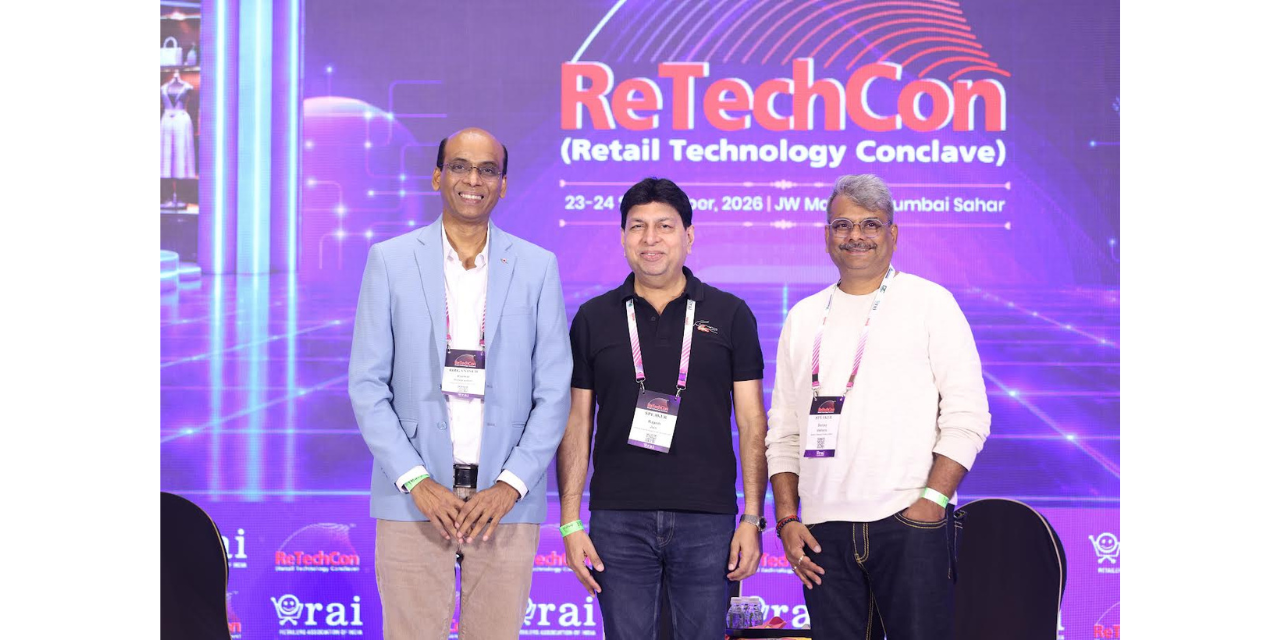
RAI Hosts 20th Retail Technology Conclave
The Retailers Association of India (RAI) hosted the 20th edition of its Retail Technology Conclave, ReTechCon 2026, on September 23 and 24.
The two-day event took place at JW Marriott Mumbai Sahar. It brought together CEOs, CIOs, technology partners and retail industry leaders.
The conclave examined how intelligence, automation and unified commerce are reshaping retail. In addition, participants discussed emerging technologies and global trends influencing the next phase of the industry.
The sessions focused on smarter decision-making and seamless customer experiences. At the same time, they explored how retailers can build more connected and responsive businesses.
AI and Technology Reshape Retail
Kumar Rajagopalan, CEO, Retailers Association of India (RAI), highlighted the growing influence of technology on retail.
“Retail has spent 50years organising itself around five Ps — people, product, place, promotion, price. Technology has quietly added two more: pace and personalisation. AI is no longer a pilot project sitting in some retailers’ innovation labs — it is already reshaping how customers are found, how products are tracked, and how every transaction becomes a data point. ReTechCon 2026 exists to have that conversation honestly, not as a sales pitch, but as an industry working out together what comes next.”
The discussions reflected the wider adoption of technology across retail operations and customer journeys. However, speakers also highlighted the gap between deploying technology and integrating it into everyday workflows.
Technology Must Address Customer Needs
Saloni Khosla, Vice President, Pepperfry, said:
“In a category like furniture, technology has to solve for a very specific problem — the customer can’t just add it to cart the way they would a t-shirt. They need to see it in their space, trust the delivery timeline, trust the return process if it doesn’t fit. Adoption for us has never been about chasing whatever’s trending. It’s been about asking which technology actually removes hesitation at the exact moment the customer is deciding, and ignoring the rest.”
Similarly, Chirag Kenia, Founder, Urban Platter, highlighted the importance of adapting business processes alongside technology.
“Every retailer today has access to roughly the same technology. What separates the ones who actually benefit from it is whether they’ve rebuilt their processes around it, or just bolted it onto the old way of doing things. We learned that the hard way — buying a tool is the easy part. Changing how your team actually works with it is where most of the value gets lost or won.”
Early Adoption and Retail Innovation
Karan Singla, COO, The Sleep Company, focused on the importance of early technology adoption.
“The retailers who are winning right now aren’t the ones with the most advanced stack. They’re the ones who adopted early enough to make mistakes while the stakes were still small. Waiting for a technology to mature before you touch it sounds prudent, but by the time it’s ‘mature,’ your competitor has three years of data and muscle memory you don’t have.”
Together, these perspectives highlighted a common theme. Technology adoption involves more than selecting new tools. Instead, retailers must also adapt their processes, teams and customer strategies.
Industry Leaders Share Technology Insights
ReTechCon 2026 featured speakers from across the retail and technology ecosystem.
Notable participants included Anil Menon, CIO, LuLu Group India; Neeraj Nagpal, CBO, Raymond; Chippy Mehta, Co-Founder, Bombay Shirt Company; Kunal Mehta, CIO, Arvind Fashions Ltd.; Chirag Kenia, Founder, Urban Platter; Vinod Kapote, Head – IT, Trent Ltd.; and Ranjit Satyanath, Chief Information Officer, Vijay Sales.
Furthermore, the sessions examined how technology is changing retail models and customer engagement. They also covered physical stores, digital channels and operational decision-making.
Key Retail Technology Trends
Several sessions explored emerging developments across the retail technology landscape.
Who’s Shopping For Your Customer?
This session explored autonomous agents and voice interfaces. In particular, it examined how these technologies could increasingly shop on behalf of customers.
As a result, the traditional browse-and-buy journey could change as retailers respond to new forms of customer interaction.
Screen To Storefront
Meanwhile, the Screen To Storefront session examined what direct-to-customer brands can learn about their customers.
The discussion focused on brands expanding from digital channels into physical retail. It also considered how physical stores can generate new customer insights.
From Followers To Buyers
The From Followers To Buyers session focused on D2C brands and community-led commerce.
The discussion examined how brands can turn community trust into sales. At the same time, it considered how they can protect the value of the communities they have built.
The Tech Adoption Gap
The Tech Adoption Gap session examined the difference between technology retailers claim to have deployed and the technology actually operating on the retail floor.
Therefore, the discussion highlighted the importance of moving beyond technology deployment towards effective implementation.
Your Customers Are The Content
The Your Customers Are The Content session explored user-generated content and communities.
In addition, it examined how these communities can become growth engines beyond conventional marketing.
The Sale Isn’t Over At Checkout
Finally, The Sale Isn’t Over At Checkout examined customer trust and purchase confidence.
The session also addressed avoidable returns and their relationship with the wider customer journey. Consequently, it highlighted the importance of maintaining customer confidence beyond the point of purchase.
Technology Takes Centre Stage in Retail
ReTechCon 2026 highlighted the growing connection between retail and technology.
Throughout the conclave, speakers examined how AI, automation and unified commerce are influencing retail operations. They also discussed the importance of integrating technology into wider business processes.
Furthermore, the sessions placed customer needs and operational efficiency at the centre of technology discussions.
As retailers continue to adopt digital solutions, ReTechCon 2026 provided a platform for industry leaders to examine practical implementation. Ultimately, the discussions reflected the changing role of technology in India’s retail ecosystem.