Dr Padma S Vankar
Consultant, Industry
Plasma technology presents significant potential in textile processing as a clean, dry, and energy-efficient method. Using plasma instead of harmful chemical auxiliaries offers an environmentally friendly, sustainable approach to fabric colouration, enabling cleaner wet processing for fabric dyeing. Air plasma treatment introduces oxygen-containing polar groups, such as C=O, O-H, and O-C=O, thereby increasing the hydrophilicity and wickability of textile samples.
Research Objective
Natural dyes on cotton and silk have traditionally been challenging for textile dyeing. This study explores the combination of plasma pre-treatment followed by rare earth (RE) salt mordanting for natural dyeing of Khadi cotton and silk. Rare earth salts are non-hazardous, eco-friendly, and thus sustainable mordants. Remarkably, the amount required for desired results is about 10 times less than conventional mordants, reducing effluent load. The synergistic effect of plasma and rare-earth mordants shows promise for natural textile dyeing.
Natural Dyes and RE Salts Used
Khadi cotton and silk fabrics were plasma-treated for 1-2 minutes to study the effects on dyeability. Fourteen different natural dyes were used: Madder, Turmeric, Myrobalan, Eupatorium, Catechu, Lac, Leafy Green, Red Sandal, Dry Walnut, Yeliona, Indigo, Punica, Heena, Rheum emodi. Six rare earth salts were tested as mordants: YCl₃, Ce₂(SO₄)₃, LaCl₃, Ce(NO₃)₃, Y₂O₃, La₂(CO₃)₃.
Plasma Effectivity
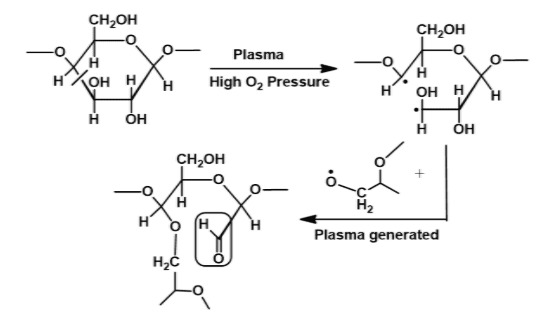
During plasma exposure, energetic species (ions, radicals, electrons, metastables) bombard the fabric surface. Initially, only the amorphous portions of the fabric etch, loosening fibre microstructure to enhance dye molecule penetration. Plasma-treated cotton fibres show increased carboxyl and carbonyl groups, enhancing wettability and wickability.
The result is improved dye penetration into the fibre structure, with plasma-treated samples exhibiting higher K/S (colour strength) values than untreated fabric. Plasma treatment also achieves about one grade improvement in wash and light fastness, physically and chemically modifying the fabric surface. At the same dye concentration, plasma-treated fabrics show darker colours than their untreated counterparts.
Colour Measurements (CIELAB Values)
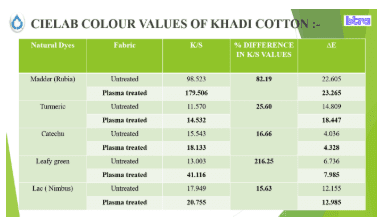
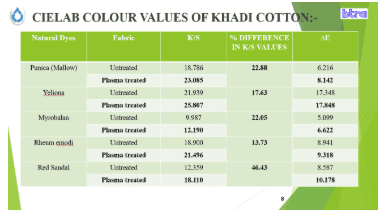
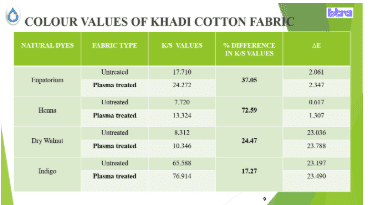
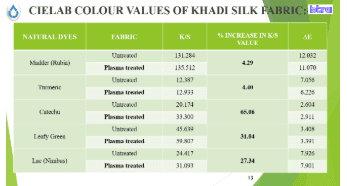
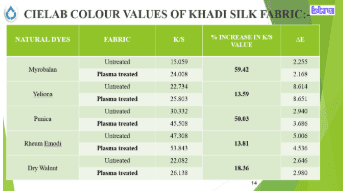

Tables of K/S values and colour differences (∆E) for plasma-treated versus untreated Khadi cotton and silk fabrics show higher colour strength and improved dye uptake with plasma treatment across all dyes tested.
Fastness Properties

Light and wash fastness generally improved by one grade in plasma-treated samples compared to untreated fabrics across dyes.
Mechanical Strength
Tensile strength tests reveal that plasma treatment causes minimal strength loss — approximately 8.5% for cotton yarn and 4-6% for fabric and silk yarn/fabric — indicating no detrimental impact on mechanical integrity.
Surface Analysis (XPS Results)
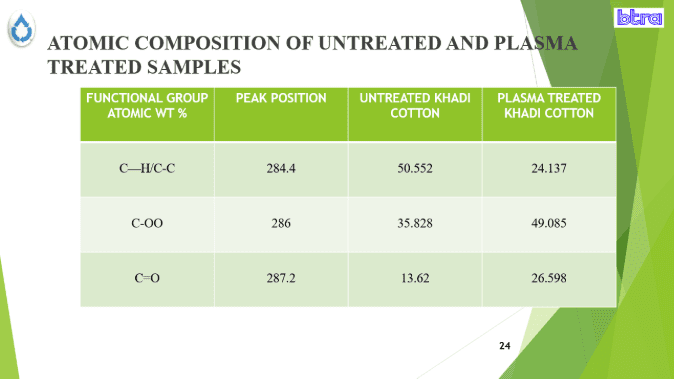
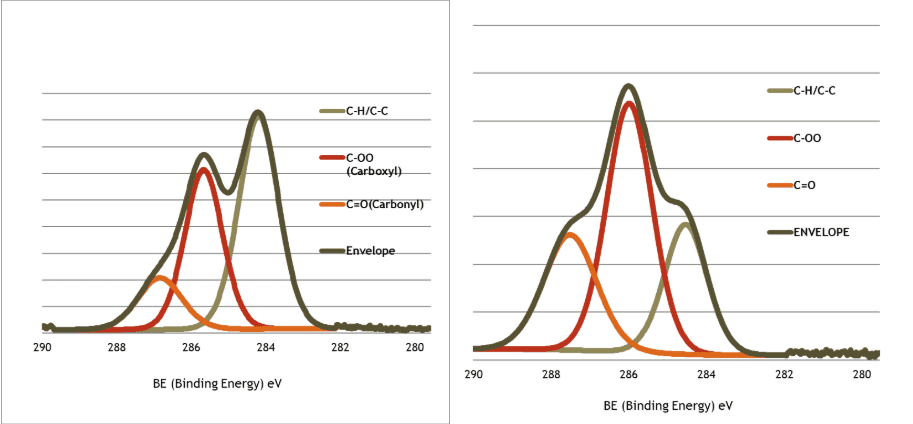
X-Ray Photoelectron Spectroscopy showed increased oxygen-based functional groups on plasma-treated Khadi cotton fabric surfaces compared to untreated samples, confirming chemical surface modification.
Conclusion
The combined use of plasma treatment and rare earth salts as mordants for natural dyeing of Khadi cotton and silk fabric results in:
- Enhanced dye uptake and colour strength (K/S values).
- Improved wash and light fastness properties.
- Increased wettability and wickability due to oxygen-containing polar groups on the fabric surface.
- Sustainable, eco-friendly process with reduced mordant quantity and effluent load.
- Minimal impact on the mechanical strength of the fabric.
This synergistic technique offers promising prospects for sustainable natural dyeing in the textile industry.
References
- Gangwar, Archana and Vankar, P.S., Natural dyeing mediated by Atmospheric air pressure plasma treatment of polyester,(2024) Pigment and Resin Technology- The international journal of colorants, polymers and colour applications, Vol. 53 No. 5, 569-575.
- Begum, Afreen; Vankar, Padma Shree (2024) Natural dyeing of khadi cotton using rare earth salts as mordant with annatto extract, Pigment and Resin technology, Vol. 53 No. 6, 1051-1054.
- Begum, Afreen; Vankar, Padma Shree, (2023) Effect of plasma on the mechanical strength of Khadi cotton, BTRA Scan, 52(4), 17-21.
- Gangwar, A.and Vankar,P.S.( 2021) Surface modified Rare earth mordanted cotton, dyed with Eupatorium Extract, BTRA Scan,VolL No 3 page 7-11.