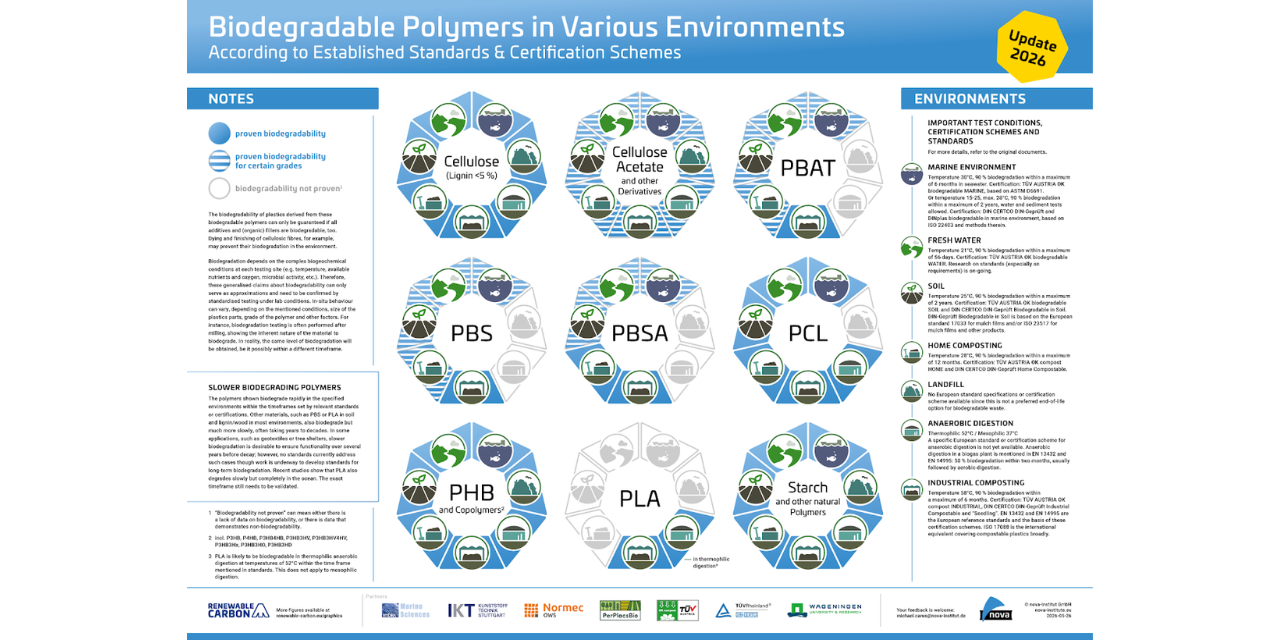
nova-Institute has released an updated version of its widely used poster titled “Biodegradable Polymers in Various Environments” under the PerPlacsBio project, offering an expanded and more precise overview of polymer biodegradability across different environmental conditions.
The 2026 update incorporates the latest scientific research and regulatory standards, providing clearer insights into how biodegradable materials behave in soil, marine, freshwater, and composting environments. It also reflects updated certification frameworks and testing methodologies used internationally.
Key material updates include revised classifications for PBSA, PBS, and PBAT, now recognised as having proven biodegradability in multiple environments, including soil, marine, and freshwater, with PBS also confirmed for home composting. These changes are based on improved material data and enhanced testing outcomes.
The poster now includes additional references to major standards such as ISO 17088, ISO 23517, and NF T 51-800, along with corrections and clarifications to existing certifications like EN 17033 and marine biodegradation protocols. These revisions ensure closer alignment with current global certification systems.
Further improvements enhance scientific clarity and usability, including a new note explaining the meaning of “biodegradability not proven,” updated information on slower-degrading materials such as PLA in marine conditions, and the inclusion of the PerPlacsBio project branding. The poster is also now available in German for wider accessibility.
Developed in collaboration with research institutions and certification bodies across Europe, the initiative continues to support science-based understanding of when biodegradability can serve as a valid end-of-life solution for plastics, particularly in agricultural and forestry applications.
The updated poster is available for download in both English and German in PDF and PNG formats via nova-Institute’s publication platform.