If you’ve never been to the Kala Ghoda Arts Festival, picture this: a crescent-shaped stretch of South Mumbai — framed by heritage buildings, art galleries, and centuries of stories — suddenly bursting into nine days of music, art, craft, conversations, and colour. No ticket counters. No velvet ropes. Just the city, its people, and creativity in full flow.
That’s Kala Ghoda. And every year, it somehow gets better.
The festival started in 1999 as something Mumbai had never quite seen before — a multi-disciplinary street arts festival, free for everyone, smack in the middle of one of the city’s most beloved cultural precincts. What the Kala Ghoda Association envisioned back in 1998 — preserving the heritage of this art district while making it alive and accessible — continues to play out beautifully each January or February. This year was no different.
Craft With a Conscience: Anveshanam Foundation
Among the many installations and stalls that lined the festival grounds, one quietly demanded a second look.
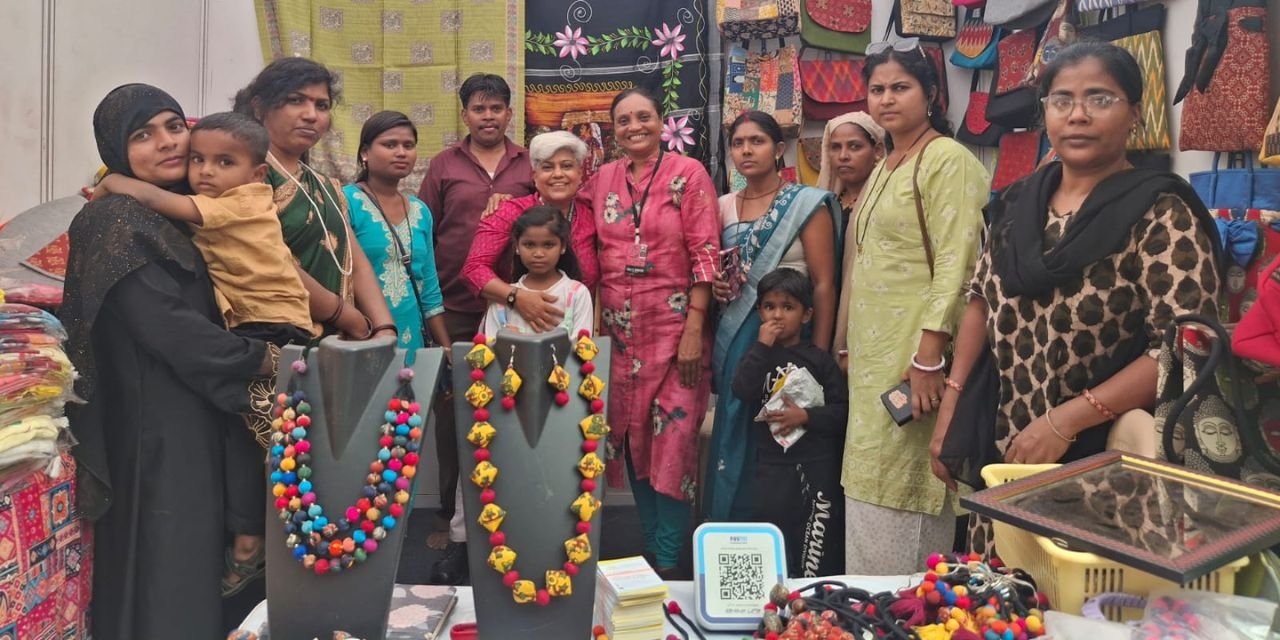
Anveshanam Foundation, led by Dr Ela Manoj Dedhia, set up what looked like a thoughtfully curated craft stall — handmade bags, jewellery, hair accessories, utility products. But once you stopped and looked closer, the story behind each piece was something else entirely.
Every item was handcrafted by women from Mumbai’s urban slums, using pre-consumer textile waste. Fabric that would have otherwise been discarded was quilted, layered, and designed into products that were genuinely beautiful — and genuinely sellable.
Over four festival days, the stall drew consistent crowds. The handmade hairbands became a surprise crowd favourite, appreciated not just for their aesthetics but for the conscious design behind them. Visitors who learned about the model — that 100% of profits go directly to the women artisans, with Anveshanam retaining no commission — appreciated the transparency and made repeat purchases. Several expressed interest in engaging beyond the festival.
For many of the artisans, this was a series of firsts: their first direct conversation with a customer, their first time presenting their craft to a public audience, their first earnings in a formal cultural setting. The foundation’s role is upstream — skill training, design guidance, financial literacy, market linkages — so that what women build, they truly own.
What Anveshanam demonstrated at Kala Ghoda 2026 wasn’t just a stall. It was a working model of circular economy and grassroots enterprise, presented in one of Mumbai’s most design-conscious spaces. The fit was perfect, and the response proved it.
Livelihood supports daily living, but a fulfilling life depends on clarity of thought, caring relationships, and respect for nature. Through Universal Human Values sessions, artisans and their families nurture understanding, empathy, and responsibility toward one another and the environment. This encourages ways of living and working that minimise harm, use resources mindfully, and sustain both community well-being and ecological balance.
Architecture That Breathes: MET School’s Loom of Time
If Anveshanam’s stall made you think about where things come from, the installation by students of MET School of Architecture and Interior Design, Nashik, made you think about where we come from — and where we go.
Guided by Head of Department Ar. Manish Patil, and narrated to visitors by third-year product design student Harivansh Narang, the installation was titled Loom of Time: Weaves of India — a response to this year’s festival theme, Ahead of the Curve.
The concept was elegant in its simplicity: life, mapped through fabric.
The installation walked visitors through the human journey — from birth to death — using different textiles at each stage. A Manzar Path (the purest ceremonial cloth in Indian tradition) at the very beginning, representing birth. Raw jute — Bardana — for early childhood, that rough and unsteady phase of learning to walk and fall. More refined jute for growing confidence. Cotton for the free, expressive years. Sarees for the role of a mother, passing on values and habits. A middle section representing choice, agency, and karma — rendered in bright yellow for the good, dark tones for the not-so-good. And finally, towards the end, clothes slowly unravelling back into threads — all converging into a single flat line, echoing the flatline of a heart monitor.
The installation didn’t tell you what to feel. It asked what you believed. Where does the thread go after it becomes one? The students didn’t answer that. They left it open, which is precisely the point of ahead of the curve. We don’t know what’s next. None of us do.
It was one of those rare installations that you walk through once and then walk through again slowly.
Why This Festival Matters
Everything raised at Kala Ghoda — every stall fee, every sponsorship — goes back into the restoration of the precinct itself. The festival is, in essence, a fundraiser disguised as a celebration. And it works, because people come not out of obligation but out of genuine love for what this corner of Mumbai represents.
The 2026 edition continued that tradition — drawing visitors not just from across the city, but from across the country and beyond. Artists, architects, students, entrepreneurs, heritage enthusiasts, and people who simply wanted a good weekend in a place that still feels like Mumbai used to.
If you missed it this year, mark your calendar for next January. And if you were there, you already know.