The global nettle fibre textile market is witnessing notable expansion, driven by increasing demand for sustainable and low-impact materials across the textile value chain. As environmental concerns reshape consumer preferences and industry practices, nettle fibre is emerging as a viable alternative within the natural fibres segment.
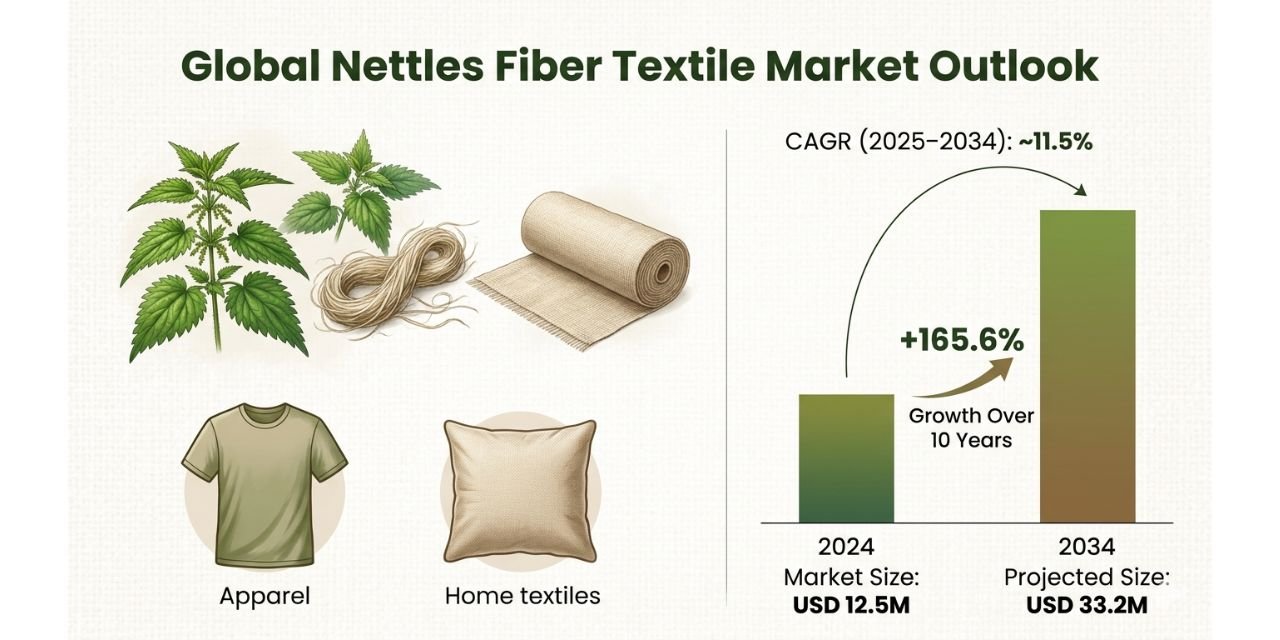
According to industry estimates, the market was valued at approximately USD 12.5 million in 2024 and is projected to reach over USD 33.2 million by 2034, registering a compound annual growth rate (CAGR) of around 11.5 percent between 2025 and 2034. This growth reflects a broader transition away from synthetic fibres towards biodegradable and eco-conscious textile solutions.
Market Evolution and Historical Context
Although nettle fibre has historical roots dating back centuries, its industrial relevance declined after World War II due to high labour costs and the dominance of cheaper fibres such as cotton. However, renewed focus on sustainability and circular textile systems has revived interest in this traditional fibre.
Over the past two decades, the market has steadily grown from nearly USD 2 million in 2000 to USD 12.5 million in 2024, supported by the expansion of the global natural fibre industry, which is now valued at over USD 69 billion.
Key Applications Driving Demand
Nettle fibre is increasingly being adopted across multiple end-use segments:
- Fashion and Apparel: Leading segment due to rising demand for sustainable fashion
- Home Textiles: Growing use in eco-friendly interior applications
- Industrial Use: Includes filtration materials, packaging, and protective textiles
- Automotive: Application in seat fabrics and interior components
Its performance characteristics position it as a strong alternative to linen and hemp in biodegradable and technical textile applications.
Regional Market Insights
- Europe holds the largest market share, driven by strong environmental regulations and eco-textile initiatives in countries such as Germany, France, and the UK.
- Asia-Pacific is expected to witness the fastest growth, supported by expanding manufacturing capabilities in China, India, and Japan.
- North America is experiencing rising investments in sustainable textiles, particularly in the United States and Canada.
- Latin America and Middle East & Africa are emerging markets with growing awareness but limited infrastructure.
Pricing Trends and Market Dynamics
Nettle fibre remains a premium material due to labour-intensive processing methods. Prices typically range between USD 15–30 per kilogram for raw fibre and USD 30–60 per kilogram for refined, spinnable fibre. Fabric prices range from USD 25 to 50 per metre, depending on blend composition and certifications.
Future Outlook and Growth Drivers
The market outlook remains positive, with projections estimating a value of approximately USD 25.8 million by 2030 and surpassing USD 33 million by 2034. Growth is supported by:
- Government incentives promoting sustainable materials
- Increasing adoption of natural fibre mandates in fashion
- Advancements in fibre processing technologies
- Rising consumer preference for biodegradable textiles
Competitive Landscape
Key players in the nettle fibre textile market include Green Nettle Textile, Camira Fabrics, Stinging Nettle Textiles, and Ecological Textiles, all contributing to innovation and supply chain expansion.
Conclusion
With sustainability at the forefront of the textile industry, nettle fibre is transitioning from a niche material to a scalable solution. Backed by strong growth projections and increasing industry adoption, the market presents promising opportunities for stakeholders across fashion, automotive, and industrial sectors.