Weaving Stories, Preserving Heritage: A Celebration of India’s Textile Soul
“Swaraj is my birthright, and I shall have it” – these powerful words from Bal Gangadhar Tilak echoed through the corridors of history on August 7th, 2025, as India once again came together to honour the artisans whose skilled hands continue to weave the very fabric of our nation’s cultural identity.
The National Handloom Day 2025 Conference successfully brought together industry stakeholders, researchers, policymakers, and artisans to address critical challenges and opportunities facing India’s handloom sector. Held at the newly renovated Textiles Committee boardroom in Mumbai, the conference marked the 11th anniversary of National Handloom Day with substantive discussions on sustainability, market access, technological integration, and heritage preservation.
The event featured presentations from Textile Value Chain, Textiles Committee, and Anveshanam Foundation. With participation spanning from seasoned industry veterans to emerging scholars, the conference demonstrated the sector’s commitment to bridging traditional craftsmanship with contemporary market demands.
Conference Opening and Context
Opening Address and Historical Significance
Ms Jigna Shah, Director of Fashion Value Chain, opened the conference by establishing the historical significance of August 7th, connecting it to the Swadeshi movement of 1905 and the establishment of National Handloom Day by the Prime Minister in 2015. She outlined the conference’s primary objective: bridging traditional handloom artistry with modern technology while recognising the authentic narratives embedded in handloom products.
Shah acknowledged India’s diverse textile ecosystem, encompassing traditional handlooms, power looms, mill sectors, and advanced machinery as complementary rather than competing elements. Her introduction of Chief Guest Ms Roop Rashi Mahapatra highlighted the latter’s five-year commitment to industry development and current leadership role as CEO of KVIC.
Welcome Address, Genesis, and Objectives
Dr Ela Dedhia, Director of Anveshanam Foundation, welcomed all participants and expressed gratitude to Honourable Roop Rashi Madam, CEO of KVIC, whose presence during last year’s online conference and again this year reflects her deep commitment to handloom weavers.
She reminded the gathering that though National Handloom Day was officially declared in 2015, but their engagement with artisans began much earlier. Recalling the pandemic, she noted how the first online conference helped weavers adopt digital marketing to promote their “beautiful work” when they struggled to meet basic needs. What began as a crisis response has now grown into an annual platform, reflecting the sector’s resilience and the need for ongoing dialogue.
This year’s event, held with the Textile Committee after last year’s partnership with Textile Value Chain, brought together designers, digital experts, faculty, students, and leading institutes. Dr. Dedhia also shared a case study of differently-abled artisans weaving on leg pedal looms without electricity, broadening awareness of what qualifies as a handloom.
She stressed that in today’s fast-changing AI-driven world, artisans must gain exposure and opportunities so they are not left behind. Concluding, she thanked industries, institutes, and designers, with special acknowledgement to Dr K. Muralidhara, Joint Director, Ministry of Textiles, and Mr Kartikay Dhanda, Deputy Director, Textiles Committee, affirming that the conference is “just the beginning” of sustained collaboration for India’s handloom sector.
The inclusion of multiple generations was intentional, aimed at fostering awareness and igniting a passion for India’s rich handloom textile heritage.
Institutional Perspectives
Textiles Committee: Quality Assurance and Market Access
Mr Kartikay Dhanda, Deputy Director, Textiles Committee, presented the Textiles Committee’s role as a statutory body operating 70 laboratories across India with 21 offices dedicated to textile quality improvement. He detailed two critical certification programs: the Handloom Mark (the world’s only origin certification for handloom products) and the India Handloom Brand (ISB) mark, ensuring quality through 12 testing parameters.
Key achievements include verification of over 1,700 handlooms in the past month through improved Standard Operating Procedures, and registration of over 25,000 entities with 9,000 pending applications. The committee has distributed 21 crore labels supported by extensive government promotional campaigns.
Significant developments announced included:
- Ministry of Textiles’ carbon footprint study by IIT Delhi showing 50% lower emissions in handloom versus power loom production
- Upcoming online portal for exclusive handloom product sales
- Concurrent National Handloom Day celebration in Delhi with Presidential participation
Registration through the online portal hlm.gov.in costs ₹50 plus GST, requiring home verification of weaving activity and loom ownership to ensure authenticity.
KVIC: Rural Development Through Traditional Industries
Mr M. Rajan Babu traced KVIC’s institutional development from Gandhi’s 1925 All India Village Industries Association to its 1956 parliamentary constitution. Operating under the Ministry of MSME, KVIC focuses on non-farm employment development and rural self-reliance through 2,900+ registered Khadi institutions serving 500,000+ artisans.
The organisational structure includes six zonal offices, 40 state offices, and 18 training centres nationwide. Primary schemes include Khadi Vikas Yojana, Rozgar Yojana, and the flagship PMEGP scheme. The Modified Marketing Development Assistance provides substantial incentives: 35% for cotton/woollen Khadi artisans, 30% for silk artisans, and up to 60% for institutions.
KVIC targets ₹250 crores annual disbursement, reaching 70,000+ artisans. Diversification initiatives include honey production programs that generated ₹70,000+ turnover within months, demonstrating the organisation’s comprehensive approach to rural development.
Leadership Vision and Strategy
Keynote Address: Comprehensive Sector Development
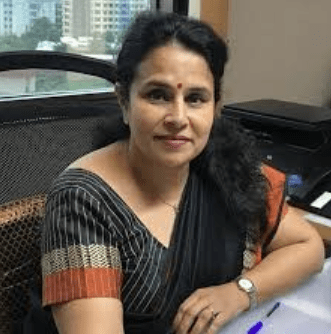
Ms Roop Rashi Mahapatra delivered a strategic vision emphasising value creation across all textile segments from traditional handlooms to technical textiles. She advocated moving beyond comparative debates between different craft sectors, focusing instead on artisan empowerment and sustainable practices.
Key policy perspectives included:
- Leveraging the 2014 GI (Geographical Indication) recognition benefits for market protection
- Strengthening product labelling with scientific credentials, including carbon footprint data
- Addressing sustainability through four critical verticals: energy, water, dye, and manpower
- Promoting natural dyes as the most critical yet underutilised sustainability component
She proposed collaboration between KVIC and the Textiles Committee for converting agricultural waste into natural dyes, creating micro-enterprises for flower waste utilisation. This approach aligns traditional knowledge preservation with environmental sustainability and rural economic development.
Knowledge Documentation and Preservation
Publication Launch Ceremony
The conference featured the launch of two significant publications in the presence of Ms Roop Rashi Mahapatra:
“The Dye Alchemist: Exploring Colors, Textiles & Healing” by Dr Ela Dedhia documents 25 years of natural dye research since 1998. The book encompasses extensive laboratory experiments and field work with artisans in Gujarat, Maharashtra, and Rajasthan, including documentation of healing properties tested in specialised laboratories.
“The Rhythms of the Loom: Keeping India’s Heritage Alive” features multiple authors sharing experiences with handlooms and artisans. Both publications represent collaborative efforts between three organisations, bridging traditional knowledge with contemporary applications.
The ceremony emphasised community impact documentation, recognising that handloom production involves entire families and villages, making comprehensive documentation essential for heritage preservation.
Digital Innovation and Market Access
Technology-Enabled Marketplace Solutions
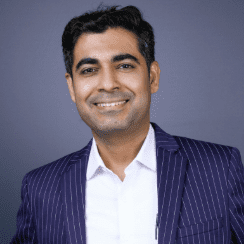
Mr Kailash Gajara, Founder of Atulsia Technologies, presented Megastores.com, an exclusive online marketplace for handicraft and handloom products, launched post-COVID to address artisan marketing challenges. His analysis identified four critical problems: reach, identity, benefit, and trust affecting both artisans and customers.
The platform addresses these challenges through:
- Blockchain technology for complete product traceability
- QR code systems enabling customer access to origin, raw materials, and artisan community information
- 500+ GST-registered sellers connecting over 5,000 artisans across 15 states
Critical market disparities were highlighted, including significant wage gaps between regions (Karnataka artisans earning ₹45/hour versus Bengal artisans earning ₹300/hour for similar work). The platform aims to address fair pricing issues while promoting authentic handmade products through enhanced market visibility.
Design and Industry Perspectives
Global Context and Standardisation Needs
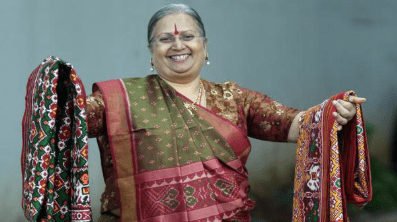
Ms Bela Sanghvi positioned India’s textile heritage within a global context, noting that India hosts the world’s largest community of skilled hand weavers, spinners, and textile artisans. This contrasts with the United States, which maintains only 5,000 remaining handlooms, highlighting India’s unique preservation responsibility.
Key industry challenges identified include:
- Sector’s loose organisation requiring standardisation and skill evaluation
- Critical fair pricing issues with stark regional disparities
- Need for consumer education distinguishing handloom from machine-made products
- Employment generation potential (silk production employs 60 people, cotton employs 80 people, from farm to finished product)
She advocated standardising over 300 identified handloom technologies to help consumers understand value propositions, explaining price variations from ₹10,000 single ikat pieces to ₹5-7 lakh double ikat masterpieces based on skill requirements and artistic complexity.
Government Schemes and Market Integration
Handloom Mark Implementation
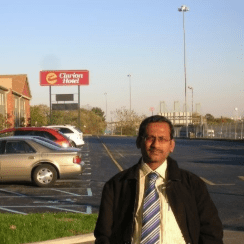
Dr K. Muralidhara, Joint Director, Ministry of Textiles, detailed the Handloom Mark and India Handloom Brand schemes as direct market connection pathways for weavers. Implemented by the Textiles Committee since 2006, these programs provide collective product identity and quality assurance.
The scheme exclusively registers weavers, societies, and cooperatives, prohibiting traders from preventing label misuse. Each label contains QR codes linking consumers to weaver information and stories, enabling direct market access from remote villages.
Implementation results include:
- Over 25,000 registered entities with 9,000 pending applications
- Particular interest from northeastern weavers seeking market exposure
- 21 crore labels distributed with extensive promotional campaigns
- ₹50 plus GST registration cost through the online portal hlm.gov.in
The initiative aims to improve weaver economic conditions through demand generation and direct market linkage, eliminating intermediary dependencies.
Inclusive Innovation and Accessibility
Differently-Abled Artisan Integration

Dr Ela Dedhia presented an impact study on handloom weaving by differently-abled persons using manual leg pedal looms at SVRR. Founded in 1965, the organisation serves 75 mentally challenged adults across three centres in Mumbai and Vasai with structured 9 AM to 5 PM operations, including transportation.
Key findings include:
- Manual leg pedal weaving qualifies as a handloom (power usage, not manual operation, determines categories)
- Six-month training programs with experienced masters
- Specialised loom adaptations enabling operation through leg pedals with hand-passed weft
- Product range including kitchen napkins, mats, towels, and doormats, using consistent wool and cotton sourcing
- Handloom weaving serves as a meditative process for the mentally challenged, providing therapeutic benefits alongside skill development
Beyond production, participants receive marketing training and directly engage customers at exhibitions, completing the value cycle while building confidence through skill empowerment.
Adaptive Technology Development
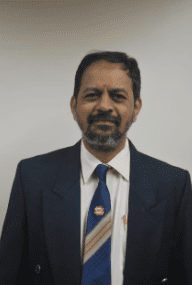
Mr Nishant Mhatre, Managing Trustee of Leela Mhatre Pratisthan, presented seven months of innovation developing handloom technology for physically challenged persons. With 48 years of handloom experience, he emphasised the essential human-machine integration, distinguishing handlooms from power looms.
His adaptive technology addresses two disability categories:
- Persons without legs but with functional hands
- Persons with other physical limitations
Using applied physical mechanics, the adaptations enable comfortable weaving of products like towels. The prototype received national recognition and the Helen Keller Award, validating the innovation’s social impact.
The Leela Mhatre Pratisthan continues organising workshops for physically challenged persons across Maharashtra, promoting handlooms as user-friendly, eco-friendly, environment-friendly, and family-friendly tools.
Research and Development Initiatives
Sustainable Dyeing Technology

Ms Afreen Begum, Senior Scientific Officer at BTRA, presented research on sustainable dyeing of handwoven Khadi fabrics using rare earth salts as eco-friendly mordants. The study addressed environmental concerns in textile wet processing while maintaining quality standards.
Research methodology included testing 14 natural dyes with six rare earth salts (cerium nitrate, lanthanum chloride, lithium compounds) as mordants. Results demonstrated:
- Rare earth salts require 10 times less quantity than conventional mordants
- Improved colour depth, light fastness, and wash fastness properties
- Significantly reduced pollution load
- Unique coordination properties create effective binding mechanisms
This research addresses consumer demands for non-bleeding fabrics while reducing environmental impact, supporting natural dye revival initiatives and global sustainability goals.
Fibre Innovation in Traditional Crafts

Ms Vibhuti Khedekar, PhD Scholar at Nirmala Niketan College, presented research on linen-cotton blends in Khadi production. Coming from a KVIC family background, her research aimed to expand Khadi’s fibre base through innovative combinations.
The project, executed at Udyogpati Gondal, Gujarat, involved 84-year-old women spinners and male weavers, developing two blend ratios:
- Blend A (55:45 linen:cotton): Higher GSM, medium air permeability, 73.1% drape coefficient, suitable for formal wear
- Blend B (30:70 linen:cotton): Improved air permeability, 63.3% drape coefficient, ideal for casual wear
Both blends demonstrated superior sustainability metrics with lower water footprint and biodegradable properties. The research addresses youth engagement challenges by creating Khadi products competitive with contemporary branded alternatives while maintaining traditional production methods.
Heritage Protection and Documentation
Regional Textile Traditions
Dr Ela Dedhia’s presentation on Kutch’s thousand-year textile heritage detailed the Vankar weaving community’s historical migration and traditional practices. The barter system between Mewal weavers and local communities established sustainable relationships involving healing services and security exchange.
Kutch textiles received GI recognition in 2011, covering 35+ villages from Anjar to Narayan. Traditional production used Kala cotton and natural dyes, with babool trees providing black and majith yielding red colours. Contemporary versions incorporate silk and mixed colours while maintaining core techniques.
Post-earthquake impacts created disparities, with some artisans achieving international recognition while others struggle for sustenance. Despite NGO interventions, challenges persist in natural dye adoption, with many artisans using non-eco-friendly mordants. A disparity exists between handloom weavers with respect to design and product development, marketing reach, technology, and financial literacy, which need to be addressed.
Geographical Indication Implementation
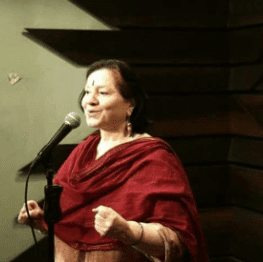
Dr Manjula Jagramka, Director at Vaitarna, addressed the GI tag significance in protecting handloom heritage. Her presentation revealed limited audience awareness of GI tags despite their crucial role in authenticity protection.
Key points included:
- Consumer education necessity in identifying authentic handloom products
- Contemporary challenges in visual product authentication
- Market protection requirements through proper certification systems
- Reference to Shyam Benegal’s “Susman” (1987) documenting the traditional weaver lifestyle
The presentation emphasised that legal protection requires corresponding market awareness and consumer education to distinguish genuine handloom from machine-made alternatives.
Entrepreneurial Innovation
Sustainable Business Models
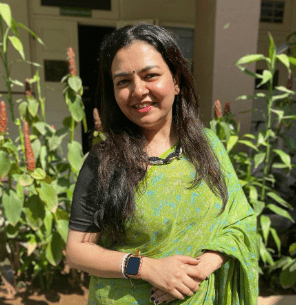
Ms Dhara Padia, Founder of Doodads Creations, presented her entrepreneurial approach to making handloom accessible across economic strata. Her business model creates products ranging from ₹50 to ₹50,000, ensuring inclusivity while maintaining quality standards.
Innovation highlights include:
- Waste management approach collecting handloom fabric scraps (chindis) from tailors
- Transformation of waste materials into jewellery products, demonstrating circular economy principles
- Post-COVID market observations showing a shift from fast fashion to slow fashion
- Consistent outperformance of handloom items over imitation products at exhibitions
Her strategic philosophy emphasises: Depth over Display, Process over Product, Impact over Impulsive, and International Runways over Street recognition.
Cultural Preservation Through Education
Student Engagement and Heritage Transmission
The conference’s cultural showcase featured students from the Department of Textile and Fashion Technology presenting regional handloom traditions through a fashion walk. This segment demonstrated practical heritage preservation through educational engagement.
Featured regional specialities included:
- Maharashtra: Paithani and Narayan Peth saris showcasing silk and khadi traditions
- South India: Pochampally double ikat, Kanchipuram silk, and Kasuti embroidery
- Regional Variations: East Indian saris, Nauvari draping, Lucknowi Chikan, and Bengal Tant
The presentation emphasised generational knowledge transfer, with contemporary students confidently presenting traditional heritage, reinforcing the handloom’s continuing relevance among younger demographics.
Conference Outcomes and Recommendations
Immediate Achievements
The conference successfully established multi-institutional collaboration frameworks, demonstrated through partnerships between academic research institutions, government agencies, and commercial enterprises. Knowledge transfer occurred across generational and sectoral boundaries, creating sustainable dialogue mechanisms.
Key networking outcomes included connections between BTRA researchers and KVIC initiatives, Textiles Committee standards supporting individual innovations, and academic institutions engaging with commercial enterprises for practical application development.
Future Directions
Emerging recommendations from conference discussions include:
Institutional Development:
- Regular symposiums for ongoing handloom development discussions
- Enhanced GI tag awareness and implementation across sectors
- Strengthened industry-academic partnerships for research applications
Market Development:
- Youth engagement programs for handloom appreciation
- Consumer education initiatives for authentic product identification
- Digital platform development for direct artisan-market connections
Sustainability Integration:
- Circular economy principle promotion in traditional textile production
- Natural dye research and implementation scaling
- Carbon footprint documentation for market differentiation
Policy Support:
- Continued government scheme optimisation based on field feedback
- International market access facilitation through certification programs
- Artisan training and skill development program expansion
Conference Management
The conference was expertly compered by Ms Priscella Pinto, Product Manager, Raymonds Pvt Ltd, who served as the compère throughout the event, ensuring smooth transitions between sessions and maintaining engagement among participants.
Vote of Thanks: The conference concluded with a heartfelt vote of thanks delivered by Ms Niyati Mota, Manager, Anveshanam Foundation, and Dr Ela Dedhia, acknowledging all participants, speakers, institutions, and the online YouTube audience for their valuable engagement and support in making the 11th National Handloom Day conference a resounding success.
Conclusion and Impact Assessment
The National Handloom Day 2025 Conference demonstrated the handloom sector’s capacity for innovation while maintaining traditional authenticity. The multi-stakeholder approach, combining academic rigour with industry pragmatism and government support with individual innovation, created a comprehensive development framework.
Student participation and cross-generational knowledge sharing indicated successful heritage transmission mechanisms. The conference’s emphasis on quality improvement, market expansion, and artisan empowerment provides a foundation for sustainable sector growth while preserving cultural integrity.
The commitment to ongoing collaboration beyond the conference, evidenced by planned follow-up initiatives and established partnerships, suggests meaningful long-term impact potential. The sector has demonstrated clarity about its challenges, confidence in its value proposition, and unity in addressing development priorities.
Moving forward, the handloom sector is positioned to leverage traditional strengths while addressing contemporary market demands through technological integration, sustainability practices, and inclusive growth strategies. The conference established that heritage preservation and modern development are complementary rather than competing objectives, providing a roadmap for sustainable sector advancement.
This entire event was curated by Dr Ela Dedhia, Founder Director, Anveshanam Foundation.