
Hardika Pravin Rakka, Textile Management Scholar, National Institute of Fashion Technology, Ministry of Textiles Govt of India.

Dr Vidhu Sekhar P, Asst Professor, Department of Fashion Management Studies, National Institute of Fashion Technology, Ministry of Textiles Govt of India.
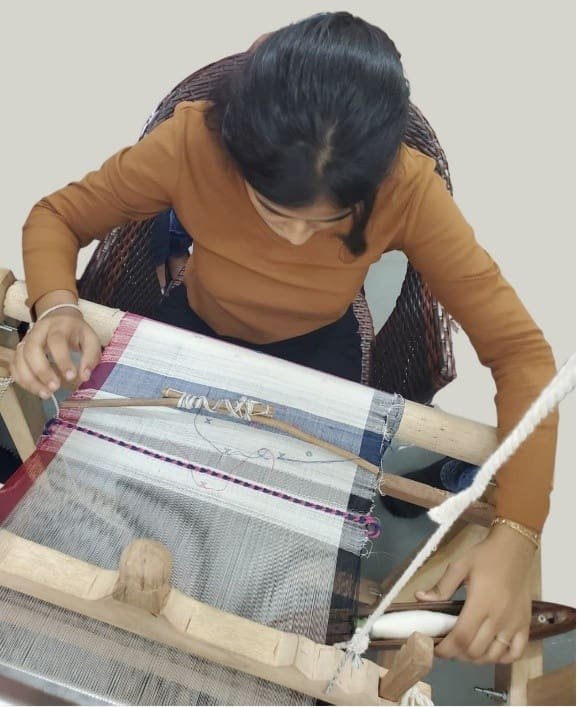
What if the oldest fabric was also the best? Even though we live in a world of labs and engineered fabrics, khadi has been a treasure in India for hundreds of years. This cloth is more than just a piece of fabric; it is living technology. It gets cooler in the summer and warmer in the winter. It breathes through the skin, and every time you wash it, it gets softer. Researchers from around the world are trying to make fabrics that can keep the body cool, absorb sweat, and change shape to fit how the body needs the. Even before the term “smart textiles” became popular, people knew these things about khadi. For hundreds of years, people have been doing it at the loom and spinning wheel, but modern science has a hard time making things that can change.
It hurts the earth just as much. It takes almost fifty-five litres of water to make one metre of cloth in a mill. Making khadi, on the other hand, only takes three litres. There are no loud machines, a lot of electricity, or trash from factories in the process. When someone spins a thread on the charkha, it helps artists and their communities. As the world measures carbon footprints more closely, the fashion industry’s emissions remain alarmingly high. Khadi teaches you how to keep the earth safe.
In the past, people thought that khadi meant freedom and independence. It all started with Gandhiji. Today, people all over the world are excited about it, and designers love it. People used to think the uneven weave was bad, but now they see it as proof that it’s real and one of a kind. When you wear it on the runway or in a store, it turns into sharply fitted blazers, pastel co-ords, trench coats, and flowing drapes that look good on everyone. When you wear it with silk or wool, it looks like eveningwear. Gen Z wants clothes that are useful, comfortable, and let air flow. Khadi has broken free from every box it was put in and has easily gone from being streetwear to high fashion. In a world where what we wear next to our skin is just as important as the food we eat or the skin care products we choose, Khadi gives you thoughtful comfort with quiet style.
This is happening in more than just India. People from different cultures can understand khadi. People in Europe value rarity, handmade design rare because they show that it is one-of-a-kind and well-made. People in North America who care about their health and like clothes made from natural materials that let air through. Wabi-sabi is a Japanese word that means finding beauty in things that are not perfect. Khadi is a big part of Indian culture, but you can wear it in other places too.
Khadi is even better for designers because it goes well with other crafts. It looks great with prints, takes dye well, and is a good base for embroidery or decoration. You could compare khadi to the earthy shapes of Baghru block prints, the fine threads of Kashmiri sozni, the sparkles of Kutchi mirrors, the depth of Ajrakh, or the stories that Kantha stitches tell. Each mix makes a piece of fabric that is both new and old at the same time. It has a lot of old information that helps us think of new ways to do things. Ritu Kumar, a designer, says that khadi is “the fabric that holds all others within it.” This quote perfectly sums up how flexible it is and how it can hold India’s textile history in just one thread.
It reminds us that the simplest things can have the most amazing potential. Khadi gives us a glimpse of what fashion might be like in the future. It cannot be made by machines; it is made by a person’s vision, heritage, and touch.