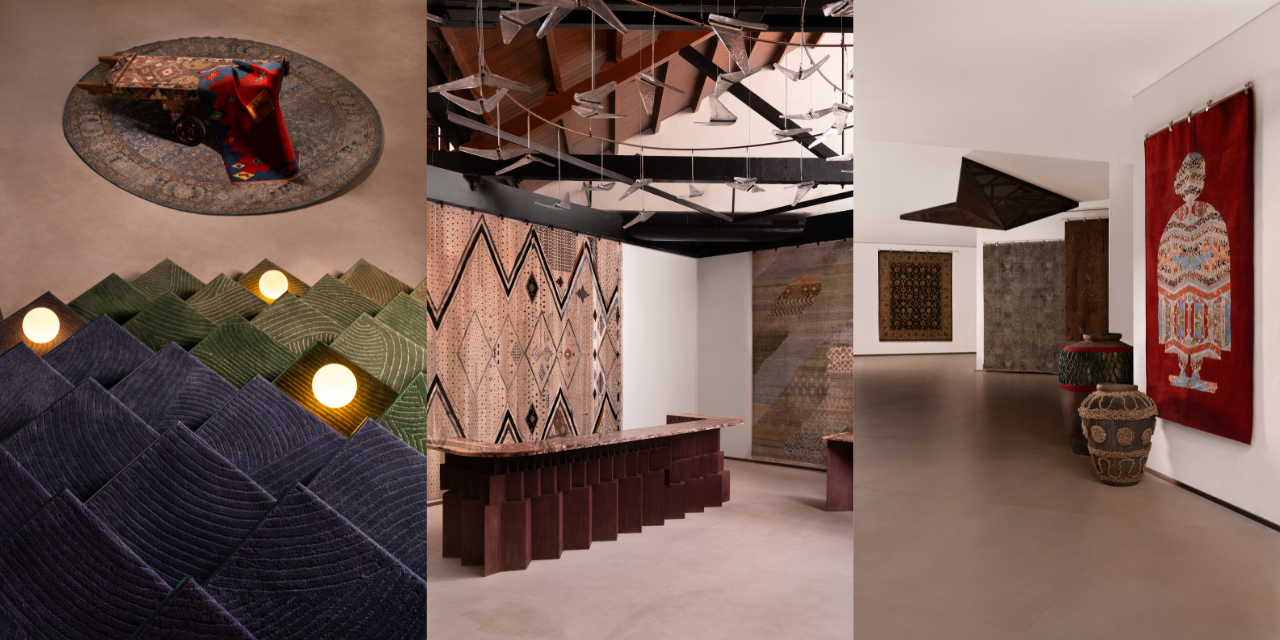
Jaipur Rugs Opens New Flagship at Mumbai’s Historic Empire Mills
Jaipur Rugs has unveiled a 20,000 sq. ft. flagship store at Mumbai’s historic Empire Mills, bringing together Indian craft traditions, contemporary design and the industrial heritage of the city’s textile district.
Located within the historic Empire Mills compound, the new flagship transforms a former industrial warehouse into an immersive experience centre centred on craft, design, architecture and contemporary luxury. The store marks a significant step in Jaipur Rugs’ evolution from a handmade rug company into a global design and luxury brand rooted in Indian craftsmanship.
Where Textile Heritage Meets Contemporary Design
Rather than presenting rugs simply as home décor products, the flagship positions them as expressions of art, craft and living heritage.
The warehouse’s original Victorian steel structure, pitched roof and clerestory glazing have largely been preserved, retaining the architectural character of a building connected to Mumbai’s textile history.
The location forms part of the historic Girangaon precinct, which played a central role in Mumbai’s textile industry. Jaipur Rugs sees the setting as an opportunity to connect the city’s industrial past with the living traditions of Indian weaving.
“For me, this store represents more than expansion. It is about taking the story of Indian craftsmanship into a space where it can be experienced, understood and valued in a new way. Empire Mills carries the memory of Mumbai’s textile heritage, while Jaipur Rugs carries the living tradition of the Indian loom. Bringing the two together felt incredibly meaningful. We want people to walk into this space and leave with a deeper appreciation for the human skill, time and emotion behind every handmade rug. This is how we believe Indian craft can find its place in the global luxury conversation,” said N.K. Chaudhary, Founder, Jaipur Rugs.
An Immersive Retail Experience
The flagship has been designed as an experience centre rather than a conventional showroom.
Contemporary collections and heritage weaves are displayed through curated environments exploring colour, texture, material and design. Artisans hand-weaving rugs in real time bring the making process into the centre of the retail experience.
Mesh partitions provide glimpses into the detailed craftsmanship involved in creating rugs that can take weeks or months to complete. Lounge settings allow visitors to experience the texture and scale of the pieces, while a vertical rug archive presents a visual journey through Jaipur Rugs’ body of work.
At the entrance, a suspended installation featuring origami-inspired metal birds creates a sculptural focal point.
“Luxury retail is changing. Customers are no longer looking only for a beautiful product; they are looking for meaning, provenance and an experience that stays with them. That is the thinking behind our Mumbai flagship. We wanted to create a space where the product, the artisan and the story behind the craft are equally important,” said Yogesh Chaudhary, Managing Director, Jaipur Rugs.
He added that Mumbai’s position as an influential design and cultural market makes the city an important destination for the brand as it works towards strengthening its global luxury positioning.
Roar Designs the Flagship
The flagship has been designed by Roar, the Dubai-based multidisciplinary design studio led by Pallavi Dean.
The studio worked with the existing industrial architecture rather than replacing it, creating a dialogue between the building’s structural elements and the tactile qualities associated with weaving.
“We didn’t want to design another showroom; we wanted to create a journey. The building already had a powerful identity, the steel structure, the pitched roof, the clerestory light and the memory of its textile past. Our role was to work with that character rather than compete with it,” said Pallavi Dean, Founder and Creative Director, Roar.
The design draws inspiration from weaving as a system of repetition, rhythm and connection, translating these principles into the architecture through fractal geometry and sculptural volumes.
Craft, Art and Global Design Collaborations
The Mumbai flagship also showcases Jaipur Rugs’ growing portfolio of design collaborations, highlighting the intersection of traditional craftsmanship, contemporary design and artistic expression.
Among the collections featured are Manchaha and Freedom Manchaha, where the imagination and individual stories of artisans form the foundation for one-of-a-kind rugs.
The store also brings together collaborations with creative voices including Pavitra Rajaram, Vinita Chaitanya, Peter D’Ascoli, Kavi, Gurjeet Singh, Gauri Khan, Tatiana de Nicolay and Her Highness Bodour Al Qasimi.
These collaborations explore the rug as more than a functional décor element, transforming it into a canvas for cultural narratives, artistic expression and contemporary design.
Putting Artisans at the Centre
A defining aspect of Jaipur Rugs’ design collaborations is the interaction between the designer’s creative vision and the technical expertise of its artisan communities.
Ideas developed by designers in India and internationally are translated through traditional weaving techniques, creating pieces that combine contemporary design language with the heritage of Indian craft.
This approach demonstrates how traditional craftsmanship can engage with global design while retaining its cultural identity.
Expanding Jaipur Rugs’ Global Footprint
Jaipur Rugs currently operates stores across India as well as international locations in Milan, Dubai, London and Singapore.
The company is evaluating further opportunities across Europe, Asia-Pacific and other established luxury markets. In India, it is also exploring expansion into markets including Chennai, Pune, Hyderabad and Gujarat.
The new Mumbai flagship at Empire Mills represents another step in this expansion, placing Indian craftsmanship and the artisan at the centre of an increasingly global luxury and design proposition.