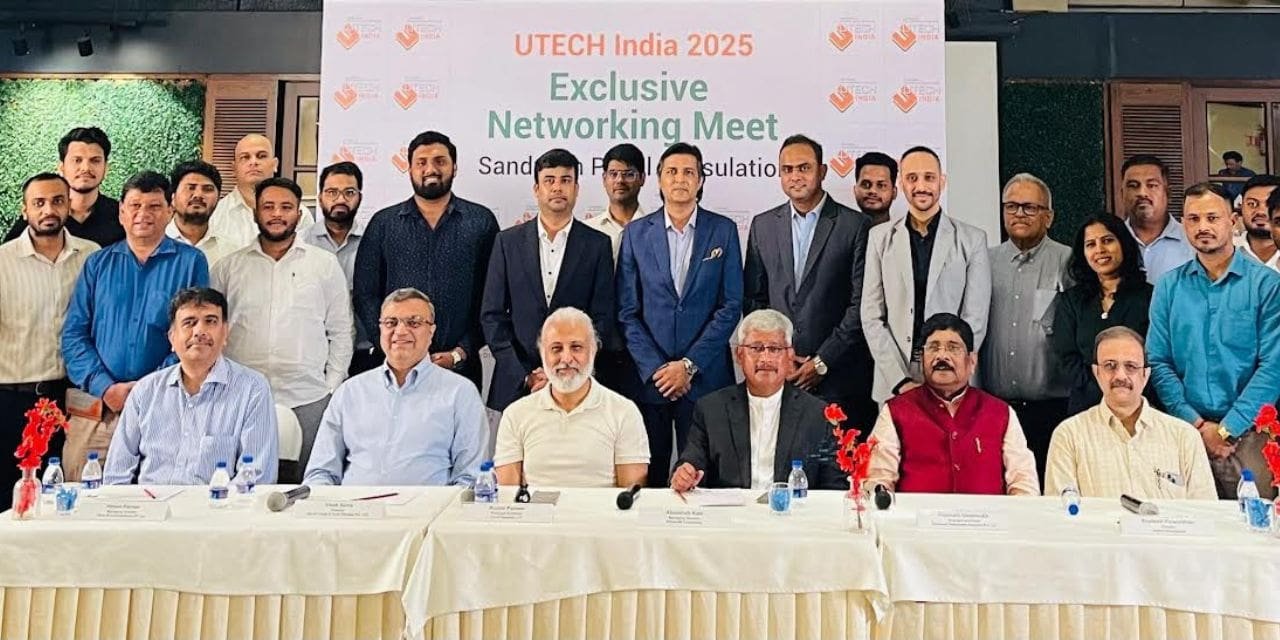
India’s path to a greener future gained momentum with the exclusive Leadership Dialogue, held ahead of the 2nd edition of UTECH INDIA – Sustainable Polyurethane & Foam (ISPUF) Expo. Themed “Transforming PU Applications, Insulation & Cold Storage Solutions,” the session brought together top industry leaders to discuss strategies for advancing sustainable polyurethane (PU), foam, and insulation innovations. The main event will take place from November 13–15, 2025, at the Bombay Exhibition Centre, NESCO, Mumbai.
Organised by Crain Communications and Media Fusion, the UTECH India Expo, alongside the Sleep Expo India Pavilion, stands as the country’s only dedicated platform for these fast-growing sectors.
Driving Innovation and Sustainable Construction
Polyurethane’s role in promoting energy-efficient construction and modern cold storage infrastructure took center stage during the discussions. Speakers explored sustainable construction methods, sandwich panel advancements, and emerging growth opportunities across the industry.
Prominent participants included Mr. Abasaheb Kale (MD, pdkASM Consulting), Mr. Hitesh Parmar (MD, REALM Intermediates), Mr. Narendra Modi (GM, Planning & Coordination, Gujarat Planning & Infrastructure), Mr. Prashant Deshmukh (Principal Architect, Prashant Deshmukh Projects), Mr. Ruchir Panwar (Principal Architect, e3+A Designs), Mr. Shailesh Patwardhan (Director, Arnita Consultants), Mr. Suunil Dabral (SVP & Regional Head – Asia Pacific, Koerber Supply Chain), and Mr. Vivek Savla (Director, Savla Foods & Cold Storage).
According to Mr. Abasaheb Kale,
“The growing focus on dry and fast construction methods is reshaping India’s infrastructure landscape. With the government mandating 25% prefabricated components in new projects, metal sandwich panels are becoming key to speed, sustainability, and thermal comfort.”
He added that despite their proven efficiency in industrial and cold chain projects, adoption in commercial and residential buildings remains limited. Given India’s rising temperatures and increasing energy concerns, embracing sustainable dry construction technologies has become essential.
Sandwich Panels: Catalysts for Green Infrastructure
Industry experts highlighted the growing importance of sandwich panels for energy efficiency, fire safety, and durability.
Mr. Prashant Deshmukh, Founder & Principal Architect, projected an optimistic outlook:
“India’s construction sector is entering a golden phase, where the adoption of sandwich panels will accelerate due to a stronger focus on quality, efficiency, and sustainability. Fire-rated panels will further strengthen compliance with modern building standards.”
Similarly, Mr. Badruddin Sudanwala, National Business Development Manager, ROCKWOOL, remarked,
“The sandwich panel industry is witnessing rapid growth as one of the most sustainable and energy-efficient alternatives to traditional systems. Prefabricated panels are redefining India’s green infrastructure.”
Mr. Nitin Kolekar, Director at Aryanvi PU Solutions, also underscored the event’s importance:
“UTECH provides a valuable platform for innovators and manufacturers to exchange ideas. As awareness grows and regulations strengthen, the industry is set for responsible and steady expansion.”
Furthermore, Mr. Kunal Karad from EPACK Prefab Technologies pointed out,
“Sandwich panels serve vital functions across pharmaceuticals, construction, and cold storage. They ensure thermal control, structural strength, and quick installation—key for sustainable infrastructure growth.”
Policy, Standards, and Competitiveness
Experts urged stronger policies and updated standards to enhance India’s competitiveness in global markets.
Mr. Abhay V. Udeshi, Chairman, Jayant Agro-Organics Ltd, noted,
“India’s PU and foam industry can become a global hub for sustainable solutions. Initiatives like Atmanirbhar Bharat, PLI schemes, and Green Building Codes are paving the way. However, addressing raw material dependency and modernizing MSMEs remain crucial.”
Adding to this, Mr. Anup Dhave, Head, Metecno Asia BV, said,
“Despite steady progress, the absence of a certifying body and outdated BIS standards restrict innovation. Updating BIS 12436 norms and managing scrap disposal and logistics costs are vital to improving competitiveness.”
Meanwhile, Mr. Sanjay Gupta, President, IFCOMA, linked these advancements to global market trends:
“Over the next decade, sectors such as footwear, construction, and automotive will drive India’s PU and foam growth, powered by sustainability, energy efficiency, and lightweight materials.”
Market Outlook: A Strong Growth Trajectory
Mr. Taher Patrawala, Managing Director, Media Fusion, summarized the industry’s momentum:
“As India moves toward becoming a global manufacturing hub, polyurethane will be central to innovation and efficiency. The India Sandwich Panel Market is projected to grow at a CAGR of 8.07%, from USD 558.61 million in FY2024 to USD 1,039.32 million by FY2032.”
Additionally, the prefabricated composite sandwich panels market is expected to expand at a CAGR of 7.2% between 2025 and 2035, reaching USD 13,623.3 million. These panels now account for 8% of the overall building materials market and 12% of prefabricated components, underscoring their increasing role in sustainable construction.
Conclusion
The Leadership Dialogue laid the foundation for strategic collaboration, innovation, and policy alignment. These priorities will shape discussions at UTECH INDIA 2025, the nation’s only event dedicated to sustainable polyurethane, foam, mattresses, and insulation solutions—uniting manufacturers, suppliers, and innovators under one roof.