
The two-day summit brings together industry leaders, policymakers and academia to strengthen India’s journey from semiconductor design to domestic manufacturing, with the formation of IDSPS as a key development.
The India Electronics & Semiconductor Association (IESA) inaugurated the IESA Vision Summit 2026 on February 25 at The Leela Bhartiya City Convention Centre, Bengaluru.
The two-day summit runs from February 25–26, 2026. It brings together industry leaders, government representatives and academic experts. The theme for this edition is “Design to Manufacturing: Synergy of Product, Production and Skill.”
The summit focuses on strengthening India’s position as a global electronics and semiconductor manufacturing hub. It also highlights the need to connect product design, production capabilities and skilled talent.
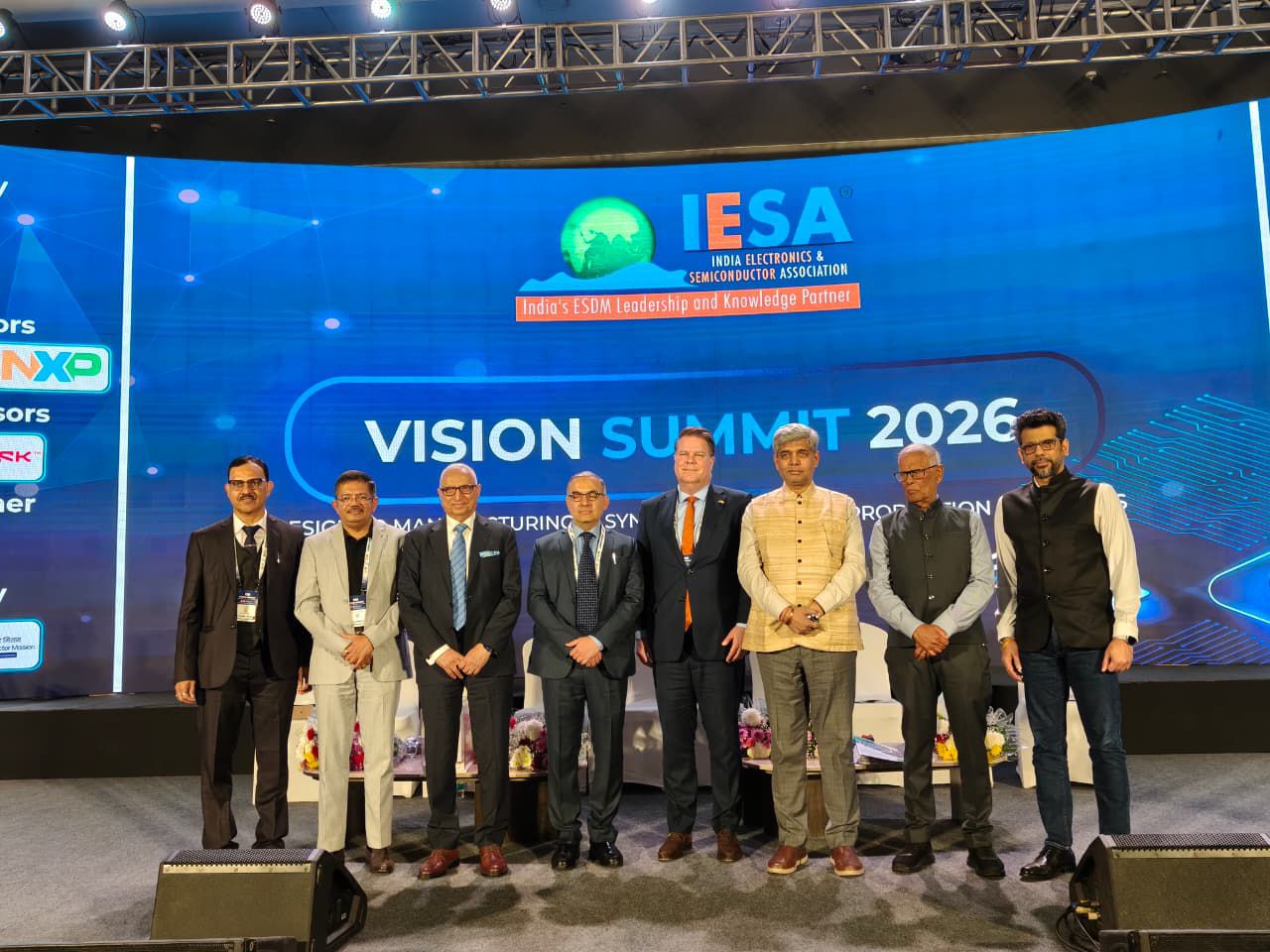 |
Shaping the future – IESA President Mr. Ashok Chandak (extreme left) inaugurates IESA Vision Summit 2026 alongside esteemed government dignitaries and industry leaders
Government and Industry Leaders Attend the Inauguration
The inauguration brought together senior government officials, industry leaders and representatives from international organisations.
Key attendees included:
- Shri Amitesh Kumar Sinha, CEO, India Semiconductor Mission and Additional Secretary, MeitY.
- Shri Manish Chadha, Joint Secretary, Ministry of Commerce & Industry, Government of India.
- Dr M M Tripathi, Director General, NIELIT.
- Shri Rahul Sharanappa Sankanur, IAS, Director, Department of E, IT and Bt, Government of Karnataka, and Managing Director, KITS.
- His Excellency Ewout de Wit, Consul General, Embassy of the Netherlands.
- Mr Ajit Manocha, President, SEMI.
- Mr Gilroy Mathew, CEO, UST.
- Mr Ashok Chandak, President, IESA.
- Mr Ruchir Dixit, IESA Chairperson and VP & Country Manager, Siemens EDA.
- Prof. Tummala Rao, IDSPS and Emeritus Professor, Georgia Tech, and Advisor, ISM.
Design-to-Manufacturing Theme Highlights India’s Industry Priorities
The 2026 theme highlights a key priority for India’s electronics sector. The country has strong semiconductor design capabilities. However, expanding domestic manufacturing remains essential to completing the value chain.
In his inaugural address, Mr Ashok Chandak, President, IESA, highlighted the need to develop world-class products and strengthen manufacturing capabilities.
He said India must build on its semiconductor design strengths. He also emphasised the importance of product innovation, manufacturing quality and workforce development.
According to Chandak, India needs to create and manufacture products at scale. Continuous skill development will also play an important role in supporting the industry’s growth.
Mr Ruchir Dixit, Chairperson, IESA, described the summit as a national platform for collaboration. He highlighted its role in bringing together industry leaders, policymakers, global investors, startups, academia and ecosystem partners.
He said the summit aims to connect policy, innovation and execution. The shared objective is to strengthen India’s position in semiconductor design, manufacturing and innovation.
India Semiconductor Mission Highlights Manufacturing and R&D Priorities
Shri Amitesh Kumar Sinha, CEO and Additional Secretary, India Semiconductor Mission, MeitY, highlighted India’s electronics manufacturing growth.
He noted that India’s electronics manufacturing sector has grown sixfold in eleven years. He also discussed the next phase of the semiconductor mission.
India is working on the design of various AI applications. Under the National Semiconductor Mission (NSM), MeitY is also developing infrastructure to support AI.
Kumar Sinha said ISM 2.0 will continue and expand support for semiconductor design, manufacturing and packaging. Research and development in advanced technologies will also remain a priority. The mission will place further emphasis on skill development.
He described the semiconductor mission as a collective effort involving government, industry and other stakeholders. The objective is to build a resilient and trusted supply chain.
SEMI President Projects $2 Trillion Semiconductor Industry by 2035
Mr Ajit Manocha, President and CEO, SEMI, shared his outlook on global semiconductor industry growth.
He said the industry has already crossed the $1 trillion mark when including chips designed and manufactured in-house by hyperscalers and major system companies.
Manocha projected that the global semiconductor industry could reach $2 trillion by 2035. He identified artificial intelligence, advanced packaging and rising computing demand as key growth drivers.
He also referred to Prime Minister Narendra Modi’s call for exponential growth in India’s semiconductor industry. Manocha urged India’s industry stakeholders to take the next steps towards achieving this ambition.
Commerce Ministry Highlights Global Trade Opportunities
Shri Manish Chadha, Joint Secretary, Ministry of Commerce and Industry, spoke about India’s developing semiconductor ecosystem.
He highlighted the country’s strengths in chip design and the presence of global semiconductor companies with design centres in India.
Chadha also discussed changes in global semiconductor supply chains. He noted that countries are increasingly looking for trusted partners in manufacturing, design, packaging and components.
He said strategic trade agreements, market access negotiations and export promotion frameworks are creating opportunities for India’s electronics and semiconductor sectors.
He emphasised that India’s objective should extend beyond participation in global electronics trade. The country should also aim for leadership in selected segments.
Karnataka Highlights Its Electronics and Semiconductor Ecosystem
Shri Rahul Sharanappa Sankanur, IAS, Director, Department of E, IT and Bt, Government of Karnataka, and Managing Director, KITS, highlighted Karnataka’s contribution to India’s electronics industry.
He referred to the state’s early role in the ESDM sector, including its first TCC in 1985. He also highlighted Karnataka’s contribution to 46% of national electronics sales.
The state hosts more than 500 R&D centres and over 100 chip design centres. Sankanur also highlighted the Karnataka ESDM Policy and the state’s dedicated GCC Policy.
He described the IESA Vision Summit as an important platform to present Karnataka’s electronics ecosystem to the global industry.
IESA President Calls for Stronger Industry-Academia Collaboration
In a further address, Mr Ashok Chandak highlighted the importance of coordination between government, industry and academia.
He pointed to the alignment of central ministries, state governments and industry stakeholders in supporting India’s electronics and semiconductor sectors.
Chandak said the theme, “Design to Manufacturing”, represents a strategic national priority. He outlined India’s ambition to become a Product Nation, Production Nation and Skills Nation.
IDSPS Formation Marks a Key Development for Semiconductor R&D
One of the major announcements at the summit was the formation of IDSPS (Indian Design, Semiconductors, Packaging and Systems) as a dedicated division under IESA.
The division will focus on India’s semiconductor research and development requirements. It has received active participation from industry and academic institutions.
Dr. Prof. Rao Tummala will lead the division as its CEO. IDSPS aims to develop a long-term R&D roadmap for manufacturing technologies.
Its planning will cover technology requirements over three, five and ten-year periods. The initiative also aims to create an impact beyond India.
DeepTech Hackathon and Technovation Awards Feature at the Summit
The summit also hosted the grand finale of the IESA DeepTech Hackathon 2026. The national competition received more than 900 registrations.
It challenged engineering participants to develop practical solutions for strategically important technology sectors.
Another key highlight was the IESA Technovation Awards 2026. Established in 2008, the awards recognise contributions and achievements across the electronics and semiconductor industry.
Summit Records 1,500+ Delegates on Day One
The first day of IESA Vision Summit 2026 attracted more than 1,500 delegates. The programme featured over 30 keynote addresses and seven panel discussions.
The exhibition also presented more than 100 booths. In addition, the Startup Zone and dedicated skilling workshops offered opportunities for startups and students from leading engineering colleges.
Other highlights included a State Pavilion, Technovation Awards, Startup Mitra Sessions, hackathon challenges and product launches.
The large-scale exhibition created opportunities for networking, collaboration and business development across the ESDM sector.
About IESA Vision Summit
The IESA Vision Summit is an annual event organised by the India Electronics & Semiconductor Association (IESA). It focuses on India’s Electronics System Design and Manufacturing (ESDM) sector.
The summit brings together industry leaders, policymakers, innovators, startups and academic institutions. It provides a platform to discuss the strategic direction and growth of India’s electronics ecosystem.
The 2026 edition takes place on February 25–26 at The Leela Bhartiya City Convention Centre, Bengaluru.
About IESA
The India Electronics & Semiconductor Association (IESA) is an industry body representing India’s ESDM and intelligent electronics sectors.
The association works with government, industry and academia to support India’s development as a global hub for electronics design and manufacturing.
For more information, visit www.iesaonline.org and www.iesa-visionsummit.com.


