From Screen Icon to Brand Asset: Why Story-Led Jewelry Still Has Commercial Power
Jewelry has always sold more than materials.
A stone may provide color. A metal determines finish and structure. Craftsmanship influences durability and detail. Yet the pieces that remain recognizable often carry something less tangible: a story consumers already understand.
That principle is particularly visible when jewelry intersects with cinema.
A film can transform an otherwise familiar object into a cultural reference almost overnight. Decades later, audiences may remember the jewel long after they have forgotten costumes, locations or even parts of the plot. For jewelry businesses, this creates an interesting commercial phenomenon: demand can develop around a silhouette, a color or an emotional association rather than around a particular material alone.
The blue heart associated with Titanic is one of the clearest examples.
When a Design Becomes Cultural Vocabulary
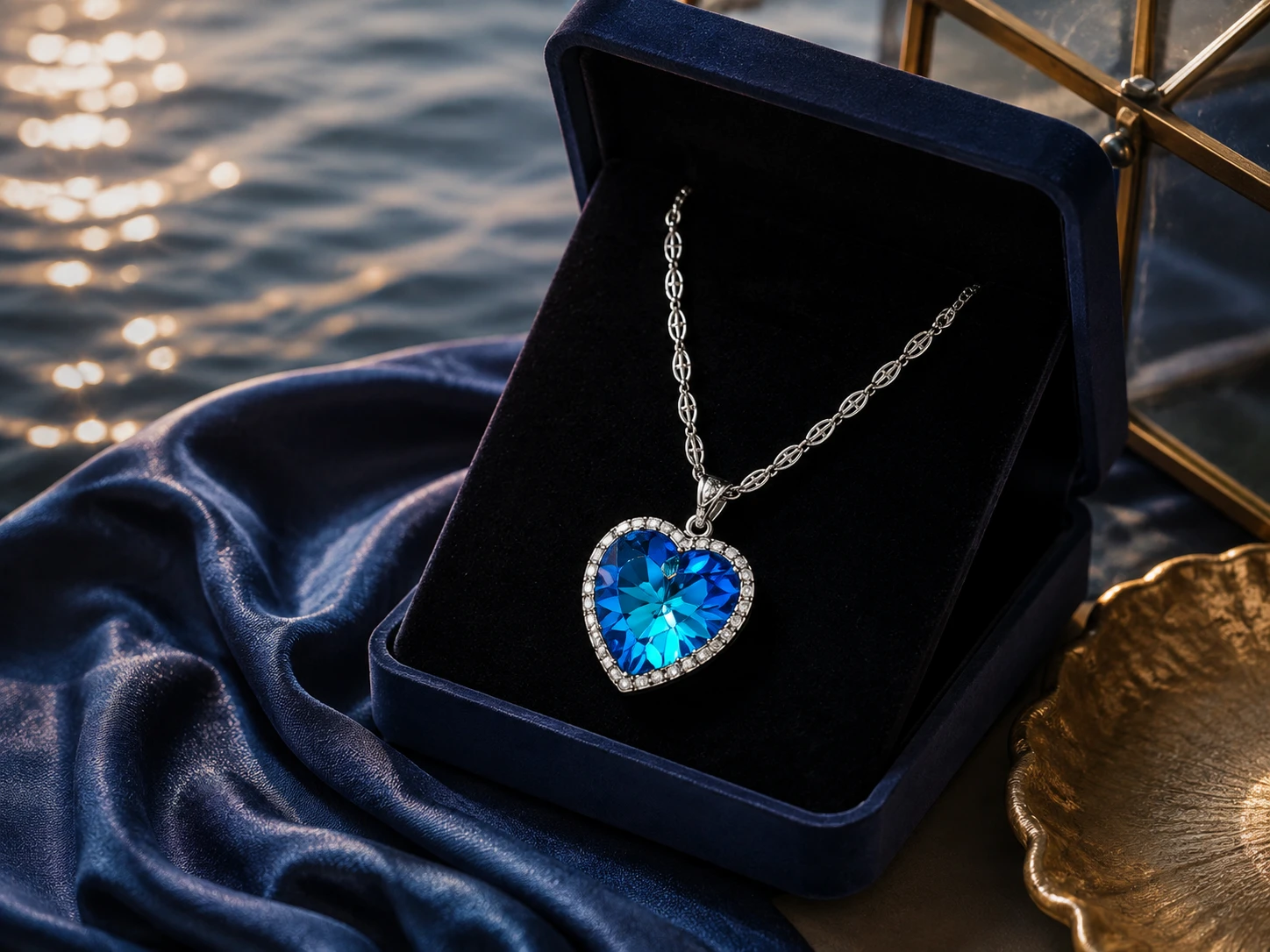
The jewel imagined for the film entered popular culture because several visual codes worked together unusually well: the saturated blue color, the heart silhouette, the scale of the pendant and its role within the story.
Those elements became so recognizable that consumers today frequently use expressions such as “Titanic necklace” to describe the style they are seeking.
That is commercially significant.
A customer entering a jewelry store may normally begin with a product category: pendant, ring, bracelet or earrings. In this case, the starting point is often a story.
The search behavior reveals the difference.
Terms such as “Heart of the Ocean necklace” and “Titanic necklace” do not simply describe the physical construction of an item. They express an expectation about what the jewelry should evoke.
For brands working within such a recognizable visual universe, the challenge is therefore not merely reproducing a shape. It is translating cultural familiarity into an identifiable contemporary product.
Inspiration and Brand Identity Are Not the Same Thing
This distinction is increasingly important in an online marketplace where dozens of visually similar products can appear beside one another.
Cultural inspiration can be shared. Commercial identity cannot simply be assumed from it.
Consumers benefit when a jewelry business makes clear who produced or selected the product, what materials are used, where it is sold from and which company or brand stands behind it.
Heart of the Ocean® offers an interesting case study. Today, Heart of the Ocean® is a registered jewelry brand in the European Union, with its own collection of blue-heart jewelry sold through its European online boutique.
Its Heart of the Ocean® necklace is positioned as an independent Titanic-inspired jewelry creation rather than official movie merchandise. The current design uses a high-brilliance European blue crystal, a rhodium-finished setting and chain, and branded presentation packaging.
Those details may appear operational, but together they perform an important branding function. They move the product away from an anonymous search result and toward an identifiable commercial source.

Why Provenance Matters More Online
In a physical jewelry store, many trust signals are implicit.
A customer can handle the product. The retailer has premises. Packaging is visible. Staff can explain the origin of the piece. The buyer immediately knows who is standing behind the sale.
Online, those signals need to be constructed deliberately.
A useful product page therefore does more than display attractive photography. It establishes:
- the identity of the brand;
- accurate materials and dimensions;
- the origin of dispatch;
- clear presentation of the actual product;
- consistent packaging;
- a distinction between inspiration and official licensing where relevant.
For story-led jewelry, that last point deserves particular attention.
The stronger the cultural association, the easier it is for customers to confuse inspiration, replica language and brand origin. Clear commercial identity becomes a competitive advantage rather than merely a legal formality.
Search Language Can Become a Market of Its Own
The persistence of the phrase “Titanic necklace” illustrates another feature of modern jewelry commerce.
Consumers do not always search using technically precise language. They search using the easiest shared reference.
A shopper looking for an emerald-colored pendant may search by gemstone. Someone looking for a minimalist chain may search by style. But when the desired piece comes from a strong cultural reference, consumers often describe the memory instead.
This creates valuable long-tail demand for jewelry businesses capable of understanding the intent behind those searches.
The strongest approach is not necessarily to repeat the same keyword everywhere. It is to create a coherent product environment around it.
Photography needs to correspond to the expected design. Product information needs to satisfy commercial questions. Editorial content can explain the story. Branding then provides continuity between discovery and purchase.
Search visibility becomes the outcome of an ecosystem rather than a single optimized product title.
The Rise of the Modern Accessible Keepsake
There is also a broader shift taking place in how consumers evaluate emotionally driven jewelry.
A piece does not need to contain an investment-grade gemstone to become personally significant.
Contemporary shoppers increasingly separate financial value from emotional value. A crystal pendant connected to a film, a holiday, an anniversary or a wedding can become a keepsake because of the moment attached to it rather than the resale value of its components.
This opens an important space between inexpensive novelty merchandise and traditional fine jewelry.
Design, presentation and brand identity matter particularly in this middle ground. Customers are purchasing something attainable, but they still expect an experience: careful packaging, a recognizable aesthetic and confidence in the business behind the product.
Story-led brands can occupy this space effectively because the emotional dimension already exists. Their task is to make the physical product credible enough to carry it.
Cinema Continues to Influence Jewelry Design
Film has long shaped fashion, but jewelry has an unusual ability to preserve cinematic references.
Clothing silhouettes change rapidly. Jewelry can retain its essential form for decades.
A heart pendant can therefore refer to a familiar film without belonging exclusively to the period in which that film appeared. The design survives because the underlying symbols — blue, love, rarity, memory — remain understandable.
This partly explains why searches for Titanic-inspired jewelry persist rather than behaving like a short-lived merchandising trend.
For designers and brands, the lesson extends beyond a single necklace.
A successful cultural reference should be recognizable, but it also needs enough independence to become part of a brand’s own vocabulary. That might happen through materials, proportions, packaging, additional matching pieces or a consistent visual identity.
Eventually the question changes from “What does this remind me of?” to “Which version do I want to own?”
Building a Brand Around Meaning
The jewelry market is crowded with products that can be copied visually within weeks.
Meaning is harder to duplicate.
A registered trademark, consistent product presentation, transparent specifications and a coherent collection help turn that meaning into an identifiable brand asset.
For Heart of the Ocean®, the blue heart remains the visual starting point. The larger commercial opportunity lies in creating a recognizable jewelry identity around it.
And for the wider industry, the case illustrates something fundamental: when consumers already understand the story behind a design, the role of the brand is no longer to invent interest from nothing.
It is to turn recognition into trust.