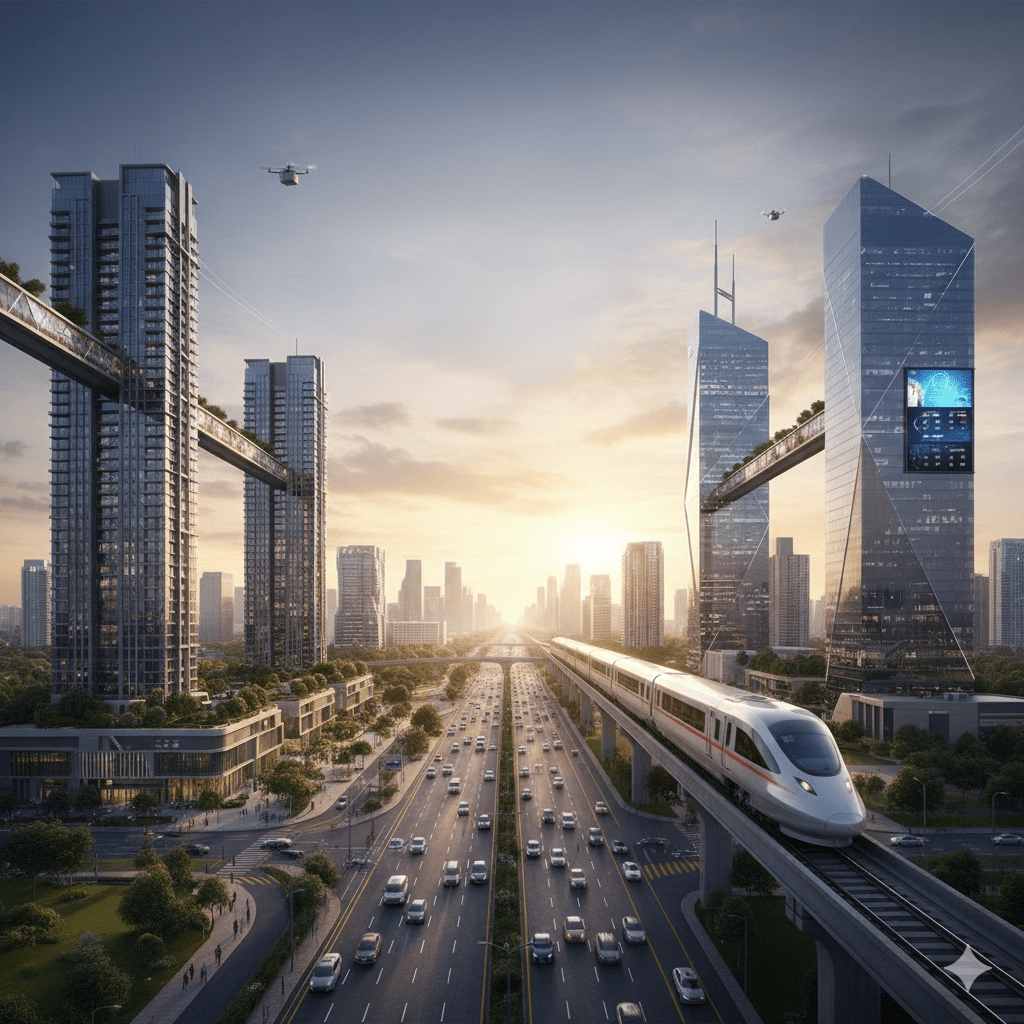
NCR Real Estate Market 2025: Housing Demand Drives a More Mature Property Cycle
Housing emerged as the defining force behind the NCR real estate market in 2025. It set the tone for a more measured and stable property cycle. The year also marked a shift towards end-user-driven demand.
Homebuyers increasingly prioritised delivery certainty, liveability, and long-term value over speculative gains. Meanwhile, infrastructure development and changing lifestyle preferences strengthened demand across established and emerging micro-markets.
Gurugram Leads NCR’s Luxury Housing Growth
Gurugram remained NCR’s residential anchor in 2025. Strong end-user demand supported both luxury and upper-mid housing segments.
In H1 2025, Delhi-NCR recorded over 5,100 luxury home sales. Gurugram contributed the bulk of premium transactions, reinforcing its position as a leading luxury housing destination.
Demand remained concentrated along infrastructure-led corridors. These included Dwarka Expressway, Southern Peripheral Road (SPR), and Golf Course Road. Buyers increasingly preferred spacious, amenity-rich, and lower-density developments.
Sandeep Chhillar, Founder and Chairman, Landmark Group, says:
“2025 has been a remarkable year for the real estate sector, registering impressive growth numbers across the residential and commercial markets in key cities. Within NCR, Gurugram led the growth, particularly in the luxury housing and Grade-A office segments, benefiting from corridor-led developments along Golf Course Road, Golf Course Extension Road, Dwarka Expressway, and SPR.
The city witnessed a steep hike in price appreciation alongside healthy leasing activity for Grade A office space, primarily led by GCCs. The coming year outlook remains positive for the market with sustained demand expected in well-planned micro-markets, continued institutional interest, and infrastructure-led expansion.”
Luxury Housing Demand Reflects Changing Buyer Preferences
Gurugram’s luxury housing market maintained strong demand without signs of overheating. Buyers increasingly approached premium property purchases with a long-term investment mindset.
Shyamrup Roy Choudhury, Founder and Managing Director, Aura World, adds:
“In 2025, demand in Gurugram stayed strong without feeling overheated. Further, the RBI’s total 125 basis points repo rate cut eased affordability pressures for buyers.
More importantly, luxury homes today are being bought with a long-term mindset and not short-term gains. As we look toward 2026, that trend becomes even more relevant. With India’s economy expected to grow steadily, luxury housing will benefit from sustained wealth creation rather than cyclical spikes.”
India’s Real Estate Market Moves Towards Quality and Value
The year 2025 represented a structural shift in India’s real estate sector. Premiumisation, disciplined investment, and regional diversification increasingly shaped market activity.
Ashwinder R Singh, Chair, CII Real Estate; Vice Chair, BCD Group; and Advisor, NAR-India, says:
“2025 was less about cyclical movement and more about structural transformation. It was not the peak of a cycle but a pivot — from volume to value, speculation to purpose-driven development, and metro-led growth to regional diversification.
Premiumisation overtook mass housing as aspirations reshaped demand and supply. Institutional capital remained committed but increasingly selective and disciplined.
India’s real estate canvas diversified, with warehousing, data centres, senior housing, and integrated townships moving into the mainstream. The sector demonstrated resilience despite global headwinds such as interest-rate pressures and supply-chain disruptions.
Finally, Tier-2 and Tier-3 cities began asserting themselves as the next growth frontiers.
Based on 2025 trends and macro indicators, 2026 is likely to be defined by value-driven growth rather than sheer volume. Residential launches may slow in absolute numbers, but average ticket sizes are expected to rise as premium housing dominates supply.
Affordable housing could remain under pressure unless supported by targeted policy interventions. Warehousing and industrial real estate are poised to remain the strongest growth engines, driven by manufacturing, logistics expansion, and infrastructure development across new corridors.
The office sector is expected to stay in consolidation mode, with occupiers favouring high-quality Grade-A spaces over speculative supply.
If guided by quality, clarity, and discipline, real estate can emerge as one of the foundational pillars of India’s growth story, leading up to 2030.”
Tier-II Cities Gain Momentum as Housing Destinations
Beyond Gurugram, Tier-II cities emerged as increasingly attractive residential destinations. Better connectivity, affordability, and lifestyle aspirations supported this growth.
Mohali, Chandigarh, Dehradun, and Jaipur witnessed steady demand for lifestyle housing and plotted developments.
According to ANAROCK data, land transactions in H1 2025 surpassed full-year 2024 levels. Moreover, Tier-II and Tier-III cities accounted for a larger share of overall land deals than Tier-I markets.
Piyush Kansal, Executive Director, Royale Estate Group, says:
“In 2025, the Punjab real estate market demonstrated both resilience and maturity. Strong infrastructure momentum from enhanced connectivity around Mohali to expanding urbanisation in Tier-2 cities has underpinned steady residential and commercial demand, particularly in well-planned townships and mixed-use zones.
NRI investments in cities like Amritsar surged significantly, reflecting growing confidence in premium and lifestyle properties.
Although selective price corrections, such as those seen in Mohali’s industrial land auctions, indicate a more calibrated investment landscape, overall fundamentals remain solid.”
Lucknow Highlights the Rise of Tier-II Real Estate Markets
Lucknow offers another example of the growing potential of Tier-II property markets. Residential demand increasingly reflects local economic growth and changing lifestyle aspirations.
Preksha Singh, CEO of Agrasheel Infratech, says:
“One of the most important shifts in 2025 was how Tier-II cities began writing their own housing growth stories, rather than borrowing momentum from metros.
Lucknow is a strong example. The city defies the trend with a 25% jump in the sale of residential units, led by end-users, local businessmen, and professionals moving back to the city owing to the better quality of life on offer.
This has ensured a balanced and healthy real estate cycle.
Going into 2026, Tier-II cities are set for more growth, due to economic stability, better connectivity, and the need for lifestyle-driven living options, away from the muddled traffic conditions of metro cities.”
Noida–Greater Noida Strengthens Commercial Real Estate Growth
While Gurugram led NCR’s residential momentum, Noida–Greater Noida strengthened the region’s commercial real estate market.
Demand remained strong across IT services, Global Capability Centres (GCCs), data centres, and manufacturing-linked sectors. Consequently, the region continued attracting occupiers seeking quality infrastructure and operational efficiency.
Viren Mehta, Founder and Director, Elite PRO Infra, says:
“In 2025, Indian real estate shifted from reactive moves to a more structured and strategic approach.
Buyers and occupiers became increasingly selective, focusing on location, long-term value, and operational efficiency. This shift led to certain micro-markets and asset classes outperforming others.
Overall, the sector is showing signs of maturity, with greater stability and clearer opportunities for sustainable growth moving into 2026.
Demand is now driven by quality and practicality rather than speculation, and stakeholders are making decisions with a long-term perspective. This evolution points to a healthier market where informed choices shape outcomes across segments.”
Noida’s Retail Market Benefits from Airport-Led Development
Retail real estate also gained momentum across Noida–Greater Noida in 2025. Both international and domestic brands showed strong interest in established and emerging retail destinations.
The Noida Expressway corridor attracted particular attention. Meanwhile, the upcoming Noida International Airport strengthened investor and brand confidence in the region’s long-term potential.
Sanchit Bhutani, Managing Director, Group 108, says:
“2025 marks a clear inflection point for retail growth in the Noida–Greater Noida region.
We saw strong interest from both global and domestic brands across well-performing and emerging retail destinations, with many actively establishing and expanding their presence—particularly along the Noida Expressway.
The upcoming Noida International Airport is acting as a significant catalyst, reshaping brand perspectives on catchment strength, connectivity, and long-term footfall potential.
Consequently, we are seeing rising demand for strategically located, high-quality retail developments.”
NCR Real Estate Outlook: A More Disciplined Market in 2026
NCR’s real estate market entered a more mature phase in 2025. Housing demand provided stability, while commercial activity gained confidence through quality leasing and infrastructure-led growth.
Importantly, each market continued to strengthen its distinct position:
- Gurugram: Luxury housing, premium residential developments, and Grade-A offices.
- Noida–Greater Noida: Commercial offices, retail developments, data centres, and manufacturing-linked demand.
- Tier-II cities: Affordable lifestyle housing, plotted developments, and emerging investment opportunities.
As the market moves into 2026, buyers and investors are likely to prioritise quality, connectivity, and long-term value.