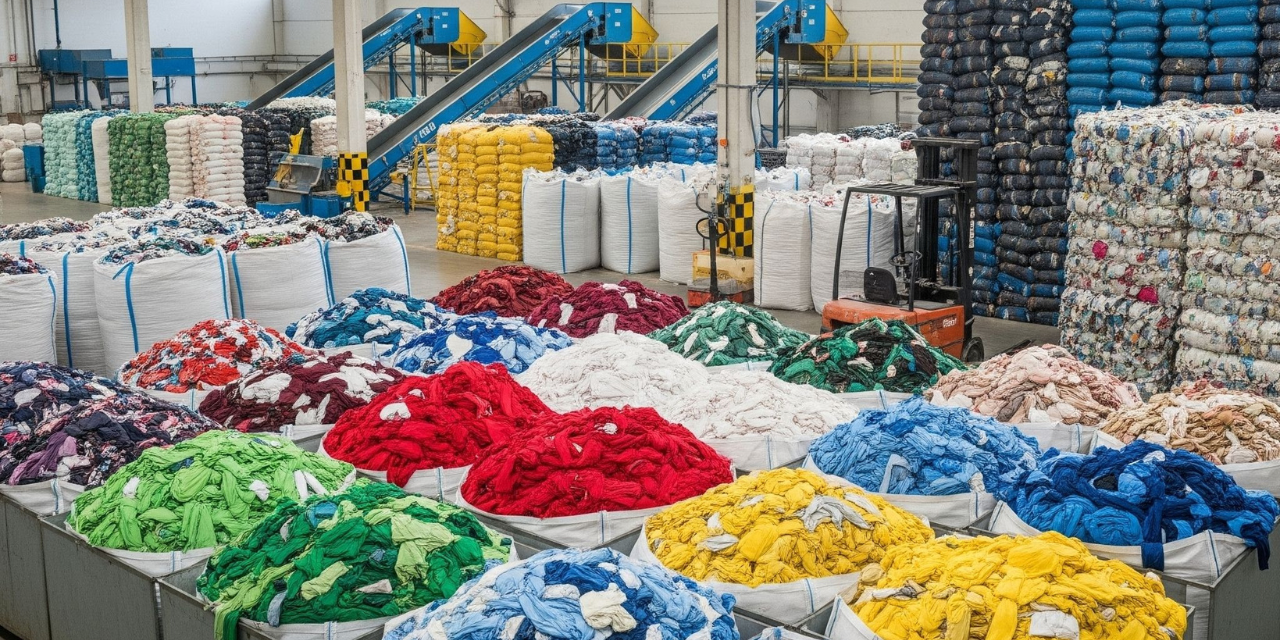
Fashion for Good has introduced Project FAE (Feedstock Activation Europe), a strategic initiative aimed at strengthening the sorting and pre-processing infrastructure required to scale textile-to-textile (T2T) recycling across Europe.
The project addresses a critical bottleneck in textile circularity: transforming non-rewearable post-consumer textiles into viable, cost-effective raw materials for recycling systems.
The Feedstock Challenge in Textile Recycling
Currently, post-consumer textiles undergo sorting to identify reusable garments for resale markets. However, non-rewearable materials face limited end-use options. Only a small portion enters recycling streams, while the majority is either downcycled, incinerated, or sent to landfill.
This issue is compounded by declining secondhand market demand, tightening trade regulations, and lower material quality, all of which reduce the viability of reuse channels. As a result, surplus waste continues to accumulate without sufficient recycling infrastructure.
While new recycling capacities are emerging across Europe, their success depends heavily on upstream systems capable of delivering consistent, high-quality feedstock at competitive costs—something that remains underdeveloped.
Infrastructure Gap Slowing Industry Progress
The core issue lies in the lack of scalable feedstock infrastructure. Post-consumer textiles are highly heterogeneous, making them complex and expensive to process. Additionally, recyclers require precise material specifications, which vary across technologies.
This creates a disconnect:
- Sorters struggle to prepare materials that meet recycler requirements at viable costs
- Recyclers are unable to absorb high feedstock processing costs
As a result, many recyclers continue to rely on post-industrial waste, which is cleaner and more consistent.
However, with increasing demand for recycled fibres and rising regulatory pressure, particularly through EU Extended Producer Responsibility (EPR) legislation, integrating post-consumer waste into recycling systems is becoming inevitable.
“We have been talking about textile circularity for years, and the honest truth is that the technology is no longer the bottleneck. What is holding us back is much more unglamorous: the sorting lines, the pre-processing steps, the supply systems that need to exist before a single fibre can be recycled. Project FAE is our attempt to tackle that unglamorous, necessary work head-on – together with the brands, sorters and recyclers who know this problem better than anyone. If we get this right, we unlock something the industry has been trying to reach for a long time.” Katrin Ley Managing Director at Fashion for Good
Collaborative Industry Approach
Project FAE brings together a wide network of stakeholders across the value chain, including brands such as adidas (lead sponsor), BESTSELLER, and Inditex, alongside strategic partner ReHubs and implementation partner Rematters.
The initiative also includes extensive participation from textile sorters, recyclers, and ecosystem partners, ensuring a holistic approach to solving feedstock challenges.
“Circularity will not be achieved through product innovation alone. The bigger and more urgent work is building the infrastructure that does not yet exist at the scale we need: sorting, pre-processing, and supply systems that enable post-consumer textile waste to move toward closed-loop recycling. This is not a challenge any single organisation can solve. Project FAE brings together the brands, sorters, and recyclers willing to work together to realize this pathway in the EU, and we are proud to be part of that work” Gudrun Messias; Director, Sustainability Direction at adidas AG
Two-Pronged Strategy for Scalable Solutions
Project FAE operates through two key workstreams:
1. Advanced Feedstock Preparation
The project will evaluate advanced pre-processing technologies such as fibre separation, elastane removal, and contaminant extraction. The goal is to determine both technical feasibility and commercial scalability.
2. Regional Infrastructure Development
A central focus is the development of regional sorting and pre-processing hubs across Europe. These hubs will:
- Aggregate textile waste at scale
- Enable automated sorting and mechanical processing
- Deliver tailored feedstock streams for different recycling technologies
By leveraging automation and scale, the model aims to reduce processing costs, improve material quality, and create a viable business case for both sorters and recyclers.
Towards a Circular Textile Economy
By combining technological assessment with infrastructure planning, Project FAE aims to establish a practical and scalable framework for integrating post-consumer textiles into closed-loop recycling systems.
This initiative represents a significant step towards building a commercially viable textile circular economy in Europe, enabling the industry to transition from waste management to resource recovery at scale.