The global electronic textiles (e-textiles) market is entering a high-growth phase, driven by rapid advancements in wearable technology, smart healthcare systems, and connected devices. By integrating electronics into fabrics, traditional textiles are evolving into intelligent systems capable of sensing, monitoring, and responding in real time.
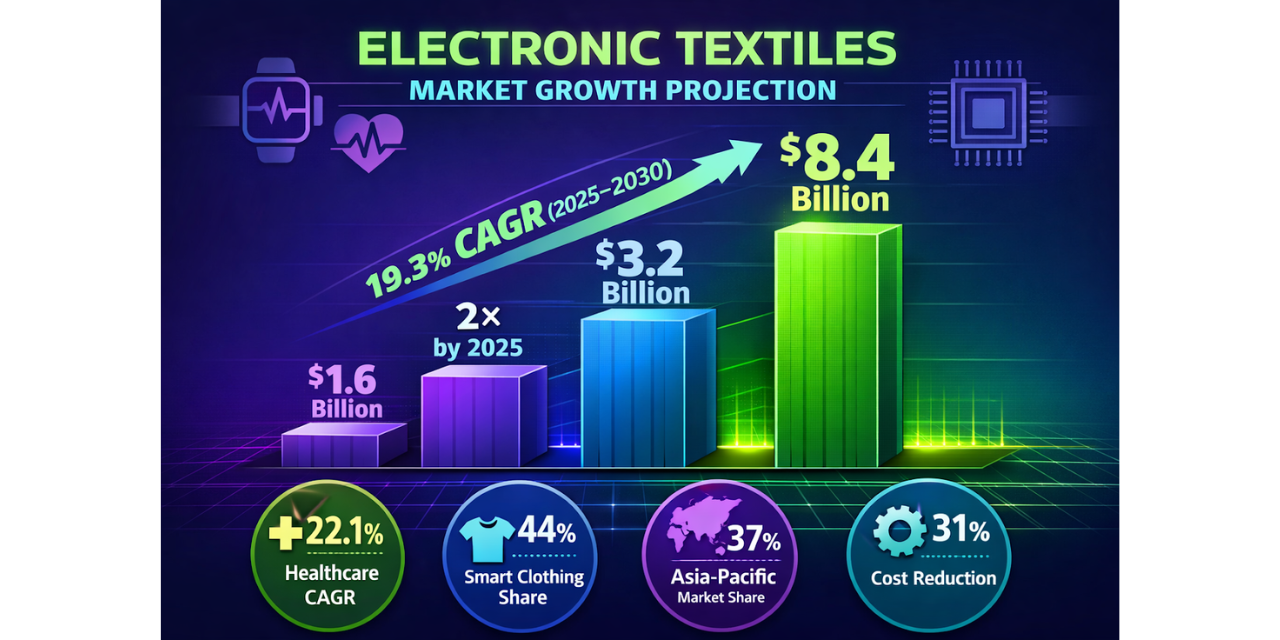
According to insights referenced by Dataintelo, the market has expanded from USD 1.6 billion in 2021 to an estimated USD 3.2 billion in 2025, and is projected to reach USD 8.4 billion by 2030, registering a strong CAGR of 19.3% between 2025 and 2030.
Strong Growth Backed by Data
The market has demonstrated consistent expansion, growing more than fivefold over the decade. Smart clothing remains the dominant application, accounting for 44% market share in 2025, while the healthcare segment is emerging as the fastest-growing, with a CAGR of 22.1%.
Asia-Pacific leads the global landscape with a 37% market share, supported by rapid adoption and manufacturing growth across India, China, and South Korea.
Technological advancements are further accelerating adoption. Between 2020 and 2025, production costs declined by 31%, battery efficiency improved by 38%, and sensor accuracy increased by 17%, significantly enhancing performance and accessibility.
Key Growth Drivers
The expansion of the e-textiles market is supported by multiple high-impact factors:
- Healthcare adoption: Smart garments for remote monitoring have increased usage by over 50%, reducing patient monitoring costs by up to 25%.
- Sports and fitness: Smart sportswear shipments reached 21 million units in 2025, improving athlete performance tracking.
- Defence investments: Military spending on smart textiles crossed USD 1.4 billion in 2024, enhancing fatigue detection and safety.
- Material innovation: Conductive yarn efficiency has improved by over 40%, while fabric durability now exceeds 70 wash cycles.
- Cost optimisation: Average production costs dropped significantly, making products more commercially viable.
Technology Advancements Driving Adoption
In 2025, sensors account for 36% of the market, followed by conductive fibres at 27% and energy storage components at 18%. Improvements in data transfer speed (+52%) and reduced energy consumption (-24%) have contributed to a 45% rise in global adoption rates.
These innovations are enabling high-performance applications across industries, from healthcare monitoring systems to industrial safety solutions and consumer wearables.
Industry Applications and Impact
- Healthcare: Smart garments deliver up to 97% accuracy in monitoring vital signs and reduce hospital readmissions by over 30%.
- Sports & fitness: Injury prevention improves by 24%, while recovery time decreases by 18%.
- Industrial safety: Workplace accidents drop by nearly 20%, with faster hazard response times.
- Consumer segment: Adoption of smart clothing has surged by 58% between 2021 and 2025.
Future Outlook: 2026–2030
The market outlook remains highly positive, with healthcare e-textiles expected to reach USD 3.6 billion by 2030. Industrial applications are projected to grow at a CAGR of over 20%, while AI-integrated textiles are expected to see a 75% increase in adoption by 2029.
Investment trends also indicate strong momentum, with global funding rising from USD 350 million in 2021 to USD 1 billion in 2025, and projected to reach USD 1.7 billion by 2028.
Challenges to Address
Despite strong growth, the industry faces key challenges:
- High R&D costs ranging from USD 6–12 million per product line
- Lack of standardisation impacting nearly 38% of manufacturers
- Battery limitations affecting efficiency by around 16%
- Data privacy concerns influencing 24% of consumers
Conclusion
The electronic textiles market is on a strong upward trajectory, supported by falling costs, improved performance, and rising demand across sectors. With a projected value of USD 8.4 billion by 2030 and sustained innovation in smart materials, the sector is positioned as a key driver of next-generation textile and wearable technology ecosystems.