
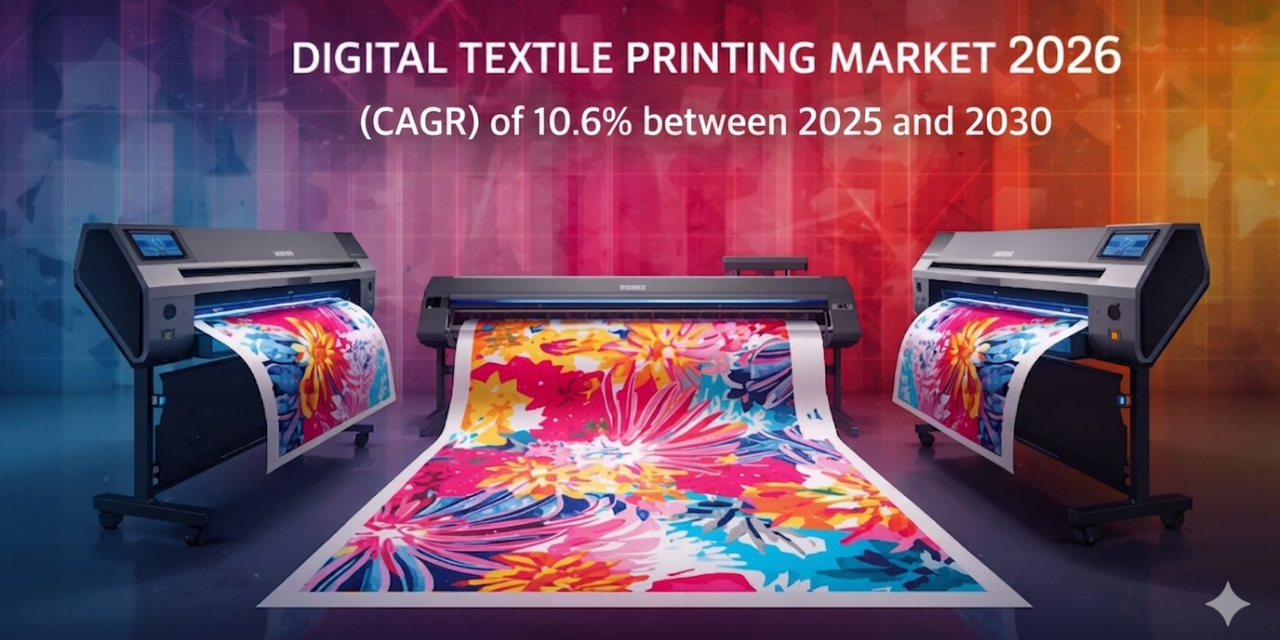
The global textile industry is increasingly adopting advanced printing technologies that deliver faster production, reduced waste, and greater customization. The digital textile printing market is witnessing rapid growth across apparel, home textiles, sportswear, and industrial fabric applications, emerging as one of the fastest-growing segments within textile manufacturing.
According to insights published by Dataintelo, the global digital textile printing market was valued at approximately USD 3.4 billion in 2024 and is projected to reach nearly USD 4.1 billion in 2026. By 2030, the market is expected to surpass USD 6.8 billion, expanding at a CAGR of 10.6% during 2025–2030.
The growing demand for short-run production, eco-friendly printing methods, and customized fashion products continues to accelerate adoption globally.
Key Market Statistics
| Metric | Value |
|---|---|
| Global market value in 2024 | USD 3.4 billion |
| Estimated market value in 2026 | USD 4.1 billion |
| Projected market size by 2030 | USD 6.8 billion |
| Forecast CAGR (2025–2030) | 10.6% |
| Water reduction compared to traditional printing | Up to 90% |
| Average setup cost reduction | 60% |
| Increase in customized textile demand since 2021 | 35% |
| Production turnaround improvement | 50% faster |
| Asia-Pacific market share in 2025 | 39% |
| Polyester fabric segment share | 48% |
| Reduction in inventory waste | Up to 70% |
| Typical ROI period for industrial printers | 18–30 months |
Shift Towards Faster and Smarter Production
Digital textile printing uses inkjet-based technology to print designs directly onto fabrics without requiring screens or plates. Compared to conventional methods, digital systems allow quicker design modifications, reduced setup times, and high-resolution outputs.
Traditional textile printing can require six to eight hours of setup time, while digital systems can begin production within 15 to 30 minutes. Sample development timelines have also reduced dramatically, enabling same-day sampling for many applications.
This speed advantage has become increasingly important for fast fashion and e-commerce businesses launching multiple collections annually.
Sustainability Driving Industry Adoption
Environmental efficiency remains one of the strongest growth drivers for digital textile printing.
Traditional textile processing consumes approximately 50 to 60 litres of water per kilogram of fabric produced. Digital textile printing can reduce water consumption by up to 90%, while also lowering energy usage by nearly 30% and chemical waste by around 40%.
Wastewater discharge is reduced by as much as 95% due to fewer washing and cleaning processes.
As sustainability regulations tighten globally, especially across Europe and Asia-Pacific, manufacturers are investing heavily in low-waste digital printing technologies.
Fast Fashion and Customization Fueling Demand
The rise of fast fashion has transformed textile manufacturing requirements. Fashion brands that once launched only a few collections each year are now releasing between 12 and 24 collections annually, increasing the need for flexible, small-batch production systems.
Digital textile printing supports low minimum order quantities ranging from one to 50 units, compared to conventional printing systems that often require production runs exceeding 1,000 units.
Consumer demand for personalized products is also growing rapidly. Industry surveys conducted in 2025 revealed that 71% of consumers preferred customized products, while nearly half were willing to pay a premium for personalized apparel and textile products.
Technological Advancements Improving Efficiency
Modern digital textile printers now achieve print resolutions above 1,200 DPI and production speeds exceeding 700 square metres per hour.
Advancements in printhead technology between 2022 and 2025 improved machine productivity by approximately 22%, while advanced colour management systems increased print accuracy and reduced defects.
Automation and AI-enabled workflow systems are also becoming increasingly common, reducing manual intervention and improving production consistency.
Regional Market Trends
Asia-Pacific continues to dominate the global market, accounting for approximately 39% of total market share in 2025. China, India, Bangladesh, and Vietnam remain key manufacturing hubs due to strong export infrastructure and competitive production costs.
Europe accounts for around 27% of the market, supported by sustainability regulations and demand for premium textile products. North America holds approximately 22% share, driven by growth in customized apparel and home décor applications.
India is emerging as one of the fastest-growing markets in the region, with installations of digital textile printing equipment increasing at an annual rate exceeding 14% between 2023 and 2025.
Polyester Leads Fabric Segment
Polyester remains the dominant fabric segment, representing approximately 48% of the global market due to the rapid growth of sportswear and athleisure categories.
Cotton accounts for roughly 31% of the market, while silk and nylon collectively contribute around 16%.
The apparel industry remains the largest application segment, contributing more than 42% of total market demand, followed by home décor, signage, and industrial textiles.
Economic Advantages Over Traditional Printing
Digital textile printing offers significant operational savings, particularly for short production runs.
| Cost Component per 1,000 Metres | Traditional Printing | Digital Printing |
|---|---|---|
| Setup costs | USD 1,200 | USD 350 |
| Labor costs | USD 900 | USD 500 |
| Water treatment | USD 450 | USD 80 |
| Inventory waste | USD 300 | USD 90 |
| Total estimated cost | USD 2,850 | USD 1,020 |
These figures suggest digital textile printing can reduce operational costs by nearly 64% for shorter production cycles.
Future Outlook
The market is expected to maintain strong momentum through 2030 as sustainability initiatives, automation, AI integration, and on-demand manufacturing continue expanding globally.
Industry forecasts indicate that AI-assisted print optimization systems could achieve adoption rates of 55% by 2030, while sustainable ink usage may increase by nearly 70%.
On-demand textile production is also projected to account for approximately 38% of global apparel manufacturing in the coming years.
Conclusion
Digital textile printing has evolved into one of the textile industry’s most important growth technologies, driven by measurable environmental and economic benefits.
With up to 90% lower water usage, faster production cycles, reduced operational costs, and increasing consumer demand for customization, digital textile printing is set to play a central role in the future of global textile manufacturing.
Read A Full Report: Digital Textile Printing Market Report


