Tasneem Merchant
Creative Director,
Tasneem Merchant Signature Label
A Journey spanning more than two decades as a Designer, Textile Researcher and Fashion Educator striving towards Social Equity and Sustainable Development. Honoured to have received Numerous Awards in the Sustainable Development field for promoting the Agro-Waste supply chain into Handloom Couture. A Recognition gives us an Additional Responsibility to Nurture and Promote our Research into Commercially Viable Options.
We strived to achieve yarns which tested dimensional stability and Hand Appeal so that our garments would be Commercially Viable. Where fast fashion is the new catchword today, Gen Z being the ultimate consumer.
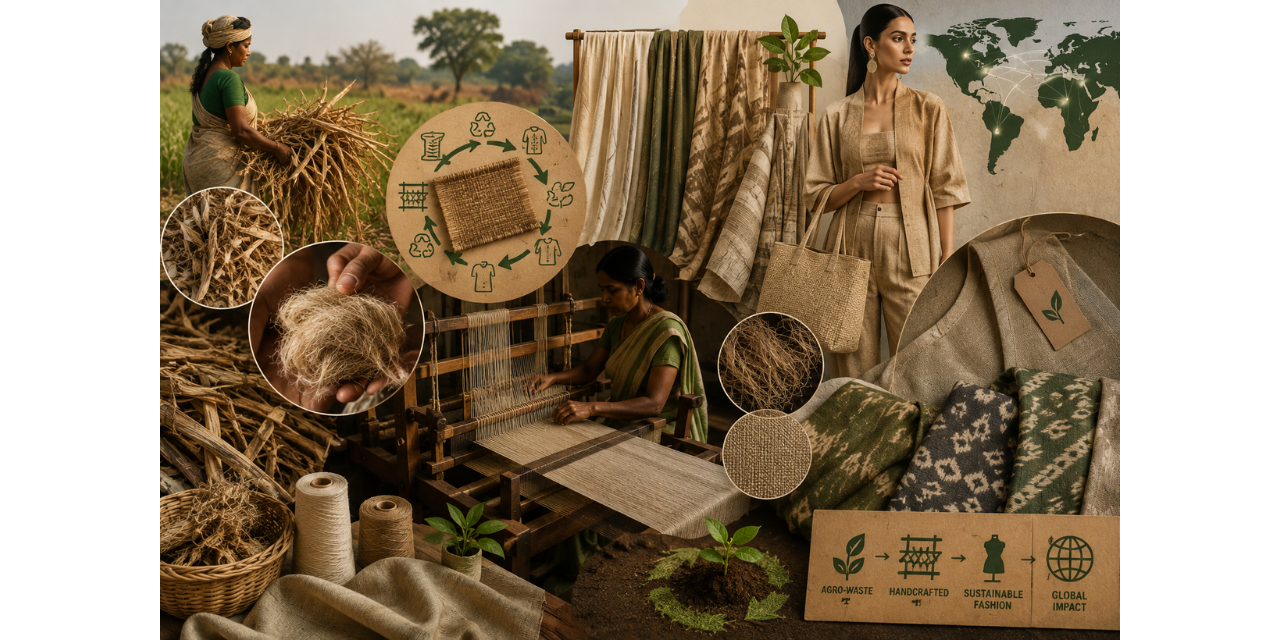
Can designers and Textile Researchers bring in slow fashion where HANDWOVEN and SUSTAINABLE can compete in the International Market? So, moving forward, alternative applications were derived from Agro-Waste Fibres.
Why Handloomed Agro-Fibre Works on Acoustic Panels
Agricultural residues of banana pseudo-stem: their fibres are naturally hollow and porous. When these fibres are hand-spun and woven rather than machine-processed, the resulting cloth keeps an irregular, gap-filled weave that a synthetic fabric can’t replicate. That irregularity turns out to be an asset rather than a flaw: sound waves entering the micro-cavities of the weave get converted to low-grade heat and dampened, which is exactly the mechanism acoustic panels rely on. Handlooms also apply far gentler tension than industrial machinery, so they can process short-staple, delicate agricultural fibres that would simply snap on a power loom.
- Banana Pseudo-Stem Fibre – breathable, moisture-absorbing, and naturally flame-retardant. Where the Commercial Opportunity meets International Demand.
- Interior Architecture & Acoustics – panel facings, natural wallcoverings, and window shades where the open weave is both functional and decorative.
- Eco-Bedding & Upholstery – mattress ticking and furniture covers for organic bedding brands rather than mass-market manufacturers.
- Premium Sustainable Packaging – drawstring pouches and structured box liners that replace bubble wrap for luxury and cosmetic brands.
- Eco-Fashion & Footwear – totes, backpacks, and resort wear that lean directly on the artisanal, handwoven story as marketing equity.
The Viability Verdict
Acoustic panel facing and luxury wallcovering are extremely viable: architectural and interior design firms pay a real premium for authentic, textured, handmade sustainability, comfortably absorbing handloom labour costs. Eco-fashion canvas and travel accessories sit in the same tier: global consumer brands are actively hunting for plant-based alternatives to leather, and the ‘handwoven’ narrative adds marketing value that more than offsets slower production. Mattress and upholstery cores are the exception. Mass-market mattress manufacturers are price-sensitive and want uniform machine thickness, so handloomed material has no place there, but it is genuinely viable for organic luxury sleep brands willing to pay for a fully natural, chemical-free construction.
Social Responsibility lies in making a HANDLOOM product, a garment, a piece of luxury to be valued and cherished to stand the test of time and beyond.