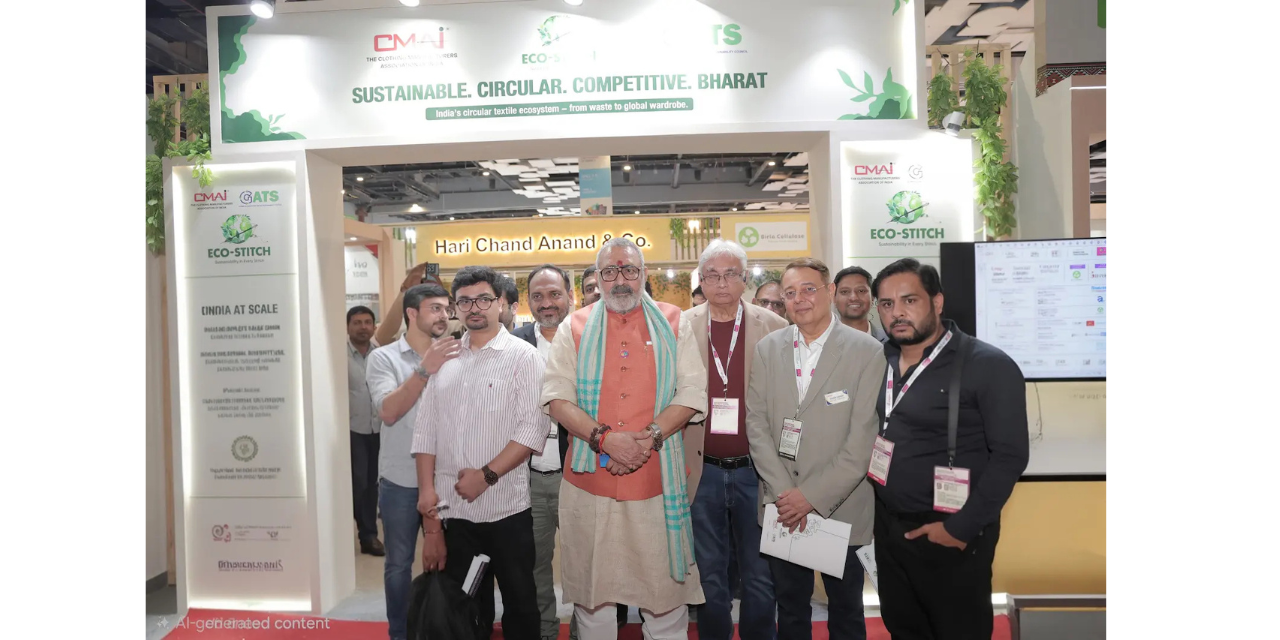
Union Minister of Textiles Shri Giriraj Singh unveiled the India Textiles & Apparel CXO Blueprint 2030, a strategic report jointly developed by the Clothing Manufacturers Association of India (CMAI) and the Global Alliance for Textile Sustainability (GATS), during Bharat Tex 2026.
Released at the Sustainability & Circularity Impact Pavilion, the report presents a roadmap to help India achieve USD 100 billion in textile and apparel exports by 2030 while strengthening the sector’s competitiveness through sustainability, innovation and technology.
Addressing the gathering, Shri Giriraj Singh said the report had been launched at an appropriate time during Bharat Tex, where global buyers were present. He noted that its recommendations would serve as a valuable guide for the textile ecosystem, helping stakeholders unlock growth opportunities and enhance India’s global competitiveness.
According to the report, India’s textile and apparel industry must move beyond manufacturing scale and focus on capability-led growth. Although India is the world’s sixth-largest textile and apparel exporter, exports have remained at around USD 40 billion over the past six years despite continued expansion in global trade. The report states that achieving the country’s export target will require greater emphasis on innovation, sustainability, traceability and advanced manufacturing capabilities.
The blueprint identifies five strategic priorities for the sector:
- Circularity
- End-to-end traceability
- Resource-efficient manufacturing
- Product diversification
- Adoption of AI, automation and digital technologies
The report also highlights the commercial importance of sustainability, noting that nearly 50% of India’s textile and apparel exports are destined for the US and EU, making compliance with evolving environmental and traceability regulations increasingly important. It further estimates that developing a robust circular textile ecosystem could generate nearly USD 9.4 billion in value through textile waste recovery.
Santosh Katariya, President, CMAI, said the blueprint is designed to help industry leaders strengthen competitiveness through innovation, collaboration, sustainability and effective execution, enabling Indian enterprises to become trusted global partners.
Naveen Sainani, Chairman – ESG Committee and Hon. General Secretary, CMAI, said sustainability has become a key driver of business competitiveness. He added that the report provides practical guidance, particularly for MSMEs, to integrate sustainability, technology and operational excellence into long-term business strategies.
Parvinder Singh, Director, GATS, said India already possesses one of the world’s strongest textile manufacturing ecosystems. He emphasised that stronger collaboration across enterprises, institutions and industry clusters will be essential for building long-term global leadership through sustainable and competitive growth.
The report also points to India’s strong domestic value addition of 83.2% in textile and clothing exports and identifies opportunities to diversify into higher-growth product categories while leveraging new trade agreements and increasing global demand for transparent, sustainable supply chains.