Kumari Nayan Tara Singh
Assistant Professor,
National Institute of Fashion Technology, Bhopal
Abstract
This paper examines the role of Chanderi fabric as a cultural and economic bridge between India’s textile heritage and the contemporary global fashion industry. Traditionally handspun and handwoven, Chanderi embodies centuries of artisanal skill, regional identity, and symbolic value. The study explores its historical evolution, the cultural relevance of Chanderi and khadi in modern fashion, and their integration into discourses on sustainability and ethical luxury. By analysing the revival of traditional weaving practices alongside contemporary design interventions, the paper highlights how Chanderi sustains rural livelihoods, fosters cultural preservation, and positions itself as a model of slow fashion within the global shift toward eco-conscious consumption. Methodologically, the research combines secondary sources with primary fieldwork conducted in the Chanderi cluster, including direct interactions with artisans, weavers, and local stakeholders. This dual approach provides insights into both the socio-economic realities of weaving communities and the broader fashion industry’s reinterpretation of Chanderi.
Keywords: Chanderi, Handspun, Handwoven, Sustainable
Introduction
Chanderi, a fine handwoven fabric, has long been synonymous with elegance, beauty, and tradition in India. Originating from the town of Chanderi in Madhya Pradesh, this textile has been crafted for centuries, using a combination of silk, cotton, and zari thread. Woven on traditional handlooms, Chanderi is characterised by its lightweight and sheer texture, delicate drape, and intricate patterns, mainly floral and geometric motifs. At the heart of this textile lies khadi, the hand-spun cotton and silk yarn, which plays an essential role in its creation. In recent years, Chanderi has seen a resurgence in global fashion markets, not only for its aesthetic appeal but also for its sustainable qualities. As the world increasingly shifts towards sustainable fashion, the revival of traditional handloom textiles like Chanderi offers both a cultural and economic bridge between India’s past and the global fashion landscape of today. This paper aims to examine how Chanderi, when handspun and handwoven, connects traditional craftsmanship with modern fashion needs, particularly in the realm of sustainability, cultural preservation, and luxury consumption. The paper will explore the historical significance of Chanderi and khadi, the modern revival of these fabrics, and their potential to redefine the future of ethical fashion.
Historical and Cultural Significance of Chanderi
Chanderi weaving, originating from the town of Chanderi in Madhya Pradesh, represents one of India’s most significant handloom traditions, renowned for its sheer texture, lightweight quality, and glossy transparency (Mukherjee, 2013). The history of this craft is deeply intertwined with regional politics, trade networks, and cultural exchanges spanning over a millennium.
The origins of Chanderi weaving are often traced back to the 11th century CE, with local legends attributing its foundation to Shishupal, a cousin of Lord Krishna (Chattopadhyay, 1995). Literary sources and archaeological evidence suggest that Central India was known for fine cotton textiles even during the Vedic period, laying the foundation for later weaving traditions (Goswami, 2011). During the Rajput and Sultanate periods, Chanderi grew into a flourishing weaving hub. By the 13th and 14th centuries, the region was already producing muslins comparable in finesse to Dhaka’s textiles (Mukherjee, 2013). The Bundela Rajputs extended significant patronage to the craft, embedding it in the cultural life of their courts (Sinha, 2007). The Mughal period marked a golden age for Chanderi fabrics. The Mughals, particularly Akbar, valued Chanderi muslins and silks for their lightness and elegance (Irwin & Hall, 1971). Mughal aesthetics introduced Persian-inspired floral motifs and the extensive use of zari (gold and silver thread), which became defining features of Chanderi textiles (Kumar, 2012). By the early 20th century, Chanderi weaving faced near extinction due to declining demand and competition. The royal family of Gwalior, particularly the Maharani, played a critical role in reviving the craft by introducing silk yarn into the weaving process, creating the now-famous silk-cotton blend (Goswami, 2011).
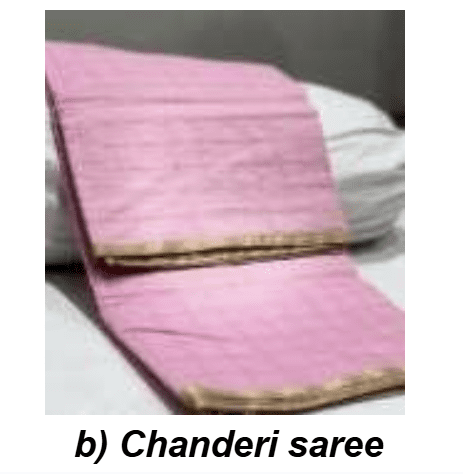
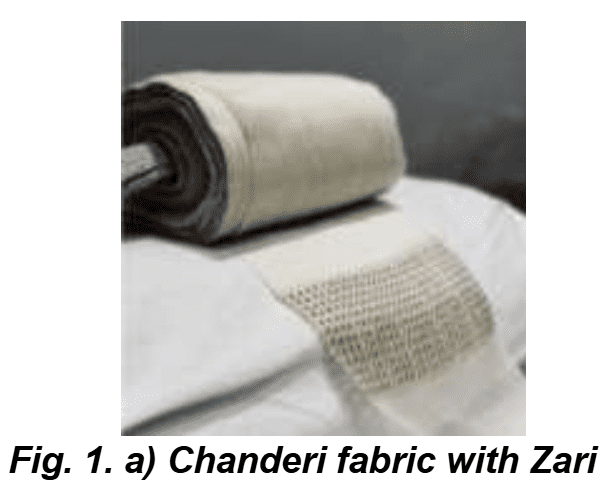
In post-independence India, the government and cooperatives promoted Chanderi weaving through exhibitions and support schemes (Kumar, 2012). A major milestone was achieved in 2009, when Chanderi fabric received the Geographical Indication (GI) tag, safeguarding its authenticity and boosting its global recognition (Patra, 2015). Today, Chanderi weaving continues to thrive, balancing tradition with contemporary design innovations, with motifs such as ashrafi (coin), bundi (drops), chatai (mat), dandidar (stripes), and floral butis still dominating its repertoire (Patra, 2015).

Traditional Weaving Techniques and Sustainable Practices
The handloom weaving of Chanderi fabric, particularly with handspun yarn, is an ancient craft that requires immense skill and patience. Artisans meticulously spin cotton into yarn, which is then dyed and woven into fabrics. The process is slow and labour-intensive, allowing artisans to imbue their personal touch and cultural identity into every piece of fabric.
The process of Chanderi typically commences with design planning, wherein artisans sketch motifs, colours, and layouts on graph paper. These designs are then translated into punched jacquard cards that guide the loom. In the pre-warping stage, yarn hanks are wound onto bobbins and transferred to a warping drum, which transforms them into the warp required for weaving. Simultaneously, borders (kinari) are prepared to complement the design. Once the yarns are dyed in the desired palette, they undergo warping, during which each thread is manually separated with bamboo sticks to avoid tangling before being rolled onto the beam.


At the loom, warp threads are carefully arranged through the harness or ranch and subsequently dented into the reed. The weaving process then begins, with the shuttle carrying the weft threads across the warp. To create decorative motifs, an additional weft thread is interlaced, resulting in the characteristic butis and borders that define Chanderi textiles.
One of the critical elements that differentiates Chanderi from machine-made textiles is its sustainability. Hand-spun yarn is made by the local weavers without the use of industrial machinery, significantly reducing the environmental impact. The energy consumption for handloom production is minimal, and the entire process, from spinning to weaving, is non-polluting, providing a stark contrast to the harmful practices of fast fashion. The revival of Chanderi, thus, presents a unique opportunity to blend traditional craftsmanship with the global demand for more eco-conscious production.

Chanderi in Modern Fashion: From Tradition to Luxury
Chanderi has undergone a remarkable transition from a textile once reserved for royalty to an integral element of contemporary fashion. Historically valued for its lightness, translucence, and intricate motifs, Chanderi was associated with aristocratic and ceremonial use (Irwin & Hall, 1971). Today, it has been reinterpreted by designers who merge its traditional craftsmanship with modern aesthetics. Through the use of contemporary patterns, innovative cuts, and versatile silhouettes, Chanderi has entered the mainstream luxury market while retaining its artisanal value.
Designers such as Anita Dongre, Sabyasachi Mukherjee, and Abu Jani–Sandeep Khosla have prominently incorporated Chanderi into bridal ensembles, evening gowns, and couture collections. This shift not only broadens the perception of Chanderi beyond festive attire but also generates sustainable livelihood opportunities for artisans, ensuring the weave’s continued relevance in a globalised fashion landscape.
Sabyasachi Mukherjee has elevated Chanderi to high couture, integrating it into intricately embroidered bridal lehengas, sarees, and dupattas. His work highlights Chanderi’s luxurious texture while demonstrating its adaptability within global luxury fashion. Anita Dongre, known for her commitment to sustainable fashion, incorporates Chanderi into eco-conscious collections, showcasing lehengas, kurtas, and sarees crafted with ethical dyes and handwoven techniques. These interventions highlight how traditional weaves can resonate with contemporary values of inclusivity, sustainability, and innovation.
The delicate balance of silk and cotton blends in Chanderi often positions it as both a luxury textile and a sustainable alternative to industrial fabrics. For contemporary consumers seeking authenticity and exclusivity, Chanderi offers a product that embodies artisanal skill, cultural heritage, and environmental responsibility.
A defining feature of Chanderi’s modern revival lies in its adaptability. While historically associated with motifs such as florals, paisleys, and geometric patterns, the fabric is increasingly reimagined through minimalistic, avant-garde, or bold design languages. Designers across India and beyond are experimenting with unconventional colour palettes, draping techniques, and silhouettes that reinterpret Chanderi for the present day.
This innovation bridges the past and the present, allowing the fabric to transcend its conventional associations with sarees and dupattas. Today, Chanderi is equally at home in coordinated sets, lightweight dresses, and structured couture pieces. Such versatility reflects its dual identity as both a cultural artefact and a dynamic fashion material.

Economic Impact of Chanderi on Local Communities
The resurgence of Chanderi in global fashion markets has had a profound economic impact on local communities in Madhya Pradesh. The production of Chanderi textiles offers a source of income for thousands of artisans, including weavers, spinners, dyers, and embroiderers, many of whom are women. These artisans work in small clusters, often as part of cooperative societies, ensuring that the benefits of Chanderi production stay within the community.
The economic importance of Chanderi cannot be understated. As hand-spun cotton is woven into fabric, it empowers local communities by providing employment opportunities that are sustainable and culturally relevant. The global demand for Chanderi and khadi-based products has created opportunities for rural artisans to be part of a growing, niche market that values tradition, quality, and sustainability.
Conclusion
Chanderi serves as more than just a textile. It is a cultural symbol, a piece of history, and a bridge between the traditional and the modern. In an era where sustainability and cultural preservation are becoming essential pillars of fashion, Chanderi exemplifies how traditional craftsmanship can thrive in contemporary markets. The fabric’s unique qualities—its elegance, sustainability, and cultural heritage—position it as a key player in the future of global fashion. By blending the beauty of tradition with the demands of modern luxury, Chanderi and kadi will continue to be a testament to the intersection of culture, sustainability, and innovation in fashion.
The trajectory of Chanderi reflects the larger discourse on sustainable luxury and heritage preservation. Once confined to aristocratic use, it has evolved into a textile that embodies inclusivity and modernity. By valorising artisanal labour, reducing dependence on industrial production, and offering consumers a sustainable luxury alternative, Chanderi exemplifies how traditional textiles can remain relevant in a rapidly changing global fashion landscape.
References
- Chattopadhyay, K. (1995). Handicrafts of India. Indian Council for Cultural Relations.
- Goswami, M. (2011). Textiles of Central India: Tradition and Change. New Delhi: Rupa Publications.
- Irwin, J., & Hall, M. (1971). Indian textile history. Victoria and Albert Museum.
- Kumar, R. (2012). Chanderi weaving: Tradition and transition. Journal of Handloom Studies, 4(2), 45–59.
- Mukherjee, S. (2013). Woven air: Textiles of India. National Museum, New Delhi.
- Patra, S. (2015). GI tags and the protection of traditional textiles: The case of Chanderi. Indian Journal of Intellectual Property, 20(3), 112–125.
- Sinha, P. (2007). Handloom heritage of Madhya Pradesh. Indira Gandhi National Centre for the Arts.
- Vogue India. (2021, July 13). 15 labels that are redefining the heritage weave of Chanderi. https://www.vogue.in/fashion/content/15-labels-that-are-redefining-the- heritage-weave-of-chanderi