The global BlueSign Certified Textile market is witnessing rapid growth as sustainability regulations, ESG-driven procurement policies, and eco-conscious consumer demand continue reshaping the global textile and apparel industry.
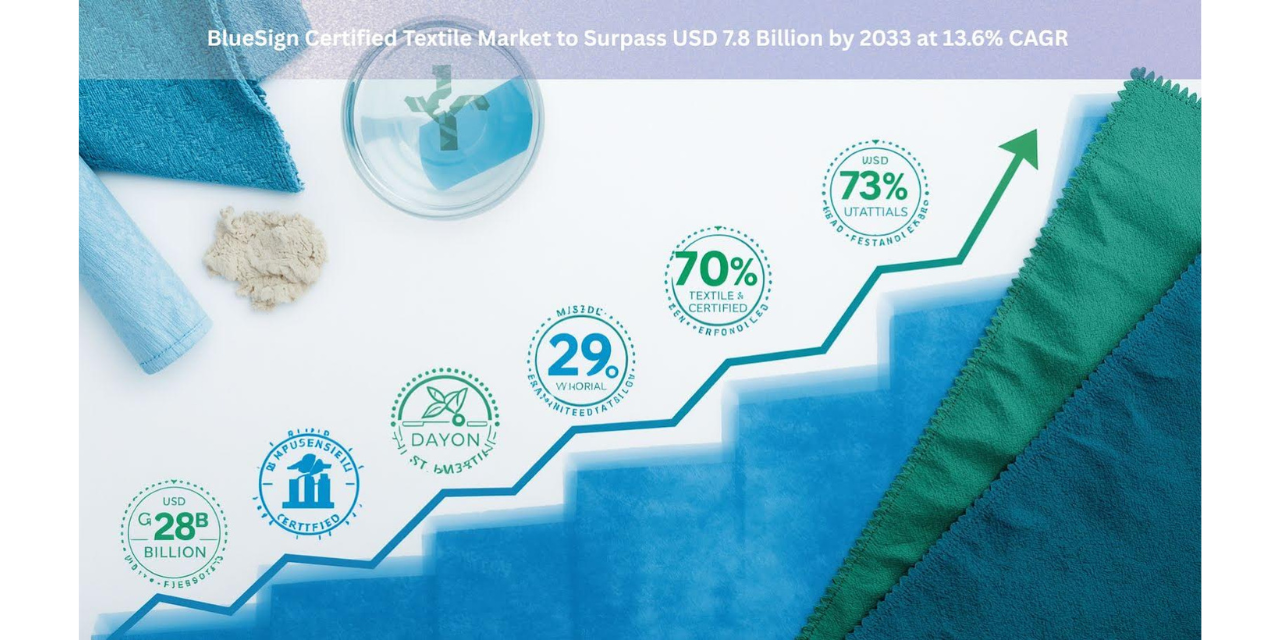
According to industry analysis by Marketintelo, the market was valued at approximately USD 2.4 billion in 2024 and is projected to reach nearly USD 7.8 billion by 2033, expanding at a CAGR of 13.6% during 2025–2033.
The shift toward sustainable manufacturing is accelerating across Europe, North America, and Asia-Pacific, with major apparel brands increasingly prioritising certified textile sourcing to reduce environmental impact and meet evolving regulatory requirements.
Strong Growth Driven by Sustainability Demand
The global textile industry currently contributes nearly 8% of worldwide greenhouse gas emissions, while more than 4% of global freshwater withdrawals are linked to textile manufacturing processes. As environmental accountability becomes central to sourcing decisions, BlueSign Certified Textile products are gaining traction among sportswear brands, luxury fashion houses, and outdoor apparel companies.
Key market highlights include:
- Global market value reached USD 2.4 billion in 2024
- Projected valuation of USD 7.8 billion by 2033
- CAGR forecast of 13.6% during 2025–2033
- Europe accounted for 38% of global revenue in 2024
- Asia-Pacific expected to record the fastest CAGR at 16.2%
- Apparel applications contributed over 52% of total revenue
- Consumer end-users represented nearly 62% of global demand
BlueSign partner manufacturers also reported measurable sustainability gains in 2024, including:
- 17% reduction in CO2 emission intensity compared to 2023
- 8% decline in freshwater usage intensity year-on-year
- 14% lower energy consumption intensity versus 2023 levels
- 31% improvement in responsible chemical usage compared with 2019 baseline levels
Historical Market Expansion
The market has experienced steady expansion over the past decade as sustainability standards became increasingly important within textile procurement strategies.
| Year | Market Value (USD Billion) | YoY Growth |
|---|---|---|
| 2018 | 1.1 | 8.5% |
| 2019 | 1.3 | 10.2% |
| 2020 | 1.5 | 11.5% |
| 2021 | 1.7 | 13.3% |
| 2022 | 1.9 | 11.8% |
| 2023 | 2.1 | 10.5% |
| 2024 | 2.4 | 14.2% |
The strongest acceleration reportedly occurred after 2021 as European sustainability disclosure laws and increasing ESG investments boosted demand for certified textile sourcing worldwide.
Europe Leads While Asia-Pacific Accelerates
Europe remains the largest regional market, accounting for approximately 38% of total global revenue in 2024. Countries including Germany, Switzerland, Italy, and France continue leading adoption due to stringent environmental regulations and strong consumer demand for eco-labelled products.
The European textile sustainability market exceeded USD 910 million in 2024, with Germany contributing more than 24% of regional revenues. The European Union’s Green Deal and Circular Economy Action Plan continue driving investments into sustainable textile production systems.
Meanwhile, Asia-Pacific is projected to emerge as the fastest-growing region with a CAGR of 16.2% through 2033. Countries such as China, India, Bangladesh, and Vietnam are significantly increasing investments in eco-friendly textile production, water-efficient dyeing facilities, and chemical management systems.
China continues to dominate global textile manufacturing with more than 52% of worldwide textile production, while India’s sustainable textile exports reportedly increased by approximately 18% in 2024 compared to the previous year.
North America Strengthens Sustainable Textile Investments
North America accounted for nearly 27% of the global market in 2024, led primarily by the United States. Sustainable apparel sales in the U.S. crossed USD 15 billion in 2024, with consumer surveys indicating that over 64% of American buyers are willing to pay premium prices for environmentally responsible clothing.
Canada is also witnessing increased investments in recycled fibre technologies and low-impact textile finishing systems.
Apparel Segment Dominates Market Revenue
The apparel category remains the largest application segment within the BlueSign Certified Textile market, contributing more than 52% of global revenues in 2024. Sportswear and outdoor apparel brands continue integrating certified fabrics into performance wear, jackets, and footwear collections.
Several premium global brands now reportedly source more than 65% of their fabrics from approved sustainable suppliers. Home textiles and industrial textile applications together accounted for over 35% of market revenues.
Corporate Investments Fueling Industry Transformation
Textile manufacturers worldwide invested more than USD 3.5 billion in sustainable production technologies during 2024 alone. Key areas of investment include:
- Closed-loop dyeing systems
- Water recycling infrastructure
- Chemical traceability software
- Renewable energy integration
- Digital product passports
Several manufacturers implementing BlueSign-certified systems have also reported operational cost reductions ranging from 9% to 15% through improved water and energy efficiency.
Long-Term Outlook Remains Strong
By 2030, sustainable textiles are expected to represent more than 22% of global apparel production, while consumer spending on sustainable apparel could surpass USD 400 billion globally.
Europe is projected to maintain leadership with over USD 2.9 billion in regional demand, while Asia-Pacific may exceed USD 2.5 billion in certified textile revenues.
As environmental regulations tighten and global buyers increasingly prioritise traceability and responsible sourcing, BlueSign Certified Textiles are expected to remain one of the fastest-growing segments within the sustainable textile industry over the next decade.
Read A Full Report: Marketintelo BlueSign Certified Textile Report