Automotive Aramid Fiber Market to Reach USD 1.62 Billion by 2034
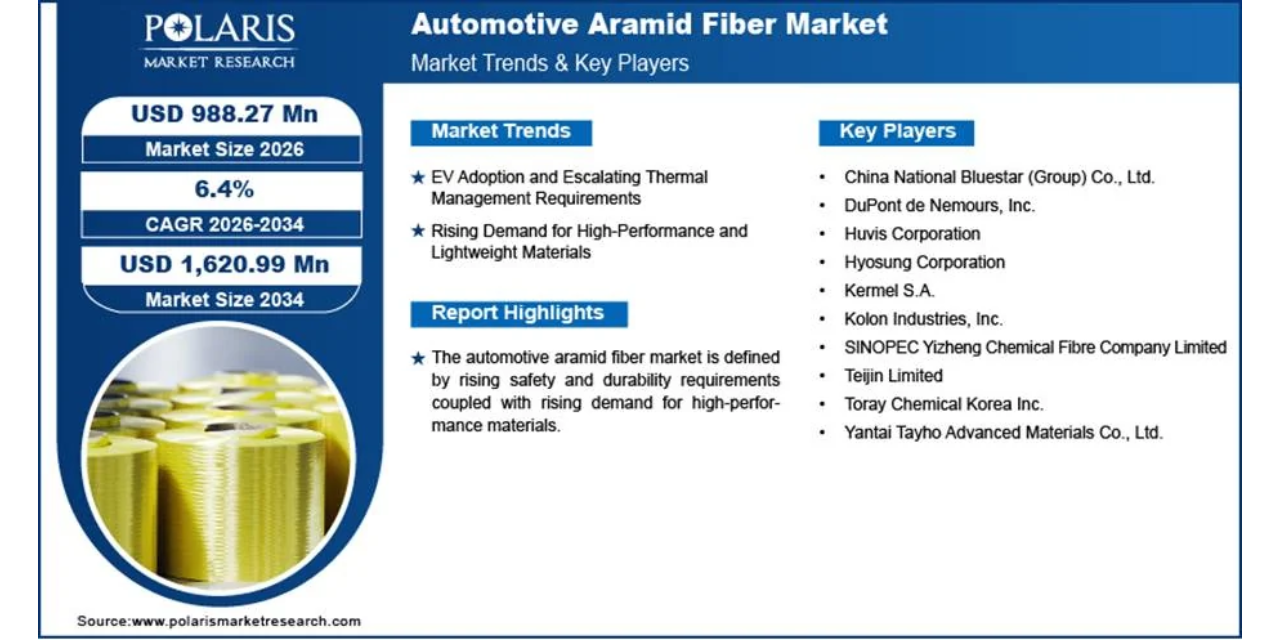
The market is projected to grow at a 6.4% CAGR from 2026 to 2034, driven by electric vehicle adoption, thermal management requirements and demand for high-performance automotive materials.
The global automotive aramid fiber market is projected to reach USD 1,620.99 million by 2034. According to Polaris Market Research, its value stood at USD 929.82 million in 2025. Over the forecast period from 2026 to 2034, the market is expected to register a compound annual growth rate (CAGR) of 6.4%.
Growing electric vehicle (EV) adoption is supporting demand for advanced automotive materials. Moreover, manufacturers are seeking lightweight, durable and heat-resistant solutions for critical vehicle components. As a result, aramid fibers are gaining importance in insulation, reinforcement and protective applications.
Automotive Aramid Fiber Market: Key Report Insights
The Polaris Market Research report examines aramid fiber demand across several automotive applications. These include tyres, braking systems, hoses, belts, insulation and composite reinforcement.
In addition, the study analyses para-aramid and meta-aramid fibers across different forms and applications. Its competitive assessment also covers major suppliers, their production capabilities, material developments and pricing strategies.
For a broader market perspective, the report examines five key regions: North America, Europe, Asia Pacific, Latin America, and the Middle East and Africa. It also considers automotive production trends, regulatory requirements and EV adoption across these markets.
Key Drivers and Emerging Market Trends
Several factors are shaping the automotive aramid fiber market. In particular, the growing focus on vehicle performance, safety and electrification is creating opportunities for advanced fibers.
Electric Vehicles and Thermal Management
Electric vehicle powertrains create specific thermal management requirements. Consequently, manufacturers are exploring aramid fibers for insulation, shielding and reinforcement. These materials offer resistance to heat and mechanical stress, making them suitable for demanding applications.
Demand for High-Performance Materials
Automotive manufacturers continue to prioritise lightweighting, durability and safety. Aramid fibers offer high strength and resistance to demanding operating conditions. Therefore, they are suitable for selected components exposed to mechanical stress and heat.
Material Substitution in Critical Components
Safety-critical and heat-exposed applications are creating opportunities for aramid fibers. In such areas, these materials can offer performance advantages when conventional alternatives do not meet technical requirements. However, adoption remains selective and depends on specific application needs.
Sustainability and Material Innovation
Material innovation is another factor influencing market development. For instance, research into recyclable and lower-impact aramid fibers could support automotive manufacturers’ environmental and lifecycle targets.
Alongside these developments, market forecasts account for vehicle production, EV adoption and regional regulatory frameworks. By assessing these factors together, analysts can identify future demand patterns and investment opportunities.
Key Market Segments Driving Demand
The report divides the automotive aramid fiber market by type, fiber form, application and region. Each segment reflects different material requirements and opportunities across the automotive value chain.
By Type: Para-Aramid and Meta-Aramid
Para-aramid fiber accounted for the largest market share in 2024. Its high tensile strength, impact resistance and fatigue resistance support its use in tyres, braking system components and reinforcement products.
In comparison, meta-aramid fibers offer thermal stability and flame resistance. Consequently, these characteristics make them suitable for applications that require protection against high temperatures.
By Application: Braking Systems and Tyre Reinforcement
Brake pads and clutch facings represent important application areas. Such components require materials that maintain stability under high loads and demanding operating conditions.
Beyond braking systems, tyre reinforcement and thermal insulation are also areas of growing interest. Furthermore, expanding electric vehicle production is adding to demand for materials that meet specific performance and thermal requirements.
Regional Outlook: Asia Pacific Leads the Market
Asia Pacific
Asia Pacific held the largest share of the automotive aramid fiber market in 2024. This position reflects the region’s importance as a major automotive manufacturing hub.
High vehicle production and established supplier networks contribute to market demand. Additionally, expanding EV production in China, Japan, South Korea and India is supporting the use of advanced materials.
North America
North America is expected to record the highest growth during the forecast period. Increasing EV adoption and demand for performance-oriented vehicles are supporting this outlook.
Furthermore, the region’s focus on advanced automotive specifications is creating opportunities for high-performance materials. Together, these factors contribute to its projected growth.
Where Is the Automotive Aramid Fiber Market Headed?
The market is moving towards selective, high-value applications rather than widespread material substitution. As vehicle electrification advances, thermal and mechanical requirements across automotive components are changing. Consequently, aramid fibers are finding opportunities in insulation, reinforcement and protective applications.
However, cost considerations and competition from alternative fibers may limit wider adoption. For this reason, manufacturers are likely to focus on components where aramid fibers offer clear performance benefits.
Looking ahead, advanced composites, EV platforms and sustainability-oriented material development are expected to influence future market opportunities. In turn, these developments could support steady, application-driven growth.
Key Questions Addressed in the Market Report
The report examines several important aspects of the automotive aramid fiber industry. Key questions include:
- What is the global market size and projected CAGR through 2034?
- Which factors are driving market growth?
- Who are the major companies, and how are they positioned competitively?
- How do fiber types, forms and applications influence demand?
- What are the key market trends across North America, Europe, Asia Pacific, Latin America, and the Middle East and Africa?
- Where are opportunities emerging in lightweight composites and sustainable aramid fiber development?
Major Companies in the Automotive Aramid Fiber Market
According to Polaris Market Research, key companies operating in the global market include:
- China National Bluestar (Group) Co., Ltd.
- DuPont de Nemours, Inc.
- Huvis Corporation
- Hyosung Corporation
- Kermel S.A.
- Kolon Industries, Inc.
- SINOPEC Yizheng Chemical Fibre Company Limited
- Teijin Limited
- Toray Chemical Korea Inc.
- Yantai Tayho Advanced Materials Co., Ltd.
Automotive Aramid Fiber Market: Segmentation
The report covers the following market segments, with revenue estimates in USD million for 2021–2034.
By Type
- Para-Aramid Fiber
- Meta-Aramid Fiber
By Fiber Form
- Aramid pulp
- Staple fiber
- Yarn and fabric
- Chopped fiber
By Application
- Brake Pads and Clutch Facings
- Tyres and Tyre Reinforcement
- Hoses, Belts and Gaskets
- Heat Shields and Insulation
- Automotive Composites and Structural Components
By Region
- North America: United States, Canada
- Europe: Germany, France, UK, Italy, Spain, Netherlands, Russia and Rest of Europe
- Asia Pacific: China, India, Japan, Malaysia, South Korea, Indonesia, Australia and Rest of Asia Pacific
- Latin America: Mexico, Brazil, Argentina and Rest of Latin America
- Middle East and Africa: Saudi Arabia, UAE, South Africa, Israel and Rest of Middle East and Africa
Access the full market insights: Automotive Aramid Fiber Market Report
Readers can also request a free sample copy of the report through Polaris Market Research.