Abstract
Khadi, once the emblem of India’s independence movement and Gandhian philosophy of Swadeshi, is today repositioned as a sustainable fabric and a symbol of cultural heritage. Despite its historical relevance, Khadi faces challenges of consumer perception, market positioning, and competitiveness in the fast-evolving fashion and textile industry. This study explores the marketing and promotional strategies of the Khadi industry in India using secondary research. It evaluates the role of government institutions, especially the Khadi and Village Industries Commission (KVIC), alongside private players, designers, and e-commerce platforms. Findings suggest that while Khadi has benefited from national campaigns, celebrity endorsements, and digital integration, gaps remain in consistent branding, quality assurance, and youth-centric positioning. The study concludes that Khadi’s future lies in balancing its heritage with modern marketing practices that appeal to conscious consumers in India and abroad.
Key Words: Khadi, Marketing, Promotional strategies, KVIC, Consumer Perceptions, Designers, Digital Marketing, Celebrity endorsement, Private players
I. Introduction
Khadi holds a unique position in the Indian textile industry. More than a fabric, it is a cultural identity that symbolised self-reliance during India’s freedom struggle. Post-independence, Khadi retained its association with Gandhian philosophy and rural empowerment. In recent years, Khadi has re-emerged as a sustainable alternative in fashion, aligning with global shifts toward eco-friendly consumption.
Yet, despite government backing and rising sustainability discourse, Khadi’s market penetration remains limited compared to other textiles. Its perception as “old-fashioned” and restricted to ceremonial or political attire hinders widespread adoption, particularly among youth. This research paper explores the marketing and promotional strategies of the Indian Khadi industry, analysing efforts by KVIC, designers, and brands to rebrand Khadi for contemporary markets.
II. Statement of the Problem
The Khadi industry faces a paradox: while Khadi symbolises sustainability and heritage, it struggles to attract younger consumers due to outdated perceptions and limited modern marketing. Despite government initiatives and promotional campaigns, Khadi’s growth is inconsistent, with low export potential and limited presence in mainstream fashion retail. There is a pressing need to examine the effectiveness of current marketing and promotional strategies and explore how Khadi can be rebranded to compete in a globalised fashion market.
III. Review of Literature
Khadi, as a fabric and ideology, has generated significant scholarly discussion across historical, cultural, economic, and marketing dimensions. However, when positioned in the context of modern marketing and promotional strategies, the literature reveals both a rich foundation and clear research gaps.
Chattopadhyay (2018) offers a seminal account of Khadi’s symbolic importance during India’s freedom movement, where the fabric embodied the spirit of *Swadeshi*. The paper positions Khadi as more than a textile—it was a socio-political weapon of resistance. Yet, while the historical weight of Khadi is acknowledged, the study points out that this symbolic legacy has not been fully converted into tangible market opportunities. The absence of a robust branding or marketing framework limits Khadi’s transition from heritage to a contemporary product category.
Building on this historical perspective, Trivedi (2010) emphasises Khadi’s political and cultural identity as a symbol of resistance to colonialism and a path to economic independence. While valuable in contextualising Khadi’s ideological foundations, the paper does not extend its analysis into modern promotional strategies that could generate real economic progress. This gap underscores the need for research that links cultural symbolism to consumer-oriented marketing practices.
Moving into consumer perception studies, Rohilla and Gautam (2022) conducted an empirical study among youth in Haryana, revealing that Khadi continues to be perceived as traditional rather than fashionable. This perception gap highlights a disconnection between heritage positioning and youth expectations. Their findings reinforce the need for innovative promotional efforts to reframe Khadi as aspirational and relevant to younger consumers.
Dhillon and Kapoor (2024) expand this argument by examining awareness among fashion students. Their work demonstrates that sustainability is increasingly valued by upcoming fashion professionals, who see potential in adopting Khadi if it is positioned as a sustainable lifestyle brand rather than being confined to heritage or ethnic fashion. This study strengthens the call for a shift in Khadi’s marketing narrative—from heritage preservation to sustainability-driven fashion branding.
In a similar vein, Varshney and Bhargava (2021) explore consumer attitudes toward Khadi, highlighting the importance of channelising positive consumer sentiment through digital platforms and e-commerce. They argue that Khadi’s future growth lies in consumer-centric branding strategies that leverage the digital ecosystem. This aligns well with global trends in fashion retail, where online platforms play a central role in brand visibility and consumer engagement.
Adding further evidence, Yadav and Modi (2023) investigate the impact of advertising on Khadi consumer awareness in Delhi/NCR. Their study compares traditional advertising methods with digital and influencer-led promotions, finding that today’s consumers respond more favourably to digital-first strategies. This empirical insight demonstrates the necessity for Khadi marketers to shift from traditional awareness campaigns to more interactive, digital-driven approaches.
While marketing and promotional strategies are vital, Rao (2017) brings attention to a foundational issue: consumer trust. His paper argues that trust in Khadi is directly tied to the quality of its production. Inconsistent quality and supply-side challenges undermine consumer confidence, thereby reducing the effectiveness of promotional campaigns. This highlights the inseparable link between production standards and marketing outcomes in sustaining Khadi’s market relevance.
Sharma and Gupta (2020) address generational perceptions, showing that millennials associate Khadi with eco-friendliness but simultaneously demand style, availability, and comfort. Their study suggests that repositioning Khadi as modern and versatile, while retaining its sustainability appeal, is key to bridging the gap between perception and purchase.
Nautiyal and Atre (2023) offer an important insight into product innovation by examining Khadi’s adoption among urban working women. Their findings reveal that when Khadi is tailored into western-style office attire, acceptance increases significantly. This illustrates that promotional strategies must be backed by design innovation that aligns with contemporary lifestyles.
The KVIC Annual Report (2022) documents impressive growth, with sales crossing Rs 5,000 crore, largely attributed to campaigns like “Khadi for Fashion.” However, while these figures are encouraging, the report provides little analytical insight into consumer behaviour or long-term marketing effectiveness. It highlights the success of promotional pushes but leaves unanswered questions about sustained consumer adoption.
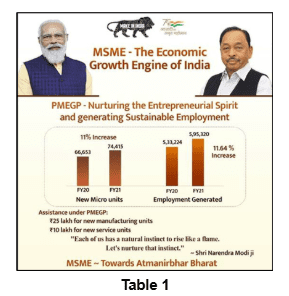
For the first time since the launch of the PMEGP Scheme in 2008, KVIC has established over one lakh new units in a financial year. These 1,03,219 units have been established at a total capital of nearly Rs 12,000 crore, out of which KVIC disbursed a margin money subsidy of Rs 2978 crore, while the bank credit flow was nearly Rs 9,000 crore. The margin money subsidy of Rs 2978 crore given by KVIC in the year 2021-22 is also the highest since 2008. A whopping 8,25,752 new employment opportunities were created across the country, which is also the highest so far under PMEGP.
Source : https://www.pib.gov.in/PressRelease19’April’22
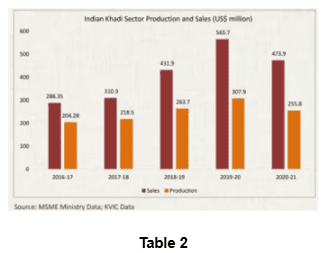
Khadi production and sales in India have grown significantly over the last five years (between FY17 and FY21). Khadi production in FY21 was Rs. 1,904.5 crore ($255.8 million), up from Rs. 1,520.8 crore ($204.3 million) in FY17, a 5.8 per cent CAGR, according to a report from India Brand Equity Foundation (IBEF) that cited the MSME ministry and
KVIC data. As compared to FY17, Indian Khadi sales increased by 13.2 percent between FY17 and FY21, reaching Rs. 3,527.7 crore ($473.9 million)
Source: https://www.moneycontrol.com/news/business/indias-khadi-market-flourishes-despite-covid-impact
The industry overview of Khadi between 2013–14 and 2022–23 demonstrates a remarkable transformation in terms of turnover, sales, production, and employment generation. The KVIC turnover (all products) witnessed more than a four-fold increase, rising from INR 31,000 crore in 2013–14 to INR 134,000 crore in 2022–23. This indicates a strong institutional effort in scaling operations and promoting Khadi as not just a traditional fabric but as a wider ecosystem of village industries. Khadi sales (fabric) also reflect an impressive growth trajectory, climbing from INR 1,081 crore in 2013–14 to INR 5,942 crore in 2022–23. This more than five-fold increase underscores the growing consumer acceptance of Khadi and the impact of sustained marketing campaigns such as “Khadi for Nation, Khadi for Fashion.” However, when compared with the broader textile sector, this figure still suggests a niche positioning, pointing toward the need for further mainstreaming.
Source: https://ibef.org/news 9th July
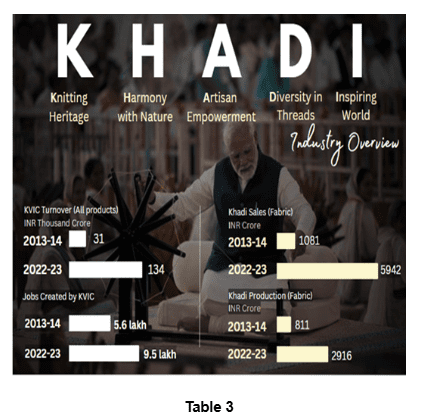
In terms of Khadi production (fabric), output rose significantly from 811 crore INR in 2013–14 to 2,916 crore INR in 2022–23. This indicates not only enhanced consumer demand but also improvements in production capacity, supply chain efficiency, and artisan engagement.Perhaps the most socially significant indicator is the number of jobs created by KVIC, which increased from 5.6 lakh in 2013–14 to 9.5 lakh in 2022–23. This highlights Khadi’s role as an enabler of rural employment and artisan empowerment, aligning with Gandhian ideals of self-reliance and decentralised economic growth.
Overall, the data suggests that Khadi has moved beyond being a symbolic fabric to becoming a dynamic sector with growing economic and social relevance. Yet, the rapid rise in turnover and sales also highlights the challenge of sustaining quality, ensuring consistent branding, and appealing to younger demographics in order to secure long-term competitiveness in India’s fashion and textile industry.
Beyond marketing, Choudhury and Ghosh (2016) focus on Khadi’s role in rural employment and economic development. While their work demonstrates the socio-economic impact of Khadi, it neglects to examine marketing as a growth driver, leaving scope for integrating promotional strategies with developmental goals.
Gupta, Rastogi, and Mathur (2021) emphasise Khadi’s eco-friendly manufacturing practices. Their study reinforces the potential of Khadi as a core part of the sustainable fashion narrative, arguing that promotional campaigns must foreground this ecological advantage to resonate with global sustainability-conscious consumers.
Yet, awareness alone does not guarantee sales. Sivasakthivel and Dhanalakshmi (2020) identify a critical gap between awareness and actual buying behaviour. Their research underlines the importance of effective marketing in converting awareness into purchase intention—an area where Khadi has historically struggled.
Pandey and Kakati (2021) frame Khadi within Gandhian ideology, portraying it as a catalyst for rural empowerment and self-reliance. While philosophically powerful, the study lacks actionable marketing insights, but it provides a cultural lens that can enrich promotional storytelling if integrated with modern branding techniques.
Finally, Tripathi (2019) evaluates Khadi’s export potential in the context of global sustainable fabrics such as hemp and linen. The paper advocates for Khadi to be promoted as a global sustainable fashion brand, emphasising its competitive advantage if strategically marketed beyond India.
The literature collectively establishes three broad themes. First, Khadi’s historical and cultural significance provides a strong symbolic foundation, but this heritage alone is insufficient for market success. Second, consumer perception studies reveal both opportunities and barriers: while sustainability offers appeal, gaps in style, comfort, and modernity limit adoption among youth and urban professionals. Third, marketing and promotional strategy research emphasises the need for digital-first approaches, design innovation, and consumer trust-building to translate Khadi’s symbolic value into economic viability.
Despite significant discussion around Khadi’s cultural role and socio-economic impact, there is a notable gap in integrated studies that evaluate how marketing and promotional strategies can bridge the gap between heritage positioning and modern consumer expectations. This research, therefore, positions itself within this gap, aiming to explore the effectiveness of marketing and promotional strategies in revitalising Khadi’s relevance in contemporary India.
IV. Objectives of the Study
- To evaluate the current marketing and promotional strategies adopted by the Khadi industry in India.
- To explore the role of government, KVIC, and private brands in promoting Khadi.
- To analyse consumer perception of Khadi with a focus on Millennials and Gen Z.
- To suggest strategic directions for repositioning Khadi in domestic and global markets
V. Research Methodology
The present study employs an exploratory and descriptive research design in order to develop a nuanced understanding of the research topic, especially in contexts where prior knowledge is limited or fragmented. Data collection is guided by a secondary research approach, utilising a diverse array of sources including academic papers, government reports, documents from the Khadi and Village Industries Commission (KVIC), market reports, industry analyses, news articles, and fashion journals. This diversity ensures a comprehensive perspective, enabling the investigation of historical, institutional, and market-oriented factors relevant to the study. Analytical procedures are anchored in a thematic analysis of literature, wherein data are systematically coded, categorised, and interpreted to identify recurrent themes and patterns that illuminate critical aspects of the research area. Additionally, policy documents are reviewed to evaluate regulatory frameworks and institutional interventions, while trend analysis is deployed to assess evolving market dynamics, shifts in consumer preferences, and innovations within the sector. The integration of these strategies facilitates a rigorous and reliable synthesis of findings, ultimately allowing the study to contribute substantively to academic discourse and inform future research and policy development.
VI. Analysis and Discussion
A) Marketing Strategies Used
- KVIC campaigns like “Khadi for Nation, Khadi for Fashion” improved visibility.
The Khadi and Village Industries Commission (KVIC) has undertaken several marketing initiatives to revitalise the image of Khadi and broaden its consumer base. Among the most significant has been the launch of campaigns such as *“Khadi for Nation, Khadi for Fashion.”* This initiative strategically blended Khadi’s heritage with modern relevance, aiming to reposition it from a symbol of India’s independence struggle to a contemporary fashion choice. The campaign not only celebrated Khadi’s national significance but also projected it as a fabric aligned with sustainability and style. The visibility of Khadi increased substantially through these campaigns, with promotional events, fashion shows, and endorsements by public figures contributing to the creation of a refreshed brand identity. However, while the campaign generated short-term visibility and record-breaking sales, the challenge remains in sustaining consumer engagement beyond seasonal or event-driven promotions.
- Reposition Khadi as premium lifestyle wear with designer tie-ups (e.g., with Raymond, FabIndia
Another major strategy has been the repositioning of Khadi as premium lifestyle wear through collaborations with established fashion and retail brands. Designer tie-ups with labels such as Raymond and FabIndia have been pivotal in bringing Khadi into the mainstream fashion retail ecosystem. These collaborations positioned Khadi not just as a traditional fabric but as a versatile material suitable for contemporary office wear, luxury clothing, and designer collections. By associating with well-known lifestyle brands, Khadi gained access to modern design sensibilities, improved supply chain networks, and a consumer base that values exclusivity and quality. This approach signalled a shift from Khadi being perceived as “heritage-only” apparel to being embraced as aspirational, stylish, and urban lifestyle fashion. Such repositioning has also helped bridge the perception gap among younger consumers who demand both sustainability and modern aesthetics.
- Digital platforms, Social media and e-commerce platforms expand urban reach.
The third significant dimension of Khadi’s marketing strategy has been the growing adoption of digital platforms, social media channels, and e-commerce marketplaces to expand its urban reach. Recognising the changing dynamics of consumer behaviour, particularly among millennials and Gen Z, Khadi marketers have increasingly leveraged Instagram campaigns, influencer partnerships, and storytelling through digital media to connect with fashion-conscious audiences. The presence of Khadi products on e-commerce platforms such as Amazon, Flipkart, and dedicated portals has expanded accessibility for urban consumers who prefer online shopping over physical store visits. Furthermore, digital engagement has enabled interactive promotional strategies such as live streaming of fashion shows, user-generated content campaigns, and festive-season discount promotions, thereby enhancing both visibility and consumer participation. Social media, in particular, has emerged as a critical promotional channel where Khadi can showcase its dual narrative of heritage and sustainability while aligning with global sustainable fashion trends.
Collectively, these strategies—national branding campaigns, premium repositioning through designer collaborations, and digital-first promotional efforts—represent a structured attempt to modernise the Khadi brand. While the efforts have yielded encouraging results, the long-term success of these strategies depends on consistency, innovation in design, and the ability to sustain consumer trust through quality and availability.
B. Promotional Gaps
- Limited global branding compared to fabrics like linen or organic cotton.
One of the most noticeable gaps lies in Khadi’s lack of strong international branding. While fabrics such as linen and organic cotton have successfully positioned themselves as sustainable, stylish, and globally relevant textiles, Khadi still remains largely tied to its regional heritage. Its marketing campaigns are often domestically focused, highlighting its national identity rather than building a universal appeal. This limits its ability to penetrate international high-fashion markets or stand alongside global sustainable fabrics. Without powerful storytelling on global platforms and strategic collaborations with international designers, Khadi risks being overshadowed despite its eco-friendly and artisanal qualities.
- Inconsistent quality and a fragmented supply chain reduce consumer trust
Another challenge comes from the inconsistent quality of Khadi products, largely caused by its decentralised and fragmented supply chain. Since production often involves numerous small-scale artisans across different regions, maintaining uniform standards becomes difficult. This inconsistency makes consumers hesitant when considering Khadi for mainstream use, as they cannot always be assured of the fabric’s durability, finish, or sizing. Modern consumers, especially in competitive retail spaces, expect standardisation, and this lack of quality assurance weakens brand credibility. Unless Khadi adopts quality benchmarks and streamlines supply processes, it risks losing relevance in the broader textile market, where trust plays a key role in customer retention.
- Youth often perceive Khadi as “ceremonial” wear, not everyday fashion
A significant promotional gap also stems from how younger generations perceive Khadi. Many associate it with tradition, ceremonies, or formal occasions, rather than seeing it as a versatile fabric for everyday wear. This perception creates a disconnect between Khadi and the evolving tastes of millennials and Gen Z, who prioritise comfort, style, and trendiness in their wardrobes. Unlike contemporary fabrics that are marketed through lifestyle appeals, Khadi is still burdened by its image as a symbolic fabric rather than a fashionable choice. Without rebranding strategies that highlight modern designs, collaborations with youth-centric brands, and marketing campaigns that showcase Khadi’s adaptability in casual and streetwear fashion, it risks alienating the very demographic that could expand its relevance.
C. Consumer Perceptions
- Millennials and Gen Z are interested when Khadi is linked with sustainability and design innovation.
The perception of Khadi among today’s consumers, particularly millennials and Gen Z, has undergone a gradual shift from viewing it as a purely traditional fabric to associating it with sustainability and innovation. Younger consumers are increasingly conscious of the environmental and social impact of their purchase decisions, and this consciousness translates into a stronger inclination toward eco-friendly fabrics. When Khadi is positioned within the larger narrative of sustainable fashion, it resonates with its values of ethical consumption and responsible lifestyle choices. However, sustainability alone is not sufficient; these generations also seek products that align with modern aesthetics and offer innovative design. They are more receptive to Khadi when it is presented in contemporary silhouettes, urban office wear, or stylish everyday apparel. The combination of heritage value, eco-conscious production, and fashion-forward design creates a stronger appeal, making Khadi relevant for this younger, style-sensitive segment.
- Celebrity endorsements and digital campaigns improve aspirational value.
In addition, celebrity endorsements and digital campaigns have played a significant role in enhancing the aspirational value of Khadi. When public figures, designers, or influencers are seen endorsing or wearing Khadi, it generates a sense of relevance and desirability among younger consumers. Endorsements work not only as symbolic associations but also as confidence-building mechanisms, assuring consumers that Khadi can be fashionable and elite. Digital campaigns on platforms like Instagram, YouTube, and Twitter have further amplified this effect by reaching tech-savvy audiences in their own spaces of engagement. Interactive campaigns, storytelling through social media, and influencer collaborations have added layers of relatability and aspiration to the brand. These strategies help reposition Khadi from being perceived as outdated or ceremonial to being considered aspirational, trendy, and aligned with global sustainable fashion movements.
D. Institutional Role
- KVIC provides subsidies, branding campaigns, and artisan support.
The Khadi and Village Industries Commission (KVIC) has been the central institutional body responsible for nurturing the Khadi sector in India. Its role extends beyond being an administrative agency to acting as a promoter, facilitator, and guardian of the Khadi brand. KVIC provides subsidies and financial assistance to artisans, ensuring that the hand-spinning and hand-weaving community continues to find livelihood opportunities in an era dominated by mechanised textile production. Beyond monetary support, KVIC has also spearheaded large-scale branding and awareness campaigns such as “Khadi for Nation, Khadi for Fashion” and “Khadi India”, which attempt to reposition Khadi as both a heritage fabric and a sustainable lifestyle choice. The institution further engages in capacity-building programs, training initiatives, and infrastructural support for artisans, thus creating a safety net that protects traditional skills from fading away. In doing so, KVIC not only sustains an industry but also safeguards cultural heritage, rural employment, and the Gandhian ethos of self-reliance.
- However, private sector marketing outpaces government-driven promotion.
However, despite these institutional efforts, the pace and scale of marketing by private sector players often surpass government-driven promotional initiatives. Private brands, especially those in the fashion and retail sector, tend to be more agile in responding to changing consumer preferences, experimenting with innovative designs, and leveraging digital-first marketing approaches. Collaborations with designers, influencer-based promotions, and omnichannel retail strategies have given private players an edge in connecting with younger, urban consumers. In contrast, government campaigns, though impactful in generating visibility, are sometimes limited by bureaucratic processes, slower execution, and a focus on symbolism rather than consumer-centric storytelling. This creates a gap where institutional support provides the foundation for survival, but private sector marketing drives the narrative of aspiration, desirability, and modern relevance. The interplay between these two forces highlights the need for stronger public–private partnerships to ensure that Khadi’s historical value is matched by competitive positioning in contemporary markets.
VII. Conclusion
The Indian Khadi industry is at a crossroads. While it enjoys government backing and renewed global interest in sustainability, its marketing and promotional strategies require modernisation. Khadi needs consistent branding, quality assurance, and alignment with contemporary fashion sensibilities. Leveraging digital platforms, designer collaborations, and sustainability narratives will be crucial for rebranding Khadi as a lifestyle fabric.
If Khadi successfully bridges heritage with innovation, it can transition from being a symbolic fabric of the past to becoming a sustainable textile of the future—both in domestic and international markets.
References:
- Chattopadhyay, S. (2018). Clothing the Nation: Khadi and its Symbolism in Indian History. Journal of South Asian Studies.
- Trivedi, L. (2010). Clothing Gandhi’s Nation: Homespun and Modern India. Indiana University Press.
- Rohilla, M., & Gautam, A. (2022). Perception of Young Consumers on Khadi in Panipat District. The Journal of Rural and Agricultural Research.
- Dhillon, A.K., & Kapoor, N. (2024). Reviving Khadi: Exploring Sustainable Qualities and Promoting Khadi among Fashion Design Students. ShodhKosh Journal.
- Varshney, A. & Bhargava, S. (2021). Market Augmentation of Khadi Products through Channelizing Consumer Attitude. Journal of Emerging Technologies.
- Yadav, D & Modi, S.K. (2023). Impact of Advertising on Khadi Consumer Awareness in Delhi/NCR. European Journal of Engineering and Technology.
- Rao, V. (2017). Khadi: Challenges and Prospects. Indian Textile Journal.
- Sharma, N., & Gupta, R. (2020). Khadi as Sustainable Fashion: Perspectives of Millennial Consumers in India. International Journal of Fashion Studies.
- Nautiyal, V.T., & Atre, A. (2023). Embracing Khadi: Urban Indian Women’s Affinity for Office Attire.* ShodhKosh Journal.
- KVIC Annual Report (2022). Government of India.
- Choudhury, S., & Ghosh, A. (2016). Economic Development and Khadi. Journal of Rural Development.
- Gupta, S., Rastogi, D., & Mathur, R. (2021). Environment-Friendly Methods of Khadi Manufacturing. Sustainable Production Journal.
- Sivasakthivel, E.K., & Dhanalakshmi, G. (2020). Awareness Level of Customers towards Khadi Products in Tamil Nadu. Ilkogretim Online Journal.
- Pandey, R., & Kakati, B.K. (2021). Reviving Gandhian Principles: Khadi as Catalyst for Rural Empowerment. Gandhi Research Foundation.
- Tripathi, V. (2019). Khadi and Globalization: Opportunities in International Markets.Indian Journal of Marketing.