
The International Textile Manufacturers Federation (ITMF) and the Institut für Textiltechnik of RWTH Aachen University (ITA) have published AI in the Textile Value Chain: A Strategic Guide to Artificial Intelligence for the Global Textile Industry. The white paper identifies poor data integration, skills shortages and gaps in governance as the principal barriers to AI adoption in the textile and apparel industry, rather than limitations in the technology itself.
The study argues that the industry’s ability to benefit from AI will depend increasingly on coordinated, industry-wide capability building.
The white paper draws on the ITMF and ITA webinar series AI in the Textile Value Chain, conducted between 2024 and 2026. Across ten sessions, more than 20 experts from companies, research institutions and policy bodies contributed their perspectives. The findings also incorporate insights from a World Café discussion with industry practitioners held during the ITMF Conference 2025 in Yogyakarta, Indonesia.
Structural Pressures Driving AI Adoption
According to the authors, AI is becoming increasingly relevant to the textile industry in response to structural pressures rather than technological hype. Demographic decline, persistent skills shortages, market volatility and growing expectations around quality, traceability and sustainability are encouraging companies to explore AI-driven solutions.
At the same time, decades of digitalisation have generated substantial volumes of industry data across multiple systems and platforms. However, this data often remains fragmented and difficult to use effectively. The white paper therefore characterises the sector as “not under-digitalised, but digitally fragmented.”
AI Applications Are Already Delivering Value
The report highlights several areas where AI is already producing measurable results in textile manufacturing and related processes.
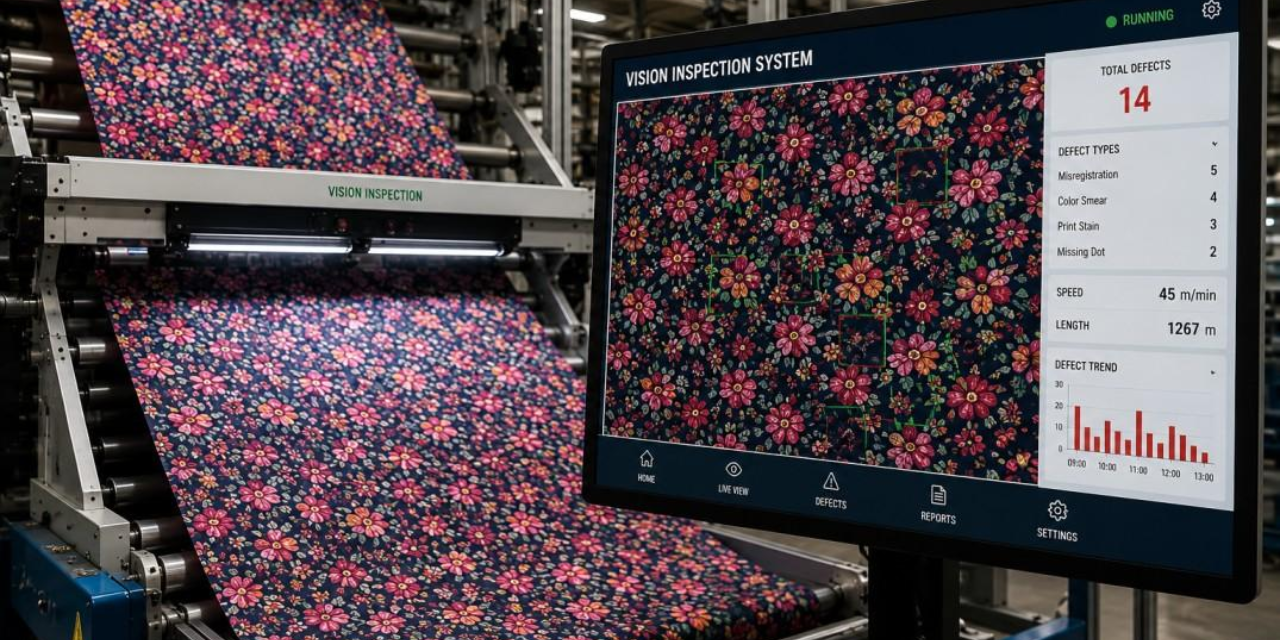
These include computer-vision systems for fabric and yarn inspection, predictive maintenance, energy optimisation and demand forecasting. One example from a nonwovens production line showed that causal AI reduced scrap by 10%.
The findings indicate that companies do not necessarily need to begin with large-scale AI transformations. Instead, clearly defined and measurable applications can provide a practical starting point for adoption.
Data and Skills Remain Critical Challenges
A central finding of the study is that data quality and workforce capabilities are more significant constraints than the availability of AI algorithms.
Industry participants highlighted that AI cannot compensate for poor-quality data. Instead, flawed or incomplete datasets can amplify existing weaknesses in business and production processes. Companies may also have considerably less structured, usable data than they assume.
The white paper consequently recommends investing in people and data capabilities before attempting to scale AI deployment.
From Decision Support to AI-Driven Action
AI applications in textiles are also beginning to move beyond decision support towards taking action within defined processes.
The report points to emerging agentic AI systems capable of coordinating multi-step activities, including sourcing-related processes. Causal AI is also beginning to adjust production parameters directly, although such applications remain subject to human supervision.
The authors estimate that fully integrated, end-to-end AI workflows could become realistic within the next two to three years.
Building Trust Around AI
Trust is identified as a decisive factor in the successful adoption of AI across the textile value chain.
Industry participants highlighted several requirements for responsible implementation, including control over sensitive data, robust cybersecurity, transparency regarding system limitations and clearly defined human accountability.
Rather than viewing AI as a replacement for human expertise, the paper emphasises the importance of maintaining human oversight while using AI to address complexity and make better use of limited expertise.
Collaboration Can Accelerate Industry Adoption
The white paper recommends that companies adopt AI incrementally, beginning with bounded and clearly defined use cases.
It also calls for data to be treated as shared infrastructure and highlights the role of industry associations and pre-competitive collaboration, particularly in supporting small and medium-sized enterprises.
Potential areas for collaboration include shared data standards, data spaces that allow ownership to remain with the original data holder, and sector-specific AI tools such as a controlled “Textile GPT.”
Olivier Zieschank, Director, ITMF, said: “AI is not a shortcut around the structural challenges our industry faces, but it can help companies manage complexity and make the most of scarce expertise. Understanding where AI genuinely helps is a learning process. That is why exchange through associations like ITMF matters so much.”
Prof. Thomas Gries, Director, Institut für Textiltechnik ITA, RWTH Aachen University, said: “Companies need a dedicated task force to embed data integration into their day-to-day and strategic technical and business processes. Partnering with external experts on a transparent assessment — a data or automation waste walk — and on effective implementation is not only decisive to future success, but essential to survive!”
The white paper, AI in the Textile Value Chain: A Strategic Guide to Artificial Intelligence for the Global Textile Industry, is available through the RWTH Aachen University publication repository. Recordings of the ITMF and ITA webinar series are available to ITMF members through the ITMF Virtual Forum.


