Who Gets to Define Sustainable Fashion? A Global South Perspective on Repair

By Prof Risha Roy, Associate Professor and Lead, Sustainable Fashion and Textile Design and Co-lead, Transdisciplinary Design, Anant National University
Sustainable fashion is often discussed through recycling technologies, circular business models and new materials. However, traditional repair cultures offer another perspective on extending garment life and reducing textile waste. From sari repurposing and traditional mending to artisan knowledge and women-led enterprises, these practices highlight the social and cultural dimensions of sustainability.
In this interview, Prof Risha Roy of Anant National University discusses the gaps between circular fashion ambitions and industry practices. She also explores how repair, traditional craftsmanship, responsible design and policy changes can help build a more sustainable fashion system.
1. What can the global fashion industry learn from traditional repair cultures of the Global South?
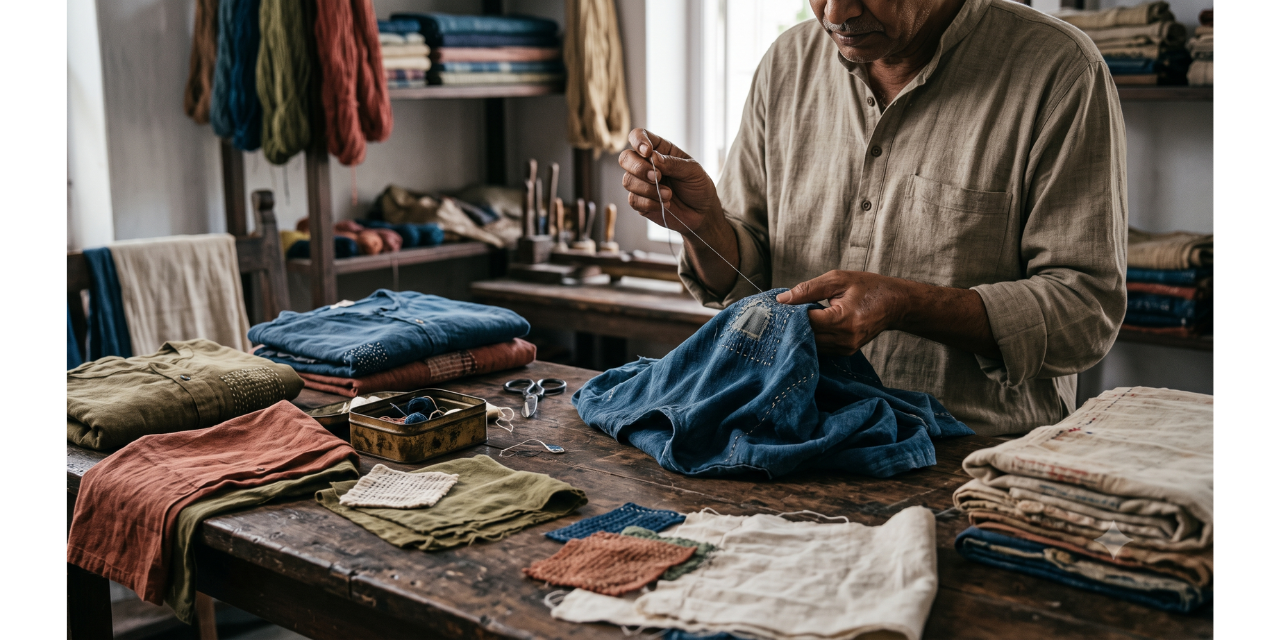
Repair was never viewed as a sustainability strategy in the Global South. Long before these terms became popular, grandmothers, neighbourhood tailors and local rafoogars were practising resource conservation in everyday life.
Traditionally, clothing moved through several stages of use. A well-worn sari might become a child’s garment, then a quilt or godhari, and eventually a floor cloth. Its value declined gradually rather than disappearing when it went out of fashion. These practices relied on human skill and adaptation rather than industrial recycling.
Repair is also skilled work. Rafoogars in Najibabad and Kashmir have restored intricate Kani and Pashmina shawls. Their expertise can make tears almost disappear, demonstrating a level of craftsmanship often overlooked in discussions about sustainable fashion.
However, we must not romanticise these traditions. Much of this work has depended on unpaid labour, particularly by women. Preserving this knowledge requires fair compensation, recognition and support for the people who sustain it.
2. What are the biggest gaps between circular fashion and its implementation?
The biggest gap is the scale of production compared with the amount of material being recycled. According to Textile Exchange’s Materials Market Report 2025, global fibre production increased from approximately 58 million tonnes in 2000 to 132 million tonnes in 2024. It is projected to reach 169 million tonnes by 2030.
Recycled fibres account for only 7.6 per cent of global fibre production, and most recycled polyester comes from PET bottles rather than discarded textiles. Textile-to-textile recycling remains negligible.
Meanwhile, blended fabrics, bonded seams and mixed trims make garments difficult to dismantle and sort. Designers create complex products, yet recyclers are expected to find solutions at the end of their life.
The people handling post-consumer textile waste are another overlooked part of this system. Informal workers, including women and children from marginalised communities, contribute to sorting, collection and recovery. Yet they often face income insecurity and health risks without adequate protection.
We also need to change how circularity is measured. The industry counts tonnes recycled but rarely measures the additional years a garment remains in use. Repair and reuse can preserve more of a product’s value, yet these strategies receive less attention.
3. Why have repair, reuse and repurposing declined in India, and how can they return?
Clothing has become more affordable, while labour has become relatively expensive. A new T-shirt can cost less than an hour of a tailor’s work. As ready-made clothing becomes more accessible, neighbourhood tailors, who once formed an essential part of the repair ecosystem, lose business.
Repair has also acquired a social stigma. As disposable incomes rise, visible mending can be seen as a sign of financial hardship rather than resourcefulness. In addition, blended fabrics containing elastane or Lycra are often harder to mend invisibly than cotton, wool or silk. This has contributed to the decline of traditional repair skills.
The revival of repair requires economic intervention, not nostalgia alone.
First, repair must become a recognised profession with formal training, certification and fair wages. Second, brands should offer in-store repairs and convenient doorstep mending services. Third, governments should introduce policies that support repair businesses.
France, for example, has introduced a repair bonus for eligible repairs at participating workshops. In India, a key challenge is making repair commercially viable despite the availability of neighbourhood tailoring services.
Finally, repair must become part of design education. I teach a dedicated repair and mending course because designers need to understand garment maintenance rather than treat it as somebody else’s responsibility.
4. How can brands design garments to make them easier to repair, reuse and recycle?
Repairability begins at the pattern-making stage, not at the end of a garment’s life.
Material simplicity is a useful starting point. Using fewer fibre blends and reducing elastane or Lycra where possible can make garments easier to repair and recycle. In construction, mechanical joining methods are preferable where suitable to adhesives and bonded seams. Generous seam allowances also make alterations easier.
Traditional Indian tailoring often allowed garments to be adjusted as the wearer grew or changed shape. This principle can help modern clothing last longer.
Brands can also design high-wear garments with replaceable components. Cuffs, collars and pockets could be made easier to replace. Reinforcing stress points, such as crotch and side seams, can help prevent common forms of garment failure.
Providing repair materials is another practical step. Along with spare buttons, brands could include matching fabric and thread. Care labels should also offer useful repair guidance, accurate fibre information and, where applicable, access to a digital product passport.
Finally, garments should be designed for a second life. Planning how existing panels can be recut into new products can support reuse and reduce waste.
5. How can brands encourage consumers to value longevity over constant newness?
The responsibility should not fall entirely on consumers. Their choices are influenced by prices, convenience and the systems created by the industry.
Brands can make garment care easier by offering accessible alterations, repairs, buy-back schemes and resale services. These options help preserve a garment’s value and encourage customers to keep using it.
Cost-per-wear is another useful way to understand value. A garment costing ₹5,000 and worn 200 times costs ₹25 per wear. By comparison, a garment worn only twice costs ₹2,500 per wear.
Brands can also demonstrate their commitment to durability through multi-year guarantees and free mending. In addition, personalisation can strengthen emotional connections with clothing. Garments associated with memories, alterations and visible repairs are often harder to discard.
Ultimately, the problem is not that people want new clothes. It is that the fashion system has made disposability the default.
6. How can women-led businesses and artisan communities build more sustainable supply chains?
My research on women-led slow fashion enterprises reveals several common practices. These businesses often produce in small batches, work on a made-to-order basis and source materials selectively from local suppliers.
Such approaches can improve resilience, reduce unsold inventory and limit exposure to sudden changes in demand. They also reduce the amount of working capital tied up in excess stock.
Many businesses incorporate maintenance into their model from the beginning. Surplus fabrics become value-added products, artisans receive more consistent work throughout the year, and alteration and mending services support customers after purchase.
Women are already central to India’s circular textile economy. Many work in informal systems that collect, sort and redistribute textile waste. Women also make up a substantial part of the workforce in recycling clusters such as Panipat.
The priority, therefore, is not simply to bring women into the circular economy. It is to recognise their existing contributions and provide formal contracts, safe working conditions, fair compensation and access to working capital.
7. How can brands collaborate with traditional artisans without exploiting their knowledge?
Transparency is the starting point. When a brand works with an artisan community, it benefits from both labour and knowledge. However, compensation often covers only the labour involved.
There are four important steps.
- Attribution: Recognise the artisan and their community on the product.
- Fair compensation: Pay for design contributions, not just production on a per-piece basis. Royalties can also support communities when their techniques or motifs are used.
- Long-term partnerships: Provide predictable orders throughout the year rather than relying only on seasonal demand. This can make traditional crafts more attractive to younger generations.
- Co-creation: Develop designs with communities rather than simply borrowing their cultural expressions. Communities should have a say in what knowledge can be shared and what should remain within the community.
Geographical indications and collective trademarks can also help protect traditional knowledge, provided the benefits reach the makers.
I teach a course called Cultural Appreciation and Appropriation to help young designers become more responsible collaborators. I also conduct similar work with artisans.
Ultimately, lasting partnerships depend on consistent engagement, shared benefits and respect for community decisions.
8. What skills and mindsets should future fashion designers develop?
Designers need material knowledge and an understanding of how the fashion system works. This includes fibre chemistry, water consumption, energy use, garment end-of-life processes and the limits of recycling technologies.
They must also understand garment construction, pattern cutting and mending. It is difficult to design for repair without knowing how to repair a garment. Through my repair and mending course, students learn to recognise what needs fixing and understand the value of extending product life.
Numeracy and regulatory knowledge are equally important. Designers should understand extended producer responsibility, life-cycle assessment, greenwashing and digital product passports. These areas will increasingly influence how products enter and compete in markets.
Beyond technical skills, designers need a more responsible mindset. They should make conscious decisions about quality, durability and end-of-life options.
Most importantly, graduates should learn to question whether a product needs to exist at all, rather than focusing only on making it more desirable.
9. How can technology and AI complement traditional textile knowledge?
Technology can support traditional knowledge in several ways. Automated fibre identification and sorting can help address bottlenecks in textile-to-textile recycling. Traceability systems and digital product passports can carry repair information throughout a garment’s life.
Better demand forecasting can also reduce overproduction, which contributes significantly to textile waste. Meanwhile, community-controlled digital archives can help preserve techniques and knowledge held by craftspeople whose skills are at risk of disappearing.
However, these technologies also present challenges. Generative AI can flatten the details of traditional surface patterns and remove the cultural meaning behind intricate techniques. Datasets may also draw on craft traditions without proper consent or benefit-sharing.
Technology should increase the value of human skill rather than replace it. Machines can be used for dangerous tasks such as shredding, chemical processing and hazardous sorting. At the same time, consent and revenue-sharing arrangements should be built into datasets that use traditional knowledge.
10. What fundamental change would make the fashion system genuinely more sustainable?
I would change the link between revenue and the number of units sold.
Global fibre production has more than doubled since 2000, while recycled content has not kept pace. Textile-to-textile recycling remains very limited. No collection or recycling infrastructure can expand quickly enough to manage the growing volume of discarded clothing.
The industry is trying to make an ever-increasing flow of products circular rather than addressing overproduction itself.
Brands should be financially responsible for the entire life cycle of the products they place on the market. Pricing and producer obligations should reflect durability, repairability and material choices. Products that are poorly designed for longevity and recovery should face greater financial responsibility.
The European Union is moving towards stronger product sustainability requirements, but similar principles need wider international adoption. Revenue from these measures could support repair infrastructure and protect the informal workers who already contribute to textile recovery.
This shift could change how brands design products, make durability commercially valuable and create better livelihoods for repair workers. It would also move responsibility away from consumers, who are often blamed for problems created by the system itself.