Shri. Dr. K.S.Muralidhara
Joint Director
Textiles Committee,
Ministry of Textiles, Govt. of India

Shri. Santosh P. Shinde
Assistant Director
Textiles Committee,
Ministry of Textiles, Govt. of India
- Introduction
The Indian handloom sector is an integral part of the country’s cultural, social and economic development. With a history spanning several millennia, handloom weaving represents one of the world’s oldest surviving textile traditions and continues to symbolise India’s artistic excellence and craftsmanship. Every handwoven fabric reflects the knowledge, creativity and skills of artisans that have been preserved and transferred across generations, making each product a unique representation of regional culture and identity.
Apart from preserving India’s rich textile heritage, the handloom sector contributes significantly to rural employment and inclusive economic development. It provides sustainable livelihood opportunities to millions of weavers and artisans and remains one of the largest sources of employment in the country. The sector also supports decentralised production systems that utilise locally available resources and traditional weaving skills, thereby strengthening rural economies while preserving indigenous knowledge systems.
The strength of Indian heritage of handloom lies in their incredible diversity. Each part of India has developed a unique weaving tradition, motif and type of looms. These range from Gujarat’s and Rajasthan’s bright Bandhani, through Tamil Nadu’s grand Kanjeevaram silks, Madhya Pradesh’s intricate Chanderi, West Bengal’s heritage Baluchari and globally acclaimed Banarasi brocade. Thus, India’s handloom tradition has produced world-famous textiles such as Banarasi silk, Kanchipuram silk, Chanderi, Ikat, Pochampally, Paithani, Patola, Jamdani, Pashmina, etc. Each region developed its own unique weaving style, reflecting local culture, art, and craftsmanship.
The textile industry has witnessed remarkable technological advancements over the past century, particularly with the widespread adoption of powerlooms capable of producing fabrics at high speed and low cost. While mechanised production has improved efficiency and affordability, it has also intensified competition for traditional handloom products. Modern powerloom fabrics often closely resemble handwoven textiles, making it increasingly difficult for consumers to distinguish between genuine handloom and machine-made products. This has resulted in market confusion, unfair competition and reduced recognition for the craftsmanship of genuine handloom weavers.
Recognising these challenges, the Government of India has undertaken several initiatives to safeguard and promote authentic handloom products. Among these initiatives, the Handloom Mark Scheme plays a significant role by providing a unique certification and identity to genuine handloom manufacturer and their products, thereby enhancing consumer confidence and supporting the livelihoods of traditional weavers.
- Evolution of the Indian Handloom Sector
From Heritage to Sustainable Fashion
The history of handloom weaving in India extends back more than five thousand years, with archaeological evidence from the Indus Valley Civilisation indicating the existence of cotton spinning and weaving. Over the centuries, Indian handwoven textiles evolved into some of the world’s finest fabrics, admired for their intricate craftsmanship, vibrant colours and exceptional quality. During different historical periods, particularly under royal patronage and the Mughal Empire, Indian textiles such as muslin, brocades, silk fabrics and fine cotton textiles gained international recognition and became important commodities in global trade.
The evolution of weaving technology also reflects the continuous advancement of traditional craftsmanship. Early weaving was carried out on simple pit looms, where the weaver operated the loom manually using foot treadles. Over time, technological improvements led to the adoption of frame looms, fly-shuttle looms and mechanisms such as dobby and jacquard, enabling weavers to produce more intricate patterns and improve productivity while preserving the handmade nature of the weaving process. These developments demonstrate that the handloom sector has continuously adapted to changing technological requirements without compromising its traditional identity.
The industrial revolution and the subsequent introduction of mechanised textile manufacturing during the colonial period posed serious challenges to the traditional handloom industry. The availability of inexpensive machine-made fabrics significantly affected the production and marketing of handwoven textiles. Nevertheless, the handloom sector survived these challenges and became a symbol of self-reliance during India’s Swadeshi movement, reinforcing its cultural and national significance.
Today, the Indian handloom sector has evolved beyond being merely a traditional craft. It represents a harmonious combination of heritage, livelihood, innovation and sustainability. Across the country, generations of weavers continue to preserve unique regional weaving traditions while producing textiles that reflect the cultural diversity of India. Renowned handloom products such as Banarasi, Kanchipuram, Chanderi, Paithani, Pochampally Ikat, Patola, Jamdani and Pashmina continue to enjoy national and international recognition for their craftsmanship and artistic excellence.
In recent years, handloom products have gained renewed prominence due to the growing global demand for sustainable and ethically produced textiles. Designers and fashion brands are increasingly incorporating traditional handwoven fabrics into contemporary apparel, home furnishings and lifestyle products, demonstrating that handloom is no longer confined to tradition alone but has become an integral part of modern fashion and sustainable textile production. Thus, the Indian handloom sector has successfully evolved from a traditional cottage industry into a globally recognised symbol of cultural heritage, responsible production and sustainable fashion.
- Handloom versus Powerloom: A Comparative Perspective
Woven fabrics are produced by interlacing two sets of yarns – the warp (lengthwise) and the weft (widthwise) at right angles using a loom. Depending on the method of weaving, these fabrics are produced either on manually operated handlooms or on electrically driven powerlooms. Although both technologies produce woven fabrics, they differ considerably in terms of production process, fabric characteristics, environmental impact, cost and consumer perception.
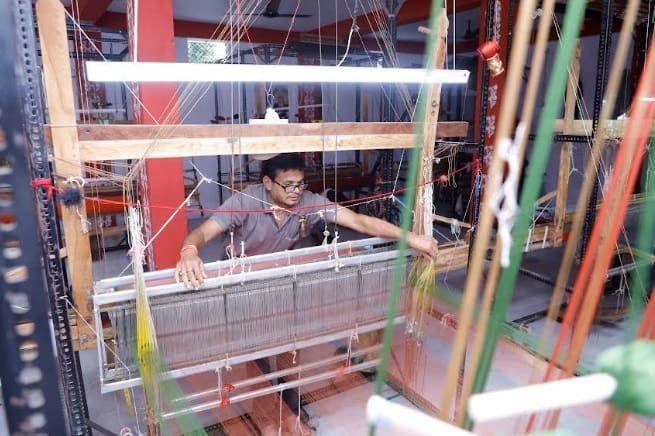
Handloom weaving is a labour-intensive process in which skilled artisans manually operate looms to create fabrics. The weaving process involves significant human intervention, making every product unique in texture, appearance and craftsmanship. In contrast, powerlooms utilise electrically operated mechanised systems capable of producing large quantities of fabric with greater speed, uniformity and consistency. Their high productivity and lower production costs have made powerlooms the dominant technology for mass textile manufacturing.
Table1: Comparison between Handloom and Powerloom Fabrics
| Parameter | Handloom | Powerloom |
| Weaving Process | Manually operated by skilled artisans | Mechanised and electrically operated |
| Production Capacity | Low to moderate | High-volume production |
| Fabric Texture | Soft, breathable and naturally textured | Uniform, compact and consistent |
| Design Characteristics | Unique, artistic and handcrafted | Standardised and repetitive |
| Selvage | Selvage often a bit rough and uneven | Selvage is typically smooth and even |
| Energy Requirement | Minimal as No electricity | Requires continuous electrical power |
| Environmental Impact | Eco-friendly with lower carbon footprint | Higher energy consumption |
| Cost | Comparatively higher due to manual craftsmanship | Economical owing to mass production |
| Employment Generation | Supports rural artisans and traditional skills | Requires comparatively less manual labour |
The advantages of powerloom technology, such as high productivity, uniform quality and cost-effective production, have enabled the textile industry to meet the growing demand for affordable fabrics. However, these advantages have not diminished the significance of handloom products. Instead, handloom textiles continue to occupy a distinctive position in both domestic and international markets due to their authenticity, craftsmanship and cultural value.
One of the most important reasons for the continued preference for handloom products is their uniqueness. Every handwoven fabric carries subtle variations in weave, texture and finish that reflect the individual skill and creativity of the artisan. Unlike machine-produced fabrics, no two handloom products are exactly identical, making each piece exclusive and artistically valuable.
Handloom fabrics are also widely appreciated for their comfort and natural feel. The manual weaving process often produces fabrics that are softer, more breathable, and suitable for prolonged use, particularly when woven from natural fibres. In addition, handloom production consumes no electricity, making it an environmentally sustainable textile manufacturing process. With increasing global awareness of sustainable and ethical fashion, consumers are increasingly choosing handcrafted products that combine quality with environmental responsibility.
Beyond product quality, the handloom sector plays an important socio-economic role by generating employment for millions of weavers and preserving traditional weaving techniques that have been passed down through generations. Every purchase of a genuine handloom product directly contributes to the livelihood of weaving communities while helping preserve India’s diverse cultural heritage.
Identification Challenges
Despite these distinctive characteristics, identifying genuine handloom products has become increasingly difficult. Advancements in powerloom technology now enable machine-made fabrics to closely resemble handwoven textiles in appearance and design. As a result, consumers often find it difficult to distinguish between authentic handloom and powerloom products through visual inspection alone.
However, there is no single standardised method/standard/specification to officially identify a product as handloom versus powerloom, and it is a significant challenge for the industry. Instead, identification relies on a combination of visual, textural, and contextual factors. The difficulty is compounded by the fact that powerlooms can now mimic the look of handloom products, making it nearly difficult for an average consumer to tell the difference.
The widespread misuse of the term “Handloom” for machine-made products has created serious challenges for the sector. Such misrepresentation leads to unfair competition, reduces consumer confidence and adversely affects the income and recognition of genuine handloom weavers. When consumers are unable to identify authentic handwoven products, the value associated with traditional craftsmanship gradually diminishes.
The growing need to protect genuine handloom products, ensure consumer confidence and provide a distinct identity to authentic handwoven textiles led to the introduction of the Handloom Mark Scheme by the Government of India. The scheme serves as an effective mechanism for certifying genuine handloom manufacturer & their products and strengthening the market position of India’s rich handloom heritage.
- Handloom Mark Scheme: Protecting Authenticity and Promoting India’s Handloom Heritage
The Indian handloom sector is renowned for its rich diversity, exceptional craftsmanship and cultural significance. However, with the rapid expansion of mechanised weaving, consumers often find it difficult to distinguish genuine handloom products from machine-made fabrics that closely resemble handwoven textiles. The misuse of the term “Handloom” for powerloom products has resulted in market misrepresentation, unfair competition and reduced recognition for the traditional skills of handloom weavers. This has adversely affected both consumer confidence and the livelihood of genuine artisans.
Recognising these challenges, the Office of the Development Commissioner for Handlooms (O/o DCHL), Ministry of Textiles, Government of India, launched the Handloom Mark Scheme (HLM) in the august hands of the then Hon’ble Prime Minister of India on 28th June, 2006. Since its inception, the Textiles Committee has been the implementing agency for the scheme. The Handloom Mark serves as a certification mark that provides a distinct identity to genuine handloom products while assuring consumers of their authenticity.
The primary objectives of the Handloom Mark Scheme are to:
- Provide a unique identity to genuine handloom products.
- Promote and strengthen the brand image of Indian handloom products.
- Enhance consumer confidence through product authentication.
- Improve market opportunities for handloom weavers in domestic and international markets.
- Protect traditional weaving practices and preserve India’s rich textile heritage.
The scheme is open to individual Weavers, Master Weavers, Cooperative Societies, Apex and Primary Handloom Weavers’ Cooperative Societies, Handloom Development Corporations, Self Help Groups, Manufacturer Exporters and Other organizations engaged in genuine handloom production. After registration and verification of the production facility, eligible producers are authorised to use Handloom Mark labels on their products.
Handloom Mark with QR code
One of the most significant features of the scheme is the Handloom Mark label incorporating a unique QR code. The label provides traceability by linking every certified product to its registered producer, enabling consumers to verify the authenticity and origin of the product. The Handloom Mark logo, developed by the National Institute of Design (NID) and registered as a Certification Trade Mark under the Trade Marks Act, 1999, is restricted to be used only by registered users. The logo symbolises the interlocking of warp and weft yarns, representing the harmonious integration of traditional craftsmanship and institutional support. This certification mechanism not only safeguards genuine handloom products from imitation but also strengthens consumer trust in certified products.
The Handloom Mark Scheme offers significant benefits to all stakeholders. For weavers and producers, it provides market recognition, product differentiation and enhanced opportunities to obtain better value for authentic handloom products. For consumers, it serves as a reliable assurance of authenticity and quality, enabling informed purchasing decisions. At the national level, the scheme contributes to preserving India’s traditional weaving heritage, promoting sustainable livelihoods, strengthening the “Brand India” image and enhancing the competitiveness of Indian handloom products in global markets.
The success of the scheme is reflected in its nationwide implementation. As per the current status, more than 29,500 users across different categories have been registered under the Handloom Mark Scheme. The scheme has covered nearly 10 lakh handlooms and approximately 6 lakh weavers, while more than 25 crore products are tagged with Handloom Mark Labels across the country. These achievements demonstrate the growing acceptance of the scheme and its important role in protecting the identity of genuine Indian handloom products. The present status of the scheme is summarised below in the map.
Present Status of Handloom Mark Scheme
Data as on 31.07.2026
- Conclusion
The Indian handloom sector is far more than a traditional textile industry; it is a living embodiment of the country’s rich cultural heritage, artistic excellence and centuries-old craftsmanship. Despite the rapid expansion of mechanised textile production through powerlooms, handloom weaving has retained its significance owing to its uniqueness, superior craftsmanship, cultural identity and sustainable production practices. The continued preference for handloom products demonstrates that consumers increasingly value authenticity, quality and the human touch associated with handcrafted textiles.
However, the growing resemblance between machine-made and handwoven fabrics has created significant challenges in distinguishing genuine handloom products, often leading to market misrepresentation and affecting the livelihoods of traditional weavers. In this context, the Handloom Mark Scheme has emerged as an important initiative of the Government of India to safeguard the authenticity of handloom products. By providing a distinct identity, ensuring product traceability and enhancing consumer confidence, the scheme protects the interests of genuine weavers while strengthening the market position of Indian handloom products.
The success of the Handloom Mark Scheme demonstrates the importance of certification in preserving India’s traditional weaving heritage and promoting fair trade practices. Continued awareness among consumers, greater participation of weavers and producer organisations, and wider adoption of Handloom Mark-labelled products will further strengthen the credibility and reach of the scheme. At the same time, collaboration among government agencies, industry stakeholders, designers and marketing platforms can help expand market opportunities for certified handloom products in both domestic and international markets.
As the global textile industry increasingly embraces sustainability and responsible consumption, India’s handloom sector is uniquely positioned to contribute to this transformation. By preserving traditional craftsmanship while adapting to contemporary market requirements, the sector continues to demonstrate that heritage and innovation can coexist. The Handloom Mark Scheme will remain a vital instrument in protecting the authenticity, identity and legacy of Indian handloom products, ensuring that this invaluable tradition continues to flourish for future generations.
Today, handloom has entered the world of modern fashion. Designers and fashion brands blend traditional handwoven fabrics with contemporary styles to create sarees, dresses, jackets, shirts, scarves, and home furnishings etc. Handloom products are now recognised globally for their sustainability, eco-friendliness, and timeless elegance. By choosing handloom products, we not only preserve India’s cultural heritage but also support artisans’ livelihoods and promote sustainable fashion for future generations.