The Journey of the Tribal Women at PIDT – From Innovation to Indigenisation

Dr. Manjula Jagatramka
Director,
Vaitarna
PIDT: People’s Institute for Development and Training is an action-based research and educational institute at the grassroots level, designing futures of the tribals at Jagdishpur, Madhupur, Jharkhand.
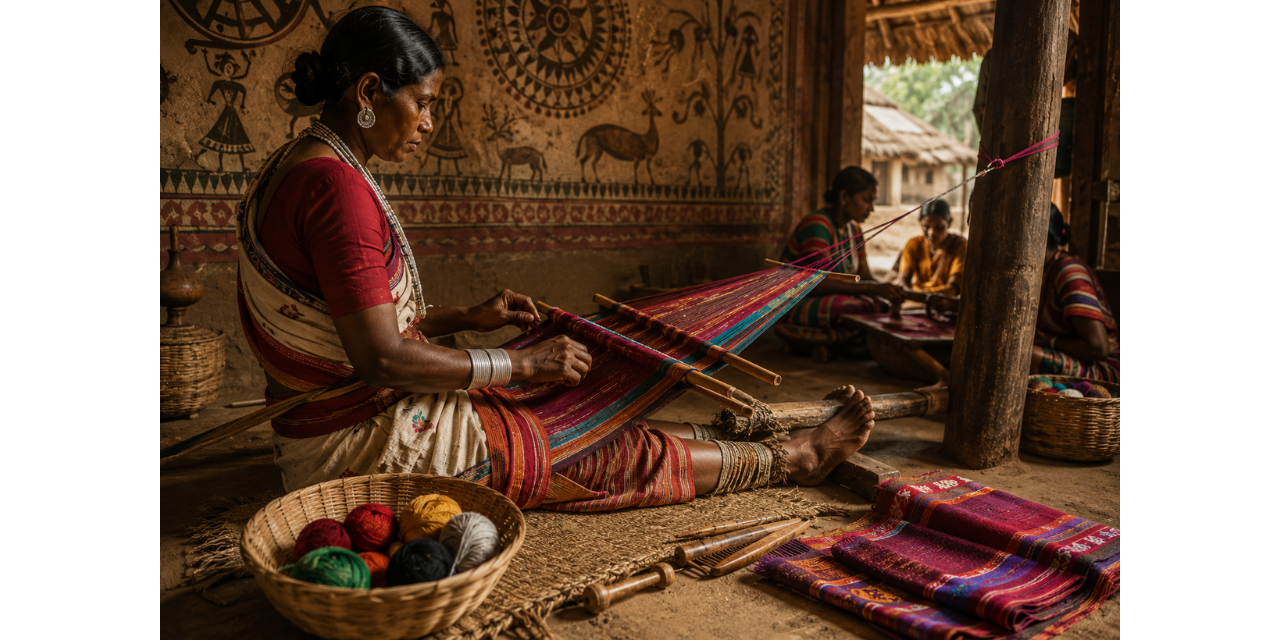
Basic, Crude, primitive – these are all words that may spring to mind when one thinks of the humble back strap loom – a description that obscures the fact that some of history’s most beautiful and complex textiles have been woven on the simple arrangement of sticks.
The puzzling collection of sticks and tangle of yarn miraculously springs to life and transforms itself into a loom when the weaver herself dons the back strap, attaches herself to the loom bar, tensions the warps and starts to weave.
Small, portable and inexpensive – the back strap loom is ideal for those who lack the space for a table or floor loom, would like to have their weaving “on the road” with them, or simply don’t have the means to invest in more sophisticated equipment.
The People’s Institute empowers women by teaching traditional and contemporary weaving, enabling them to produce high-quality, marketable fabrics and finished goods. The women can also work flexibly from home, as the looms and materials are portable—offering accessible, skill-based work that promotes financial independence.
Embedded in the jungles, actually the degraded forest of Jharkhand. The railroads built by the Britishers took away the livelihoods of the local people, causing a lot of migration.
Handloom was a pit loom in Jharkhand. Skilling innovation was tried with the back strap loom. Indira actually designed and conducted the workshops with women from across Deoghar, Dumka and Godda districts, helping them to create products for the upmarket.
Interesting to find that the Kole tribe took it very naturally. They actually adopted making the loom locally. Innovation, adoption, adaptation and indigenisation of the back strap loom. Through constant work with the women, they started inserting their colours & patterns, eventually making a lot of products for their own usage. It’s happening at Madhupur block, so they have named it Madhupuri Loom.
Small artisans play a big role in emerging economies. The “artisan economy” is one of the largest employers in the developing world. But these entrepreneurs, many of whom are women, are often limited by their inability to access financial services such as loans to expand their operations and hire workers. The research shows that when women entrepreneurs succeed, they drive economic growth and invest more back into their families and communities. It is said that altogether, the world’s artisans represent the fourth largest economy on the planet. The area of PIDT’s work, however, is in a very backward area, and we are engaged in immense effort to bring the artisans to be entrepreneurs in new expanded markets.
Currently, the focus is on developing distribution strategies and expanding market access for the Institute’s woven products.
The products now require viable markets to ensure sustained profitability and long-term success. We seek to connect the women’s craftsmanship with consumers through both local and international channels.