Dr. Ela Manoj Dedhia
Director,
Anveshanam Foundation
Abstract
India’s handloom sector represents one of the world’s oldest living textile traditions and continues to support millions of artisan households. Beyond preserving cultural heritage, the sector contributes significantly to rural livelihoods and environmentally responsible production systems. Despite increasing appreciation for handmade textiles, weaving communities continue to face challenges such as unstable incomes, dependence on intermediaries, rising production costs, and declining participation by younger generations.
This study examines the handloom clusters of Peddapuram, Uppada, and Dulla in Andhra Pradesh through field observations, interactions with weaving families, and analysis of the handloom value chain. Particular emphasis is placed on the often-overlooked contribution of women and the importance of integrating Universal Human Values (UHV) into livelihood development initiatives.
The study concludes that sustainable handloom development requires a comprehensive approach involving economic empowerment, institutional support, cultural preservation, community participation, and human-centred development.
- Introduction
Handloom weaving represents a unique combination of technical expertise, cultural identity, and intergenerational knowledge transfer. Unlike mechanised production systems, handloom weaving depends heavily on family participation, traditional skills, and community cooperation. The sector also offers environmental advantages through lower energy consumption and sustainable production methods.
The present study focuses on three weaving clusters located in Andhra Pradesh:
- Peddapuram, known for silk dhoties, garments, shirting materials, and silk sarees.
- Uppada, internationally recognised for its Geographical Indication (GI)-registered Jamdani sarees.
- Dulla, a comparatively smaller and less documented cluster that preserves traditional weaving practices.
The research examines not only the technical aspects of weaving but also the social, cultural, and economic conditions affecting weaving communities.
- Methodology
The study adopts a qualitative and exploratory approach based on field visits, direct observation, informal discussions with artisans and their families, and documentation of production processes. Secondary information was obtained from government publications, academic literature, and institutional reports.
The research analyses the handloom value chain through the following stages:
Fibre → Yarn preparation → Dyeing → Warping → Sizing → Loom preparation → Weaving → Finishing → Marketing → Consumer
The study further evaluates sustainability from five perspectives:
- Technical sustainability
- Economic sustainability
- Social sustainability
- Environmental sustainability
- Cultural sustainability
- Findings and Discussion
3.1 Cluster Characteristics
Each cluster possesses a distinctive identity shaped by its history, techniques, and market orientation.
- Peddapuram artisans have successfully adapted to changing market requirements while retaining traditional skills. However, they face intense competition from power looms and increasing production costs.
- Uppada weavers produce highly skilled Jamdani textiles requiring considerable time, precision, and craftsmanship. Despite strong market demand and international recognition, artisans often receive only a small portion of the final retail value.
- Dulla provides important insights into the experiences of smaller weaving communities struggling with limited market exposure and inadequate institutional support.
3.2 Family Participation and Women’s Contribution
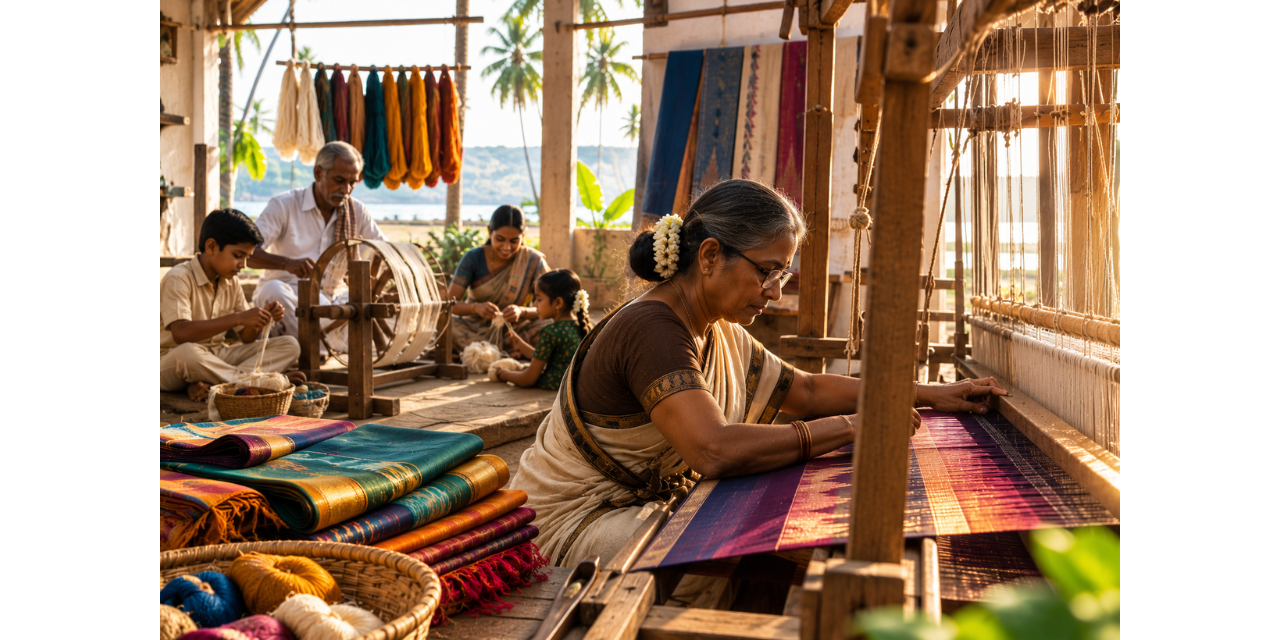
The study demonstrates that weaving is fundamentally a household-based occupation. Men generally operate the looms, while women perform crucial tasks, including yarn preparation, bobbin winding, warp arrangement, sizing, quality control, finishing, and packaging. These contributions often remain economically invisible despite being indispensable to production.
Recognising women’s participation can strengthen household incomes, promote entrepreneurship, and improve gender equity.
3.3 Intergenerational Knowledge Transfer
Traditional skills are usually transmitted through family-based learning systems. However, many young people perceive weaving as physically demanding work with limited financial security and social recognition. The gradual decline of younger generations’ interest threatens the continuity of specialised knowledge and traditional techniques.
3.4 Economic Challenges
The findings reveal that the principal challenge is not a lack of skill but rather the inability to convert craftsmanship into sustainable income. Most weavers depend upon intermediaries who control raw materials, designs, and market access. Rising costs and limited bargaining power further reduce profitability.
A handloom saree may require several days of labour, yet the income earned often remains inadequate when compared with the value generated across the supply chain.
- Universal Human Values (UHV) and Sustainable Development
The study proposes that sustainable livelihoods cannot be achieved solely through economic interventions. Universal Human Values provide an additional framework for strengthening cooperation, responsibility, trust, and resilience within artisan communities.
The principal dimensions of UHV relevant to handloom development include:
- Recognition of the dignity of labour
- Strengthening family harmony and mutual support
- Building self-confidence and community resilience
- Promoting responsible financial management
- Encouraging collaboration among stakeholders
Such an approach complements policy support, improved infrastructure, market access, and financial assistance.
- Recommendations
Based on the findings, the following measures are proposed:
- Strengthen direct market linkages through digital platforms, exhibitions, and storytelling-based marketing.
- Promote cooperatives and producer-led enterprises to improve bargaining power.
- Develop collaborations among artisans, educational institutions, designers, researchers, and industry partners.
- Recognise women’s contributions through skill certification, financial inclusion, and entrepreneurship programmes.
- Encourage younger generations through digital training, skill development, and improved income opportunities.
- Integrate Universal Human Values into artisan development programmes.
- Conclusion
The handloom clusters of Peddapuram, Uppada, and Dulla demonstrate that weaving is much more than a production activity; it is a living system that connects culture, family, knowledge, and livelihood. Although these communities possess exceptional skills, they continue to face significant economic and social challenges. Sustainable development requires a balanced approach combining fair markets, institutional support, technological innovation, cultural preservation, and human development.
Every handwoven textile carries not only artistic value but also the stories of the individuals and families who dedicate their lives to preserving these traditions for future generations.
Acknowledgements: Artisans, Aditya University, Anveshanam Foundation